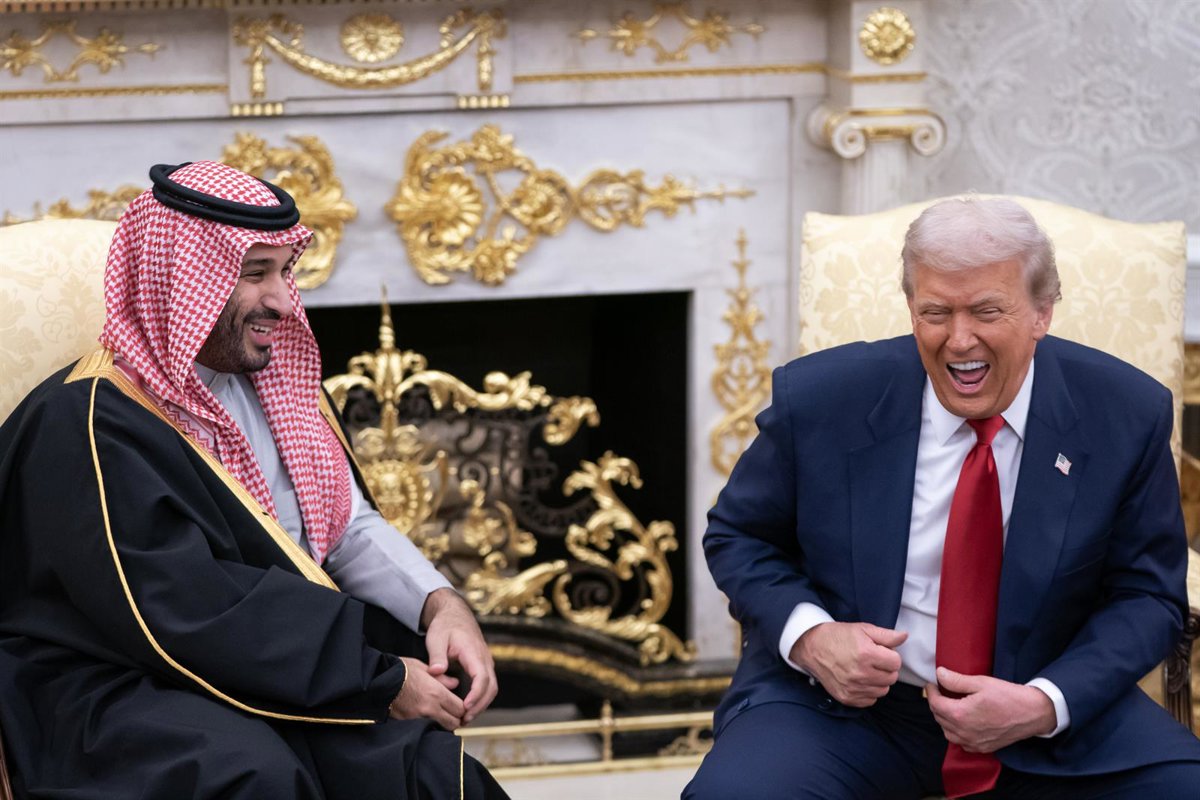
The president of the United States, Donald Trump, and the crown prince of Saudi Arabia, Mohamed bin Salmán, held a telephone conversation this Saturday in which they discussed, among other aspects, the delicate current situation of the war in Iran, after a week of bombing exchanges and new North American ultimatums regarding the reopening of the Strait of Hormuz.
The Saudi Foreign Ministry explained in a statement that both leaders have analyzed “the current situation in the region, including talks between the United States of America and the Islamic Republic of Iran”, with particular emphasis “on the importance of ensuring the safety of maritime navigation, protecting sea routes and supporting efforts that contribute to regional security and stability.”
In parallel, there has also been an additional conversation between the two diplomatic heads of both countries, the Saudi Foreign Minister, Faisal bin Farhan, and the North American Secretary of State, Marco Rubio.
In a brief statement, the Saudi Foreign Ministry indicates that both have discussed “the current situation, as well as the importance of continuing close coordination and consultation to promote security and stability in the region.”
The calls have occurred in the midst of the latest North American threat: official US sources have confirmed that the United States has given Iran until this Saturday to publicly announce that it will allow free, safe and unrestricted navigation through the Strait of Hormuz.
“The Trump administration demands that Iran issue a public statement on Saturday recognizing the opening of the Strait of Hormuz and committing to cease attacks on merchant ships,” US officials told reporters at a press conference on Friday, as reported by Axios and the Wall Street Journal.
Meanwhile, the Iranian Foreign Minister, Abbas Araqchi, arrived this Saturday in the capital of Oman, Muscat, to discuss the extremely delicate moment that the negotiations are going through.
Araqchi has been received by his Omani counterpart, Badr al Busaidi, who until the outbreak of war on February 28 was in charge of putting both countries in contact during a series of negotiations on the status of the Iranian nuclear program, interrupted by the wave of joint attacks launched that day by the United States and Israel against the capital of Iran and other strategic points.
8540594 Shorelines Casino Shorelines Casino
Bahamas Local : Profile : shorelines-casino
shorelines-casino
shorelinescasino
shorelinescasino's Blog – Community – The Sims 3
casino-club-regent – View Classified – The 016 – Worcester, Mass.
casino-club-regent casino-club-regent
Casinoclubregent
Casinoclubregent
Casinoclubregent
casino-mcphillips-station – Scholistico
CasinoMcphillipsStation (@casino4575799) | Investagrams
24liveblog – Live Blogging Platform, Live Blog Tool, Liveblog Plugin for WordPress
casino-mcphillips-station (casinomcphillipsstation) – Profile | Pinterest
Itaku — Online Art Community
luc-ky8's profile / DeSmuME forums
Member Profile: magic-palace-online magic-palace-online | Livres Blurb France
magic-palace-online's Profile – Bestialzoo Net – Zoo videos
magic-palace-online
magic-palace-online
newbrunswickcasino – KingMods
new-brunswick-casino-online – Le Salon Beige
newbrunswickcasinoonl#143704 user profile
Memberlist.Php
new-brunswick-casino-online – Prosebox