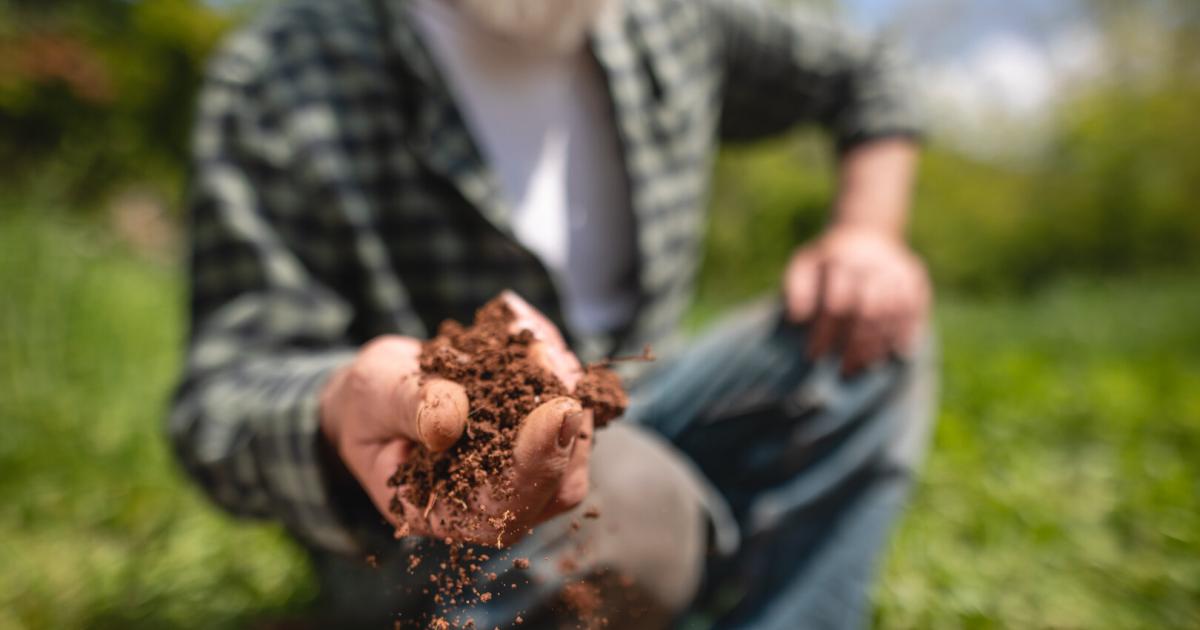
Farmer Hans Gnauer does a few things differently on his field than many of his colleagues. Always in focus: healthy soil. When he sows his wheat, he places the seed through a small slit in the surface.
Otherwise the farmer foregoes Grumble (Lower Austria) in the district Hollabrunn on soil cultivation. He pays attention Species richness and holds a specific one Crop rotation a. Even soil is hardly visible in his fields because the surface is permanently covered with plants or crop residues to protect the soil.
Gnauer is an advocate of the regenerative agriculture. This combines elements from conventional and organic agriculture. “The best of both worlds,” Gnauer tells the KURIER. The goal is to imitate natural processes and give nature “the strength to defend itself,” says Gnauer.
Austrian wheat is currently in emergency maturity
This is mainly because of the consequences climate change increasingly important. This spring wasn’t the first time that heat waves and drought threatened farmers’ harvests. Currently it is located Wheat In many places it is in so-called emergency maturity, where it has to be harvested prematurely – usually with lower yields.
Prepare more precisely drought and Heavy rain less worried than other farmers. Its soil absorbs water quickly and stores it “like a sponge”. Water also flows quickly through the natural canal system – for example through dead plant roots or the burrows of earthworms – instead of washing away the surface.
Studies show that regeneratively cultivated areas can store up to 30 percent more water than conventional fields. And thanks to the protective layer of plants and mulch on the field, the water evaporates more slowly, even in high heat.
Regenerative agriculture is still in its infancy in Austria
Despite the advantages, regenerative agriculture is still in its infancy in this country. Most people fail Financial. “You have to invest in this system,” explains Gnauer, “but unfortunately money is very tight in agriculture.” He himself started working his fields according to regenerative standards seven years ago. The initial period is expensive: “You have to expect 20 to 30 percent higher costs per year – and that for a period of five to ten years.”
Local farmers receive financial support from individuals environmental programsfor example for the use of catch crops. Gnauer speaks of 100 to 200 euros per hectare. In retail, farmers cannot charge higher prices than for conventional products because regenerative farming is different Bio is not controlled and certified. That’s why only a few hundred farmers in Austria rely on the alternative methods.
In South America, gentle farming is more widespread
Their role models are companies in southern countries. “The colleagues there have been having problems for a long time,” says Gnauer. In many South American In countries, more than 35 percent of fields are already farmed regeneratively. Many agricultural crops there are coming under increasing pressure due to climate change – for example Coffee: Especially those Arabica-Varieties that are most commonly grown worldwide are sensitive to temperature fluctuations.
“Climate change could mean that 50 percent of the current Arabica areas will be lost in the future. This will have an impact on the quantity and therefore on the price,” explains Marianne Neumüller-Klapperauthorized representative and head of sustainability Nespressothe COURIER.
Nespresso is trying to support its coffee farmers in countries like Colombia in switching to regenerative agriculture through collaborations and advice. As she says, there will be no alternative to this gentle form of farming in the future for Neumüller-Klapper. “It’s not just about sustainability; Resilience theme.“
Member.Php
Fsy3Eu
Members – Cinema Treasures
Profile
reatblucasinoonline
Форумы GIS-Lab.info – Профиль пользователя reatbluehasinoonline
224691
mcphillipscasinoonlin on Zortrax Library – Profile
mcphillipscasinoonlin | Profile
Check out @mcphillipscasinoonlin on OnlyLinks
Mcphillipscasinoonlin Mcphillipscasinoonlin – B?char | Universalhunt.com
novascotiacasino
Members Profile: novascotiacasino | user 1159479
Novascotiacasino Novascotiacasino
Profile
Novascotiacasino
pickeringcasinoonline
pickeringcasinoo
Muvizu | pickeringcasinoonlin's profile | Latest
Pickeringcasinoonline
Roton Products, Inc.
World Aquaculture Society. Profile
Default.Aspx
Home – villentocasinoonline – The Stamp Stampede
Personal Transformation Institute