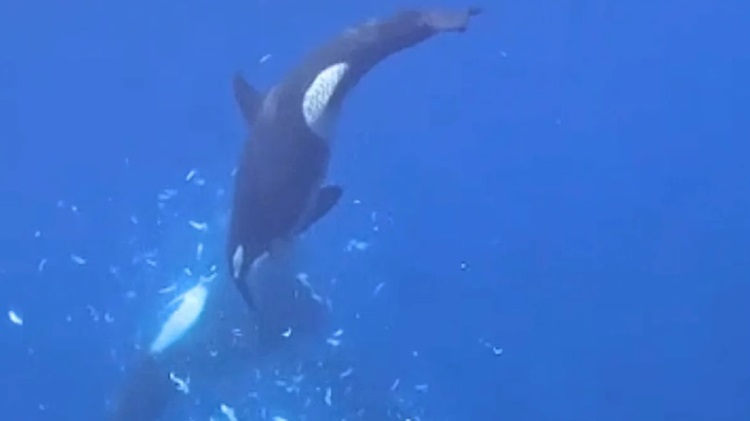
The carcass of a giant sunfish exploded after a powerful high-speed collision with a killer whale, right before the eyes of researchers.
Theo Live Scienceresearchers witnessed killer whales collaborating to smash sunfish carcasses into pieces and speculated that this was a food processing technique to make it easier for their young to eat this giant bony fish. In two separate encounters, a killer whale held onto a sharp-tailed moonfish (Masturus lanceolatus) while its companion rushed forward. It dropped the sunfish’s carcass right before the impact so that its companion could ram it head-on at high speed, causing the carcass to break into many pieces in the water.
Kathryn Ayres, a scientist at the conservation organization Beneath the Waves, and her colleagues called the behavior “bursting” and detailed the observation on July 23 in the journal Frontiers in Ethology. According to research results, killer whales do not try to kill the sunfish because it has already died. Instead, they may be breaking up the massive fish carcass to make it easier for members of the school, especially juveniles, to eat.
The first encounter that Ayres observed took place in July 2024 near a seamount off the coast of Baja California Sur, Mexico. An adult female killer whale holds the rudder-like tail of a sunfish while a male of the same group rushes forward in a belly-up position. It drops its prey’s carcass just before impact. The powerful impact created a loud noise and caused the sunfish’s flesh to crumble. A young killer whale then swims into the debris suspended in the water and eats small pieces, the adults eat the rest.
The second encounter recorded by diver Héctor Franz in September 2025 also happened similarly. According to CNNsunfish (Mola Mola) is among the heaviest fish in the world with a weight of more than 1,800 kg and a length of up to 3 meters. Killer whales often coordinate attacks in pairs or groups when targeting large prey. However, before, researchers have never observed them performing a torpedo-style stab that causes their prey to explode like that. The diet of killer whales is very diverse depending on where they live, including seals, beluga whales, narwhals, humpback whales, and blue whales, requiring unique feeding methods such as tearing into pieces with strong impact.
This behavior of killer whales is very similar to coordinated attacks that Ayres and his colleagues have encountered, in which killer whales confront whale sharks (Rhincodon typus) also in the Gulf of California. During those hunts, killer whales take turns ramming their prey. Although the headbutting action is quite familiar, the sequence of holding, releasing and dismembering the carcass may be a new hunting technique for killer whales.
The killer whale rammed the carcass of the sunfish and broke it into many pieces. Video: Kathryn Ayres
The research team hypothesized that the adult killer whale was processing food for the calf because both encounters involved a smaller member. But the above two observations are not enough to prove that they intentionally feed or educate their young. Sharing food can also strengthen bonds within the herd.
Researchers also do not rule out the possibility that it was playful behavior for entertainment. Killer whales are intelligent and highly social animals, and they sometimes play, toss, or crash into their prey without eating it immediately. Ayres noticed the large wound on the sunfish’s body before the collision, revealing that the killer whale may have eaten the most nutritious internal organs of its prey.
The study’s authors speculate that dispersing the moonfish’s bacteria-rich skin and cartilage tissue could affect the surrounding water or expose the killer whale to beneficial bacteria. The flat body structure of sunfish is unusual, possibly making it more susceptible to breaking into pieces under the high-speed impact of a killer whale than other fish.
Member Profile: handwire53 | Blurb Books
colddonald22 » Аренда спорткаров BMW i8, AMG GT S
waxpump80 » VLauncher
HedgeDoc – Collaborative markdown notes
HedgeDoc – Collaborative markdown notes
advertising [licensed for non-commercial use only] / 강남쩜오의 특징과 이용 문화 살펴보기
5 Steps To Secure A Shade Sail Attached To Roof Safely
Halbheer, Doran, Andersen, por Sergio Cabanillas – Tomajazz
CodiMD – Collaborative markdown notes
Los 10 mejores arquitectos en Torrevieja – World of Holistic Architecture
Experience Unmatched Luxury: A Guide to Gangnam’s Premier Entertainment – DESTINEHERALD
CodiMD – Collaborative markdown notes
Tudo o que precisas saber antes de escolher o teu vape em Coimbra – HedgeDoc
Bogui jazz
Gerden Center
HedgeDoc – Collaborative markdown notes
HedgeDoc – Collaborative markdown notes
Estrategias efectivas para ganar en juegos de azar paso a paso
HedgeDoc – Collaborative markdown notes
NLW // Téma megtekintése – GG88 – The Respected Betting Software of 2025
Tips for Getting New Clients As a Realtor | Top To High
No deposit betting bonus
Fastbase Investor Relations – Opportunity
Jazz Con Sabor Cubano En Madrid 279328
Elevating Your Evening: The Ultimate Guide to Gangnam’s Premier Nightlife