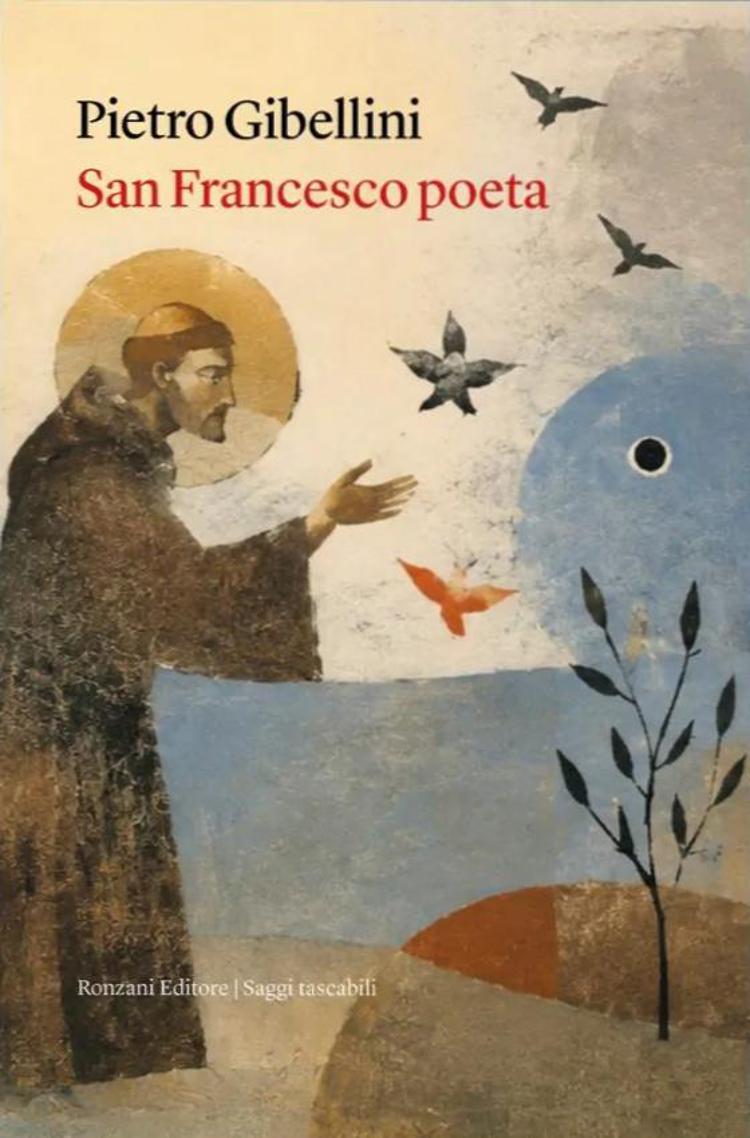
Saint Francis of Assisi enters the Divine Comedy even before being celebrated in Paradise, but his face changes along with the poem. In Hell he is the saint who tries to save Guido from Montefeltro and however finds himself without arguments before the devil; in Purgatory his presence remains implicit; in Paradise he becomes the protagonist of one of the most famous eulogies of Italian poetry. It is precisely this transformation that is reread by the philologist and literary critic Pietro Gibellini in the book “San Francesco poet” (Ronzani Editore), where the scholar identifies new sources and proposes new keys to understanding the relationship between the Assisiate, Dante and his Canticle.
The main novelty of the study concerns some medieval sources hitherto neglected by Dante scholars. Starting from Hell, Gibellini recalls the bull Mira circa nos, with which Gregory IX canonized Francis in 1228, just two years after his death. The pontiff presented the saint as a new Samson, capable of fighting the enemies of the faith with a “donkey’s jaw”, and attributed to him a “wise ignorance”. It is possible, according to Gibellini, that this very image contributed to Dante’s representation of the saint in canto XXVII of the Inferno. Francis, called to lead Guido da Montefeltro to Heaven, is unable to respond to the logic of the devil, who claims the friar’s soul for himself. The punchline – “you didn’t think I was löic!” – thus becomes, in the scholar’s reading, the sign of a phase in which Dante could consider Francis more holy than wise.
The perspective changes progressively. In Canto A reminiscence already reported by Hermann Gmelin in 1947 and, according to the scholar, remained essentially without further discussion in the main comments.
However, it is in Paradise that the search for new sources becomes more incisive. For cantos It is the same concept that Dante formulates through Thomas: “Provence, which governs the world (…) ordered two principles”. This isn’t just a thematic similarity. Even the images used by the pontiff – the battle between the forces of good and evil and the Church as a vineyard invaded by brambles – reappear in Dante’s text. For Gibellini the coincidences are such as to hypothesize a true intertextual relationship.
But the new reading also concerns the portrait of Francis. Dante, the scholar observes, puts poverty at the centre, as opposed to the wealth of the nascent mercantile society represented by the saint’s father. Humility, on the other hand, is almost removed. Above all, Francis appears proud before the Pope and courageous in his mission to the East. It is an image far from that of the humble and meek saint delivered by subsequent tradition.
Another element that has so far been little considered concerns the stigmata. Dante defines them as the “third seal” granted by God to the Franciscan order, after the oral approval of Innocent III and the official approval of Honorius III. Gibellini finds a possible explanation in a Parisian sermon by Thomas Aquinas, dating back to the 1270s, in which the Dominican quotes Francis and recognizes a divine seal in his stigmata. The discovery takes on particular importance because the stigmata, made known after the death of Francis, were questioned or denied even in Dominican circles. And Thomas, in another text, associates Francesco and Domenico as instruments of Providence: another possible piece of the mosaic that leads from history to Dante’s poetic construction.
Gibellini thus also reads the different voices of the two protagonists of the diptych. Thomas, a rationalist, constructs a controlled eulogy, in which the miracles take a back seat, with the exception of the stigmata. Bonaventure, on the contrary, insists on the prodigious and prophetic dimension of Dominic’s life. Dante, according to the scholar, therefore adapts the style of the story to the personality of the two theologians who pronounce it. Furthermore, in Thomas’ speech, the long metaphor of the sun seems to recall the Franciscan Canticle and leads to the famous “do not say Ascesis (…) but Orïente”. The relationship between Francesco the poet and Dante thus also becomes a relationship between two forms of religious poetry.
From this reading comes another hypothesis destined to reopen an ancient question: who is “he / who made the great refusal out of cowardice”? Gibellini relaunches the thesis formulated in 1896 by Giuseppe Roselli: not Celestine V, nor Esau, nor Pilate, but the rich young man of the Gospel, the one who refused Christ’s invitation to sell his possessions, give them to the poor and follow him. It is a hypothesis that the scholar directly connects to the evangelical passage commented by Thomas in the text in which Francis and Dominic are presented as instruments of Providence. The journey ends with Madonna Povertà, the allegorical figure through which Dante represents Francis’ radical choice. Here too Gibellini proposes a possible source in courtly literature: the woman despised by everyone because she is apparently ugly and decrepit, but seen as beautiful by her lover. A motif from French literature that would arrive in the Mare amoroso, a repertoire of amorous topoi linked today by critics also to the name of Brunetto Latini, Dante’s teacher.
The overall thesis is therefore that of a slow Dante-like discovery by Francesco. Mortified in Hell, almost invisible in Purgatory and celebrated in Paradise above all for his poverty, the saint reaches a fully central position only later, in canto XXXI of Paradise, where he appears at the top of the white rose, between John the Baptist and Augustine. It is in this long evolution that Gibellini places the “long wave” of the Canticle: not only a religious text intended for devotion, but a poem capable of leaving traces in the Comedy and, later, in the verses of Gabriele d’Annunzio. A legacy that the essay reconstructs through texts, sources and consonances, without transforming every similarity into a certainty: precisely the boundary between direct influence and common heritage of religious poetry remains, in the last part of the study, an open question. (by Paolo Martini)