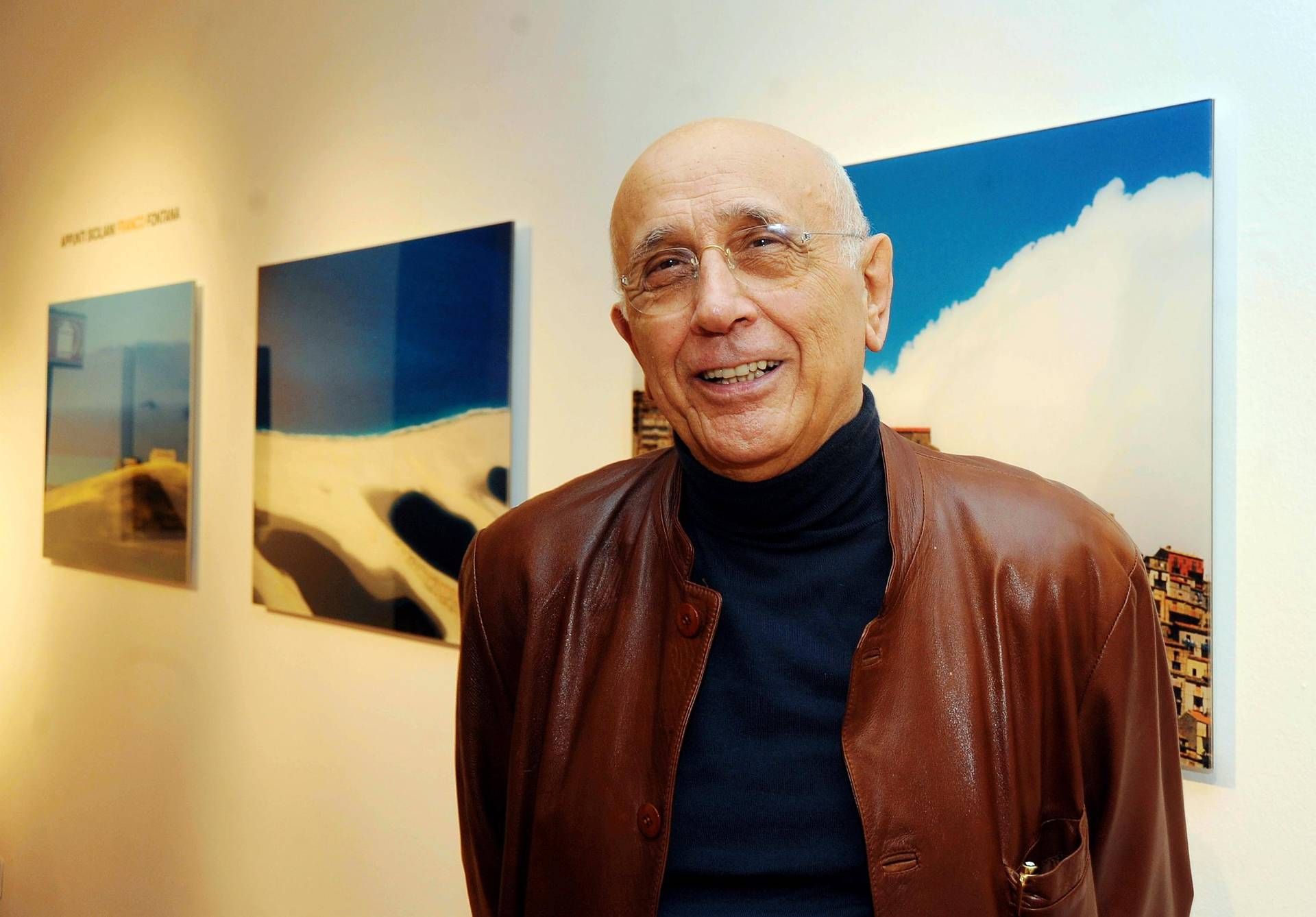
Franco Fontana, one of the great masters of twentieth-century photography and a visionary innovator of color photography, has died at the age of 92 in Modenawhere he was born on 9 December 1933. His death marks the end of an era, leaving an immense legacy made up of unmistakable images, refined style and artistic coherence that has spanned over sixty years of history. Fontana revolutionized the way of conceiving photography, elevating color to a narrative and poetic tool; he broke the academic canons, establishing himself as one of the fathers of contemporary photography. His works are preserved in over 50 museums around the world.
Over 70 books have been dedicated to him, published by Italian, French, German, Swiss, Spanish, American and Japanese publishers. Over 400 personal and collective exhibitions he has held on four continents.
Career
Fontana’s career began relatively late: only in 1961, already an adult, did he approach photography as a self-taught person, frequenting photo clubs and experimenting with passion, but as an amateur. However, behind that amateur approach there was already a profound sense of composition and an unusual aesthetic sensitivity. Already in his first works we can perceive the interest in photography that was not a simple reproduction of reality, but the expression of an idea, of an interior perception. His vision was decisively influenced by the great masters of Abstract Expressionism and Minimalism such as Mark Rothko, Barnett Newman and Ed Reinhardt, painters who had made color a form of spirituality and silent visual depth. From these suggestions Fontana developed a unique photographic style, based on abstraction, sharp lines and intense color contrasts. In a historical moment in which art photography was dominated by black and white, and color photography was often relegated to a commercial or amateur role, Fontana had the audacity to subvert the rules, proposing a radically new visual language, made up of color fields and essential geometries.
The first personal exhibitions arrived in the mid-sixties, first in Turin in 1965 and then in his native Modena, in 1968, at the Galleria della Sala di Cultura. It was precisely the latter that marked the definitive turning point in his career, attracting the attention of critics and enthusiasts. In 1963 he had already participated in the Third International Biennial of Color in Vienna, and the following year the magazine Popular Photography dedicated a portfolio to him with text by Piero Racanicchi, opening the doors of the international panorama for him. The consecration came in 1974 at Photokina in Cologne, one of the most important photography fairs in the world, where his color images were welcomed with enthusiasm, marking a turning point not only for his career, but for photography itself. Fontana demonstrated that color could be an artistic language, not just decoration.
In the following years his works were exhibited in the most prestigious museums in the world: from the Museum of Modern Art in New York to the Musée d’Art Moderne de la Ville de Paris, from the Museum Ludwig in Cologne to the Tokyo Metropolitan Museum, from the National Gallery in Beijing to the Australian National Gallery in Melbourne, up to the Stedelijk Museum in Amsterdam and the Victoria and Albert Museum in London. He participated in personal and collective exhibitions in Paris, Berlin, Athens, Amsterdam, Tokyo, Moscow, Buenos Aires, Sydney, but also in Italy, in venues of excellence such as the Palazzo Reale in Milan, the Galleria Civica in Modena, the Gam in Turin and the Magazzini del Sale in Venice. His work was the subject of a large retrospective monograph in 2003 with an introduction by AD Coleman, while in 2024 an important anthological exhibition was dedicated to him at the Ara Pacis Museum in Rome.
In addition to landscape, a subject with which he is universally identified, Fontana sensitively explored other genres, from the nude to architecture, from urban space to shadow as a conceptual theme. In “Presenzassenza” from 1982, for example, he conducted a visual reflection on the concept of presence and absence through shadows; while in 2000, with “Surprised in the American light”, he focused on the human figure and its relationship with the urban environment. In recent years he also dedicated himself to digital processing, without ever losing stylistic coherence: even in manipulation, color always remained the absolute protagonist, together with geometry, understood not as technical rigor but as poetic form.
His editorial production was vast: over seventy volumes published in Italy, France, the United States, Japan, Spain and Germany. Among the best known are “Skyline” (1978), “Kaleidoscope” (1990), “Polaroids” (1997), “Route 66” (2002), “Franco Fontana – Retrospettiva” (2005). Parallel to his artistic career, Fontana was also very active as a commercial photographer. He collaborated with international companies such as Fiat, Volkswagen, Sony, Volvo, Canon, Kodak, Versace, Ferrovie dello Stato and Snam, and with numerous magazines, including Time, Life, Vogue USA, Vogue France, Panorama, Il Friday di Repubblica, Sette, Epoca, Frankfurter Allgemeine and New York Times.
No less important was his commitment as a popularizer and trainer: he held workshops, seminars and conferences all over the world, from the Guggenheim Museum in New York to the Tokyo Institute of Technology, from the universities of Toronto, Barcelona, Taipei and Paris to the Pompidou Center and the major Italian universities. He was artistic director of events such as the International Photomeeting in San Marino, the Toscana FotoFestival and the Interfoto Festival in Calabria.
During his career he has received numerous awards and recognitions. Among the most important, the Culture Award of the Presidency of the Council of Ministers in 1989, the Photographic Society of Japan Award in 1990, the Friuli Venezia Giulia Award, the City of Venice Award, the Guitarra Award of Cordoba and the Pisa Award for Photography on the occasion of the 650th anniversary of the University of Pisa. In 2006 he received an Honorary Master’s Degree in eco-compatible design from the Polytechnic of Turin. In 2012 he was awarded the Lifetime Achievement Award by the Nettuno Photofestival, and in 2013 he participated in the It@rt project with a series of limited edition artistic t-shirts. (by Paolo Martini)
Press Release: New Art Print Pure Silk Pillowcase Launches for Winter
Mulberry Silk Bedding, Pillowcases, Eye Masks & More
Hypoallergenic Pure Silk Bed Sheets & Duvet Covers: Extended Product Line
Where can I buy an unbleached silk pillowcase
Introducing the UK's Largest Range of Silk Bed Sheets for Emperor Beds
Mayfairsilk Unveils Exquisite Summer 2023 Collection, Celebrating the Effervescent Hue of 'Champagne'
Pop-up store in Chelsea
Mayfairsilk Unveils New Summer Print The Palms
Champagne Silk Pillowcase
Best Silk Pillowcase For Red Hair
Elegance Pure Mulberry Silk Cushion Covers
Mayfairsilk Unveils Luxurious Autumn 2023 Collection Elevating Silk Bedding To New Heights
Fridja Steamer The Best Hand Held Steamer For Bedding And Beyond
Silk Eye Mask Your Key To A Blissful And Restful Night S Sleep
Botanical Bliss Butterflies And Blooms Silk Pillowcase
5 Reasons Why Silk Pillowcases Make The Best Christmas Presents
Mayfairsilk Luxury Bedding Featured In The Interior Design Yearbook 2024
Pillow Talk Claudia Fallah
Isolation Fashion Mayfairsilk Pillow Challenge
Embracing The Barbiecore Aesthetic With Mayfairsilk S Pink Pillowcases And Silk Sheets
Marilyn Monroe Silk Pillowcases Types Prices
Mayfairsilk Launches Limited Edition Printed Pillowcases For Autumn 2025
Top 5 Unusual 35Th Wedding Anniversary Gifts For Your Wife 2025 2026 Ideas
Top 5 Unusual 35Th Wedding Anniversary Gifts For Your Husband 2025 2026 Ideas
Art Imitates Nature A Floral Renaissance At Saatchi And In Silk 5
Pure Gold And Silver Silk Pillowcases
6 Best 11 Year Wedding Anniversary Gifts For Husband Traditional Modern Ideas
Can X Ray Techs Give Injections Scope Of Practice Explained
Rental Kharma > Improve Your Credit Fast With Rent & Utilities
The Leapfrog Effect & Credit why the Middle Score