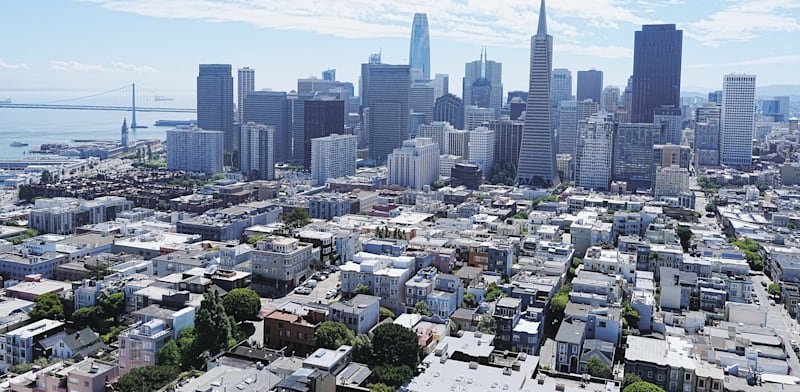
San Francisco. Flowers and wine for realtors showing apartments at open houses. Rent for a year in advance. $2,250 for a room without a closet.
The city’s housing market was already a battleground for renters, and the boom in artificial intelligence has further accelerated the tough race to find an apartment, as tight supply clashes with high salaries in the industry. In less than two years, the average asking rent in metropolitan San Francisco rose by 18% and reached $3,728 per month, according to the real estate data company Costar. This year, San Francisco overtook metropolitan New York for the first time since 2019, regaining the title of the highest average rent in the US.
In the most sought-after neighborhoods, the rent can reach twice the average. Bidding wars push the prices of some apartments to five-figure sums.
● The real estate agent who reveals: the reason I don’t buy my daughter an apartment in Israel
● About 70% of the apartment buyers who canceled a deal in Tel Aviv did not purchase another apartment
Ten stood in line to talk to the landlord
Darren Malott, 23, moved to San Francisco for a job in finance after graduating from UCLA in June. After weeks of going through ads looking for an apartment for himself and three roommates, he finally found a four-bedroom apartment in the historic and affluent Nob Hill neighborhood.
When he arrived at the open house, there were about two dozen people there, and ten of them were waiting in line to talk to the landlord about the apartment, the rent for which was $7,800 a month. Malot gave him a letter with personal details on all four partners, including their credit ratings.
Bidding started at $8,000, jumped past $8,500 and reached $9,800. Malot bid $10,000 and won the apartment. The renovation and view are impressive, but one of the partners is paying $2,250 for a smaller room that doesn’t even have a closet.
“I was already ready for me to say, ‘Okay, we’ll pay $10,000,’ and she’ll come back to me and say, ‘Will you agree to 10,200?'” he said.
decreased during the plague, and rises again
Rents in San Francisco fell during the pandemic, as people left the cities in search of more space and moved to work remotely. Remote workers slowly returned to the city, and some large companies left it permanently. According to Costar data, asking rent across the metropolis fell by more than 7% during 2020, then remained largely at or below pre-pandemic levels until last year. The trend changed with the decline of the epidemic, the decrease in the scope of remote work and the transition of the artificial intelligence companies based in the city to extensive hiring.
Today, affluent workers in the AI industry are driving much of the recovery. Capital raising by venture capital funds in the San Francisco Bay Area is on the rise, and this year San Francisco recorded the highest increase in the number of advertised vacancies among the major US rental markets, according to real estate research firm Green Street.
And there is no sign of a slowdown on the horizon: artificial intelligence companies continue to rent additional office space and attract new workers to the city through high salaries, and these need a place to live. One startup even offers employees assistance with paying rent if they choose to live near the office.
Want to live near OpenAI and Anthropic
The increase in demand for apartments occurs at the same time as the decrease in the number of apartments available for rent. The rate of vacant apartments in metropolitan San Francisco fell in the second quarter to 3.7%, compared to 4.9% in the corresponding quarter last year. This is the lowest vacancy rate among US metropolitan areas, with the exception of New York and San Jose in California.
The result is a frenetic market, where ads for renting apartments in the city may disappear within hours of their publication. In the most sought-after apartments, rents can jump hundreds of dollars within a day or two as landlords try to capitalize on demand.
Rents are rising the fastest in neighborhoods like Mission Bay, a relatively new area on the waterfront where OpenAI’s offices are located, and SoMa, a former industrial area where Anthropic’s offices are located.
Some residents paid $1,500 above the asking price to win an apartment. Landlords began to offer more frequent payments to tenants living in rent-controlled apartments in exchange for vacating, and rent increases are spreading…
Jaya Gupta, a 28-year-old partner at a venture capital fund, saw a two-bedroom apartment on a high floor in a luxury building in May that was being offered for rent for $10,000 a month. Hoping to improve her chances, she offered to pay rent in advance and in cash for three months. In the end, she lost the apartment to an employee in one of the largest artificial intelligence laboratories. “Someone just paid for the whole year,” she said.
Renters don’t have many new apartment buildings to choose from, as the rate of new construction is lower than in other major coastal cities, such as Seattle and New York. Efforts to increase the scale of construction in California are slowly gaining momentum in San Francisco. In the Marina district, plans to build an 800-apartment tower have sparked controversy among many residents.
Lily Mastrangelo, 22, had recently graduated from the University of San Francisco and was hoping to find an apartment under a new lease that would take effect on August 1. At first she planned to live with a roommate. The two saw an outdated two-bedroom apartment offered for $4,800 a month. After that, the owner of the house sent a message to all interested parties and wrote that he had received an offer of $6,300.
“We both made good money, but not enough to spend more than $3,000 each on rent,” Mastrangelo said.
A broker recommended that they separate and each look for an apartment of their own. Later Mastrangelo visited a one-bedroom apartment offered for $2,800 a month. It had one window, and he was facing a large garbage can. “It was the ugliest place I’ve ever seen in my life,” she said.
In the end Mastrangelo found a sublet: she would pay $2,520 for a bedroom and private bathroom in a woman’s home in the upscale Rashan Hill neighborhood. Her new partner is 67 years old and has two cats. The two have not yet met, but spoke on the phone. The lease is up in November, and then Mastrangelo will try her luck again in the rental market.
The woman told her that some of her previous tenants had eventually decided to extend their stay. “It must be really nice to live with her,” she said. “Trust me, it’s a bargain.”
SMMFlare Expands Platform Infrastructure for Resellers and Digital Service Management | WVVA
SMMFlare Expands Platform Infrastructure for Resellers and Digital Service Management | WXOW
SMMFlare Expands Platform Infrastructure for Resellers and Digital Service Management | WYOW
Stocks.Php
Stocks.Php
Stocks.Php
Stocks.Php
Stocks.Php
Stocks.Php
Stocks.Php
Stocks.Php
Stocks.Php
Stocks.Php
Prairieland FS | Prairieland FS
Stocks.Php
Stocks.Php
News About PRO AG MARKETING
Stocks.Php
Stocks.Php
Stocks.Php
Stocks.Php
Stocks.Php
Stocks.Php
Stocks.Php
Stocks.Php
Stocks.Php
Stocks.Php
Stocks.Php
Stocks.Php
Stocks.Php