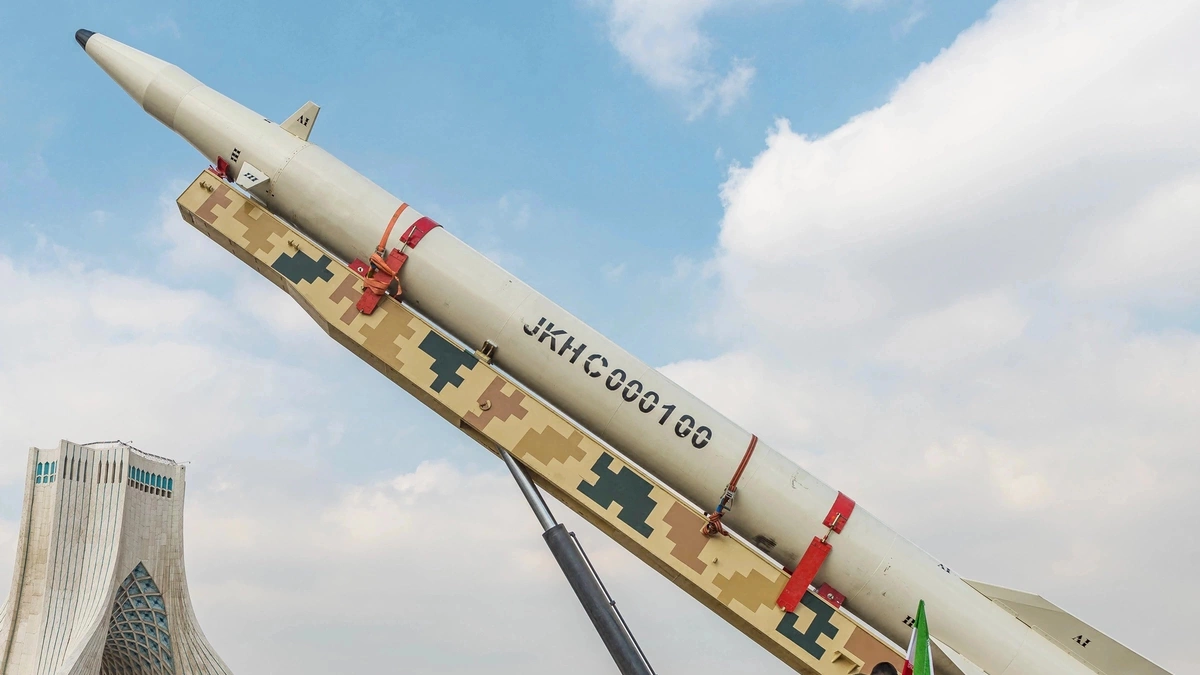
Iran lifted its self-imposed limit on missile range, seemingly to reach more targets and ensure launch pad safety.
Iran’s Islamic Revolutionary Guard Corps (IRGC) spokesman Hossein Mohebbi announced on November 7 that the country’s self-imposed limit on missile range “has been removed”, adding that Tehran will demonstrate that capability through actual combat operations instead of relying solely on empty words.
He affirmed that Iran is continuing to research to increase missile range and will have the necessary conditions in case the leadership decides to reconsider its nuclear doctrine. An IRGC spokesman stated that Irna has built a series of “missile cities” and underground production facilities, helping to maintain weapons manufacturing and development activities even during wartime.
Origin of missile range limits
General Mohammad Ali Jafari, then commander of the IRGC, revealed in 2017 that Supreme Leader Ali Khamenei stipulated that Iranian missiles were only allowed to reach a maximum range of 2,000 km. By 2021, Mr. Khamenei explained that there had been many complaints about the limit and there were calls to increase the range of Iranian missiles to 5,000 km, but he prevented and maintained the 2,000 km limit.
Iran’s underground “rocket city” in a video posted on October 31. Video: X/IranObserver0
The above statements show that technological limitations are not the cause of the 2,000 km limit, but a political decision from the top leadership.
Former IRGC commander Hossein Salami, who died in the June 2025 conflict with Israel, also reiterated this in a television interview. He emphasized that Iran did not face technical or technological barriers if it wanted to increase the range of its missiles, but at that time did not consider Europe a security threat, so it did not develop missiles capable of raiding deep into the continent.
According to the news agency Tabnakthe limit not only met an important part of Iran’s defense needs against regional threats, but was also a political and security guarantee for European countries at the time.
Iran has long been able to produce missiles with a range of over 2,000 km
Iranian military expert Mohammad Sadegh Alizadeh affirmed that the country has had the ability to create ballistic missiles with a range exceeding 2,000 km since the mid-2000s.
Hassan Tehrani Moghaddam, the father of Iran’s missile program, was at that time implementing a project to develop a ballistic missile using a solid fuel engine capable of reaching Israel and a satellite launch vehicle. Moghaddam in 2005 sent a letter to leader Khamenei to report that the project had entered the final stage.
“The Sejjil two-stage rocket is one of the by-products of the program,” said expert Alizadeh.
Late Iranian leader Ali Khamenei spoke in Tehran in January. Photo: AP
Technological advances achieved during the implementation of the project have helped Iran master the ability to create missiles with a range beyond Israeli territory. However, that capacity is under the direct supervision of Mr. Khamenei, the decision to deploy it or not still depends on Tehran’s strategic calculations.
Iran’s Supreme Leader did not allow the production of weapons with a range of more than 2,000 km, because the context at that time did not require Tehran to do this. “Iran assesses that the security threat to them is only within 2,000 km and Israel is the only party willing to risk launching an attack,” Alizadeh said.
Although it is forbidden to build weapons that fly farther than 2,000 km, Iran’s leader does not object to the development of rocket technology used to send satellites into space. Projects in this field continue to be carried out under the supervision of the IRGC and the Iranian Ministry of Defense.
Motivation to push Iran to remove ‘metal ring’
Expert Alizadeh believes that the situation has changed after the 12-day conflict in June 2025, as well as the war that broke out in the Middle East since the end of February.
While this conflict was going on, Iran realized that a number of logistics and infrastructure facilities outside the Middle East, especially in Europe and the southern Indian Ocean, were supporting the US campaign. The above developments have changed Tehran’s calculations, causing Supreme Leader Mojtaba Khamenei to remove the missile range limit.
Alizadeh noted that the threat to Iran has now gone beyond its previous geographical scope, forcing the country to adopt new measures.
Iran’s medium-range ballistic missile Kheibar Shekan at a rally in Tehran in 2025. Photo: AFP
Iranian military expert Mohammad Taher also said that the country needs to increase the range of missiles to attack Israel from battlefields located deeper to the east of the territory, that is, places as far away from the enemy as possible.
According to Taher, Iran previously concentrated a large number of missile launch sites in the west and central regions of the country, causing them to be constantly attacked by Israel. Therefore, removing the “metal ring” with missile range is an urgent strategic need so that Iran’s missile batteries can attack the enemy from a safer position.
Agreeing with Alizadeh, Taher also believes that the current conflict in the Middle East shows that many US military support facilities are located outside of West Asia, so Iran needs to increase the flight range of its missiles to be able to attack those targets if necessary.
Iran recently announced it would remove the missile range limit, but did not rule out the possibility of having secretly done so before.
The Iranian military in March launched two ballistic missiles against the US outpost Diego Garcia in the Indian Ocean. One missile was said to have encountered a problem mid-journey and fell into the sea, the other missile was intercepted by a US warship launching a missile.
It is worth noting that the Diego Garcia base is located nearly 4,000 km from Iranian territory, showing that the missiles Iran launched are capable of exceeding the 2,000 km limit. The international community’s popular opinion is that Tehran already possesses ballistic and cruise missiles with a range of around 3,000 km.
Crafting a Legacy_ The Impact of Seiko Mod Watches on Horology.pdf
How to Customize Your Seiko Mod Watch for Different Occasions
Casinoturneringer_ Alt Du Trenger å Vite.pdf – Shared with pCloud
Arten von Casinoboni und wie man sie optimal nutzt.pdf
Preview
A5Uzkehazttvtfgd
Dropbox
Wie man Spielgewohnheiten in Online-Casinos kontrolliert(2)
Gy64Vx6Ngg3A7A3D
Dropbox
Hvordan Unngå de Vanligste Feilene på Nettcasino
Industry-Specific Data Breaches: What 2026 Has Taught Us
The Most Common Sources of Data Leaks in 2026
Notes – Online Notes Service
Top Cyber Threats to Watch Out For in 2026
How to Rebuild Your Digital Security After a Data Breach
How Data Breaches Affect Your Credit Score
The Advantages of Proactive Data Monitoring and Alerts
The Impact of Data Breaches on Consumer Trust: A Study
Why Regular Data Leak Checks Are Essential for Everyone
How to Securely Manage Your Passwords Across Multiple Accounts
How to Protect Your Personal Information Online in 2026
Ultimate Guide Monitoring Your Personal Data Online
HedgeDoc – Ideas grow better together
HedgeDoc – Collaborative markdown notes
HedgeDoc – Collaborative markdown notes
HedgeDoc – Collaborative markdown notes
Nbqirvgqusjldj Fsyukw
HedgeDoc – Collaborative markdown notes
HedgeDoc – Collaborative markdown notes
Tx Yra1Gq1Obvgzhvahqaw
Making sure you're not a bot!
Password Management: How to Create Strong, Unbreakable Passwords
HedgeDoc – Collaborative markdown notes
8Tzd7Usvrvg6Amgmr9M3Ma
HedgeDoc – Collaborative markdown notes
HedgeDoc – Collaborative markdown notes
Top Cyber Threats to Watch Out For in 2026
The Advantages of Proactive Data Monitoring and Alerts
Notes – Online Notes Service
How to Keep Your Mobile Devices Secure from Data Leaks
Industry-Specific Data Breaches: What 2026 Has Taught Us
How to Educate Employees on Data Security
How LeakCheck Enhances Your Online Security Strategy
Personal vs. Corporate Data Breaches: What's the Difference?
The Future of Data Security: Trends and Predictions for 2026
Understanding the Impact of Data Breaches on Businesses
Password Management: How to Create Strong, Unbreakable Passwords
Understanding Data Leaks Comprehensive Guide
HedgeDoc – Ideas grow better together