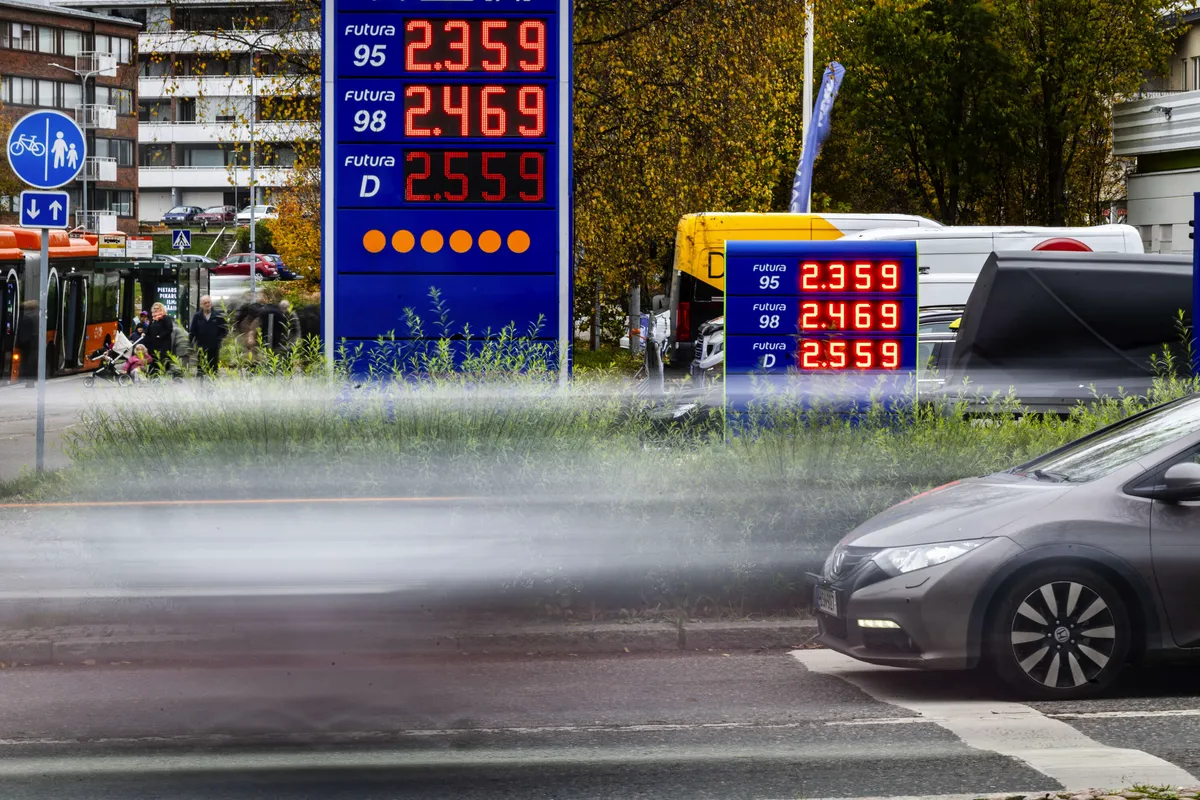
“You can’t see it on the meter,” is the lament on social media and coffee tables when the financial media reports on the price of crude oil.
Based on the statistical information collected by the editor, there is a grain of truth hidden in everyday experience: although the pump prices of fuels follow the price development of crude oil in particular, they sometimes react leisurely to falling prices.
The most recent example can be found from last summer.
From May 2026 to July, the average price of Brent crude oil fell from 92 euros to a generous 73 euros, or about 20 percent. Pump prices in Finland also fell, but significantly less. The price of diesel per liter fell from around 2.26 euros to 2.09 euros, or less than 8 percent. 95-octane gasoline became cheaper from around 2.09 euros to 2.05 euros, or only 2 percent.
The price dive was short-lived, and the price of oil rose sharply again in the fall. Diesel followed the rise, but gasoline became more expensive.
You can view the differences in more detail in the diagram below.
During 2025, the price of crude oil fell by 30 percent, to around 53 euros per barrel. Gasoline and diesel prices fell by only a few percent. Based on the graph, 2025 is indeed a long period when the price levels of crude oil and fuel liquids differed from each other.
In the background, there must be at least a strong concern about the geopolitical twists and turns shaking the oil market. There have been enough of them in recent years due to the various conflicts in Ukraine and Russia, as well as in the Middle East and the United States.
Also, for example, in 2022, when Russia started a war of aggression in Ukraine, the average price of a barrel of crude oil in June rose to almost 116 euros. At that time, gasoline cost EUR 2.57 and diesel EUR 2.44 per liter in Finland.
By December, the price of crude oil had fallen below 77 euros per barrel, or about 34 percent. In the same time, the price of a liter of gasoline fell to about 1.87 euros, or a good 27 percent, but the price of a liter of diesel remained at about 1.98 euros, or only about 19 percent.
The price of diesel is tight
Even now in November, oil prices have been falling, and gasoline has already dropped below two euros in some places. However, the price of diesel has remained higher.
According to traffic expert Hanna Kalenoja, gasoline has become cheaper in part because the demand for it is significantly lower in winter. The demand for diesel, on the other hand, still exceeds the supply, and the refining margins are high, which is also reflected in the distribution price. Kalenoja commented on the matter Ilta-Sanom.
Finnish consumers pay the highest prices for fuel in Europe. A large part of the price is taxes. About half of the price of gasoline and about 40 percent of diesel consists of taxes.
The value of crude oil on the world market is the most important, but not the only factor affecting the price of tax-free fuel. The price is also affected by at least processing, biocomponents, logistics, storage, distribution chain margins, exchange rates, local competition and futures prices, i.e. future prospects.
It is therefore natural that the pump price does not completely follow the oil price. And it’s not worth selling a batch of fuel that was previously bought at a higher price at a loss.
One of the reasons for the gently falling prices in Finland has also been given as a lack of competition. The competitive situation has weakened even more for the Russians I was boiling evaporated from the market.
“It is clear that if the competition decreases, then the pricing power will improve,” commented OP Pohjolan rescuer Lippo Suominen in July.
What: Crude oil grades
Brent: The world’s most important oil reference grade, the price of which a large part of the world’s crude oil is tied to. The oil comes from the North Sea oil fields.
WTI: North America’s main reference quality. Abbreviation for West Texas Intermediate.
Urals: Oil from Russia, heavier than Brent. Refining it requires more desulfurization capacity from the refinery, which is why it is traditionally cheaper than Brent on the market.
In Finland: The fuel sold to consumers is mainly refined at Neste’s Porvoo refinery and partly imported as finished products from the Nordic countries. Before 2022, Porvoo mainly refined Russian Urals oil.
The consumer prices presented in the story are Statistics Finland’s monthly average prices. The monthly average oil prices have been calculated from the Brent prices of the information service company Factset.