After a decade of perseverance with bananas, durians, pigs, and silk, Hoang Anh Gia Lai has overcome the liquidity crisis, erased accumulated losses of tens of trillions and is recovering strongly.
Ten years ago, Hoang Anh Gia Lai (HAGL) fell into a liquidity crisis when total debt exceeded VND 36,000 billion, causing the company to face mounting difficulties. Founder Doan Nguyen Duc (elected Duc) said there were times when the company had no money left to pay staff salaries, familiar partners in the past refused to meet, and all doors were almost closed. “That was the period when I felt the loneliest in my life,” Mr. Duc once exclaimed.
HAG’s long-term investments in rubber and hydropower did not generate cash flow, the company was almost on the brink of “bankruptcy” at that time, forcing the business to undergo comprehensive restructuring.
Rebuilding from collapse
When the company fell into a state of “hanging by a thread”, instead of withdrawing from the market, Mr. Duc chose the opposite: selling assets, cutting costs and restructuring from the ground up. He reached an agreement with THACO to transfer HAGL Agrico. This helps HAG clear trillions of dong in debt, creating a financial foundation for a new agricultural model. From chili and passion fruit to banana, durian, banana-eating pig or mulberry, every initiative revolves around one principle: creating real cash flow.
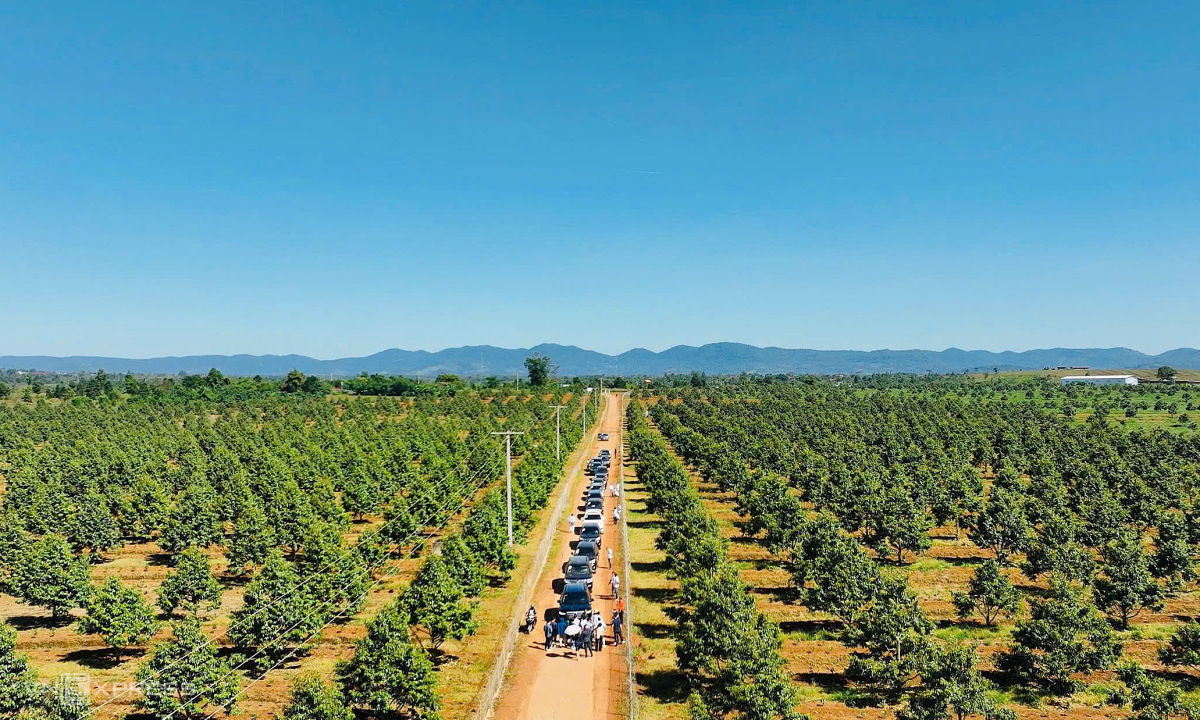
Currently, Duc gourd company applies the “four plants, two children” model. The four trees include: 7,030 hectares of bananas, 2,140 hectares of durian, 3,000 hectares of coffee, 1,000 hectares of mulberries. The two animals are pigs and silkworms. This company’s banana-eating pig system reached a scale of about 500,000 pigs in nine farm clusters, with 64,641 pigs sold after nine months, showing that the supply chain has operated stably.
Hoang Anh Gia Lai’s silk spinning factory in Ham Rong. Image: Thi Ha
Hoang Anh Gia Lai’s silk spinning factory in Ham Rong, 2.5 hectares wide. Bau Duc explained that HAGL not only grows crops but also wants to expand into deep processing. “Growing mulberries, raising silkworms, spinning silk” – three small links, but if implemented large enough, they will create sustainable value,” Mr. Duc shared during a recent field trip.
He calculated that the investment in one hectare of mulberries is about 500 million VND but the yield is outstanding. With 13-15 kg of leaves for 1 kg of cocoons, then 7 kg of cocoons for 1 kg of silk, each hectare produces 100 tons of leaves per year, equivalent to 0.95-1.1 tons of silk. With an international price of about 65 USD per kilogram, silkworm revenue is currently higher than banana cultivation. The first batch of silk was exported to India in July, while by-products such as pupae and waste silk are also fully utilized. The company plans to open an additional 3-hectare factory with a capacity of 1,000 tons of silk/year, to complete the value chain.
Many shareholders appreciate this direction. Investor Dao Phuc Tuong in Hanoi commented that the closed ecosystem helps HAGL control quality and increase product value.
However, mulberry is only part of the multi-layered picture that this business is building. Bananas and durians are still the mainstay of cash flow: in the first nine months of the year, bananas reached 365,670 tons, durians 3,284 tons, expected to be harvested in full from 2026. Coffee with 3,000 hectares is expected to contribute steady cash flow in the next three years. According to Mr. Duc, these pieces create a value cycle, reduce risks and retain profits in the system.
Speed up after restructuring
Changes in strategy and operations have been reflected in Hoang Anh Gia Lai’s business results. In the first nine months of the year, net revenue reached 5,600 billion VND, up 33% over the same period; Of which fruit contributed 4,408 billion VND, accounting for nearly 80% of total revenue. Profit after tax reached 1,312 billion VND, completing 87% of the year’s plan.
As of November, HAG’s profit is estimated at VND 1,800 billion. The management board forecasts that the fourth quarter will record additional extraordinary income, bringing the whole year’s profit to about 2,800 billion VND if there are no major fluctuations. This is the fifth consecutive year the business has maintained profits after the restructuring period.
This recovery marks a turning point compared to the period 2016-2021, when high debt and scattered assets caused HAGL’s accumulated loss of nearly 7,000 billion VND. By July this year, all accumulated losses were written off, and the company only recorded a debt of VND 7,000 billion.
This enterprise plans to bring Hung Thang Loi Gia Lai Joint Stock Company to the stock exchange in 2026 and Gia Su Lo Pang in 2027. The audited growing area is about 18,000 hectares, aiming for 30,000 hectares by 2030, including 10,000 hectares of Arabica coffee, 7,000 hectares of bananas, 3,000 hectares of durian, 2,000 hectares of mulberries. and other crops.
Many shareholders believe that HAGL has moved to a stable operating stage, with a chain of links from garden – barn – factory and a clearer financial and risk management strategy. Currently, the company’s “blood clot” of accumulated losses has been resolved, and debt has shrunk. Looking back on the past journey, Mr. Duc said: “In the past I was reckless, now I am sure.” According to him, abusing bank loans is an expensive lesson that businesses should never repeat.
Lessons on risk and management
A group of shareholders visits the durian garden in Laos of Hoang Anh Gia Lai. Image: Thi Ha
According to Bau Duc, the most difficult thing in agriculture lies not in technology but in the market and quality standards. Regarding the market, the company’s bananas and durians currently have stable output in China, Japan, and Korea; Even though the factory has only been operating for four months, it already has an export contract to India.
He further analyzed that HAGL’s biggest challenge is controlling pesticide residues. Silkworms are very sensitive and can only eat completely clean mulberry leaves, so the entire mulberry growing area of the enterprise does not use drugs and is managed separately to avoid risks from residential areas or neighboring growing areas.
General Secretary of the Vietnam Fruit and Vegetable Association Dang Phuc Nguyen said the world’s demand for silk is increasing rapidly in the high-end segment and technology applications. “This will be an opportunity for Vietnam when global demand for silk exceeds supply. As for bananas, Vietnam has disease-resistant varieties and growing areas near the consumer market, so it also has an advantage,” he said.
Mr. Nguyen assessed that the participation of large enterprises such as Hoang Anh Gia Lai creates a boost for both industries by expanding production, improving quality and meeting import standards. If there are a few more businesses with equivalent capacity, the competitiveness of Vietnamese agricultural products, from bananas to silk, will improve significantly.
HAG tests freezing Monthong fruit to perfect the process, aiming to export whole durians from 2026. Photo: Thi Ha
Regarding finance, HAGL prioritizes reinvestment instead of borrowing. After restructuring, the debt to charter capital ratio is 0.51 times; debt to equity 0.48 times; Debt to total assets 0.23 times – the foundation for the expansion phase.
This development was acknowledged by Mr. Nguyen Duc Nhan, Director of Mirae Asset Securities Company’s Business Center, as “a clear change after restructuring”. According to him, the initial mistakes cost Duc’s company but also helped accumulate experience. Through the survey, Mr. Nhan noted that the management and operations of this enterprise have improved.
According to him, agriculture still has potential risks from policies, weather and investment environments in Laos and Cambodia. However, HAGL is now in a better position than before, with room for expansion and strong growth in key industries.