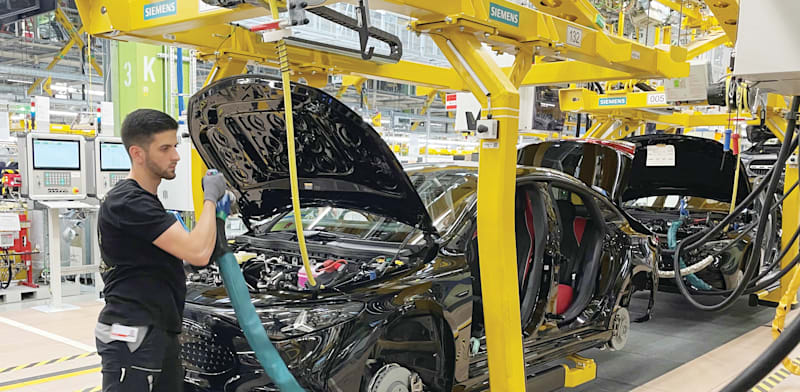
Giant German companies, which were at the center of the economic prosperity of Europe’s largest economy in the previous decade, have since the beginning of the year embarked on restructuring processes, which include the dismissal of tens of thousands of workers “at almost any cost”. Among the 40 largest companies in Germany, the financial reports indicate provisions of close to six billion euros only since the beginning of the year in favor of spending cuts, mainly in the field of personnel. The strict German labor laws oblige them in various cases to offer exorbitant terms in exchange for voluntary retirement.
The reasons for the layoffs are also those that have generally clouded the German economy since the war in Ukraine broke out: high energy prices and a forecast that the cheap Russian gas that was the basis of prosperity will not flow again; The wave of inflation will significantly increase wages in the economy and the price of labor; The new tariffs imposed by the American government on European exports to the USA as well as the decline of the Chinese car market, which was a major source of income for the German manufacturers.
Factories are cutting production, some companies have announced the transfer of their operations to the US or Asia, where there is cheap energy and no planned taxes on carbon dioxide emissions, and job retention programs that were implemented in the past are no longer considered realistic, because the crisis is long-term.
Early retirement and grants
The German economy is faltering and has even experienced periods of recession in the last two years, and it is also expected to end this year with zero growth. The conservative government that came to power this year promised to change the picture, subsidize energy for factories and revive German industry. But the signs so far are that the big corporations have decided to reduce activity, even if this involves huge costs for them. From the beginning of 2024, the “restructuring” costs, which are mainly dedicated to compensation, early retirement and retirement grants, amounted to 16 billion euros, for the 40 companies that make up the German DAX index, according to the calculations of the German newspaper “Handelsblatt”.
Friedrich Mertz, Chancellor of Germany / photo: ap, Ebrahim Noroozi
The terms of which winners who are laid off in many cases are exceptional, including continued salary payment for 52 months after retirement (five years), and also including six-figure grants. Since the beginning of the year, the companies that have invested the most in cuts are Mercedes (1.4 billion euros) and Volkswagen (900 million euros). Siemens spent about 500 million on personnel cuts and “Bayer” company about 400 million euros. The data is detailed in the financial statements of the companies and reviewed by “Handelsblatt” experts. The shares of the car companies, however, have risen by about 10% since the beginning of the year, against the background of their actions.
The German automobile industry, which is facing heavy competition from Asia, severe European regulation and now new tariffs on exports to the USA, is among the main victims of the economic crisis currently affecting Germany. Last year, according to a study by EY, the automobile companies alone directly laid off approximately 51,000 workers in Germany, close to 7% of the total workforce in the field. Because these companies have a central role in the German market, and are at the head of supply chains involving thousands of other small companies, the impact of their decline is expected to be severe.
The companies that set aside the most funds
in favor of spending cuts this year
Mercedes
1.4 billion euros
Volkswagen
900 million euros
Siemens
About 500 million euros
Bayer
About 400 million euros
Subsidizing huge companies
According to a survey by the economic institute IW, 38% of German companies intend to make layoffs in 2026. 32% of respondents (2,000 company managers in Germany) said that they intend to produce less next year. The industrial sector is expected to be hit the hardest, including the chemical, mechanical engineering and automobile industries. Although the German defense sector is booming, it is difficult to estimate how much it will compensate for the decline in recent areas. “The need for restructuring is particularly high in the automotive industry, the mechanical industry and the chemical industry in Germany,” an expert in the field of labor relations told Handelsblatt. According to the data of the German CBS, these fields shed about 120 thousand workers in the past year.
The German government has promised to renew growth by investing 500 billion euros in the German economy in the coming years, effectively removing the “debt brakes” that prevented it from running into a significant deficit. One of the measures proposed in next year’s budget is to subsidize energy for giant German companies to the level of 5 euro cents per kilowatt-hour. Before the war in Ukraine, the price was about three euro cents, after which it reached an average level of 15 euro cents. But political considerations may affect the subsidy, and it is limited to two years only. The move also depends on the approval of the European Commission, which must ensure fair competition in the bloc.
Among the recent additions to layoff notices are the truck company MAN, which will lay off about 1,200 workers, and the “Bosch” company, which will lay off about 13,000 workers in Germany, about 10% of its workforce in the country. Most of the layoffs concern the production of parts for vehicles and in several of the company’s plants there have already been protests against the move.
For your attention: The Globes system strives for a diverse, relevant and respectful discourse in accordance with the code of ethics that appears in the trust report according to which we operate. Expressions of violence, racism, incitement or any other inappropriate discourse are filtered out automatically and will not be published on the site.