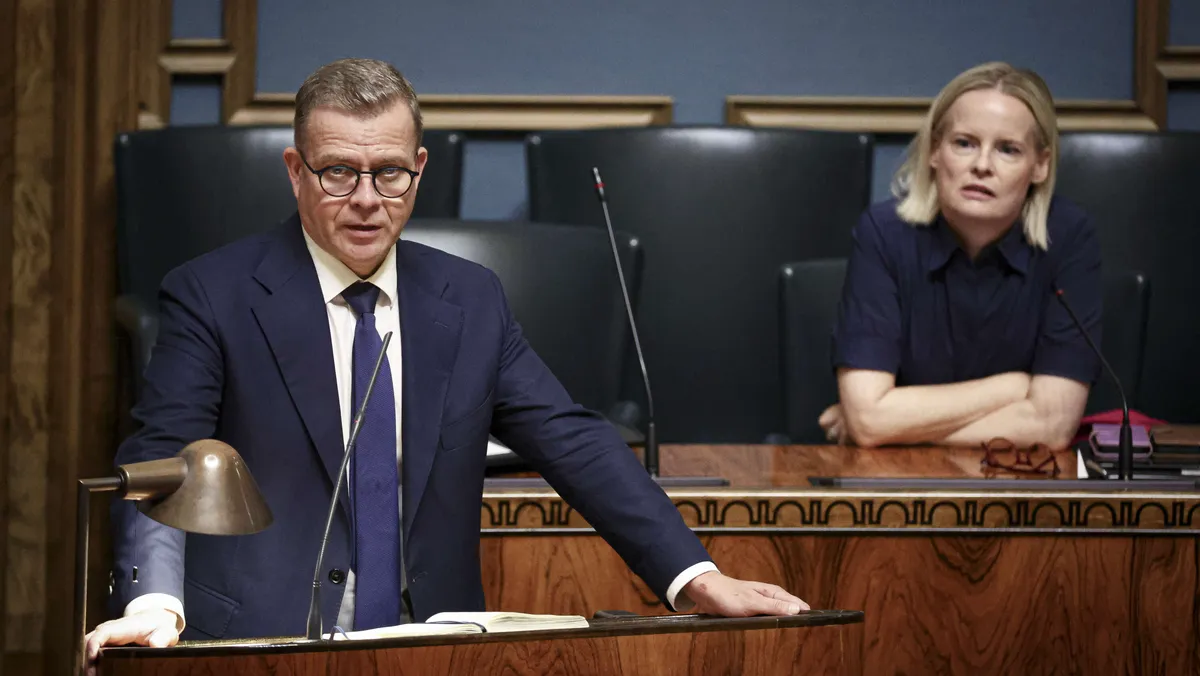
Finland ending up in the EU’s economic monitoring category should be a wake-up call at the latest that major, structural changes are needed in Finland to get the economy on the path to growth.
The EU Commission said on Tuesday that it is considering initiating an excessive deficit procedure for Finland. The deficit of the public finances is predicted to rise to 4.5 percent of GDP this year and remain around four percent in the following years. The commission also sees the debt ratio rising to more than 90 percent of GDP next year. The EU’s target figures are three and 60 percent.
In the summer, Finland avoided the observation category thanks to an exception granted due to the increase in defense spending, but even that was not enough anymore.
Being placed in the monitoring category is embarrassing for Finland, when EU tables have been demanding economic discipline from others for years. The observation category is especially associated with the problem countries of Southern Europe. Many of them have got their deficits under control, and currently there is a motley group of countries from different parts of Europe in the observation category.
The government has justified the billion adjustments for Finns by avoiding the monitoring class, and the opposition is now being criticized for the government’s excessive saving in a down economy. However, the problems have accumulated over the years.
Of course, the war of aggression started by Russia in Ukraine and the end of trade with the East have been an exceptional blow to the Finnish economy. In addition to Finland, the EU Commission also assesses the need for a monitoring class for Germany, whose industry is weighed down by the end of the flow of cheap Russian gas. Germany still avoided the deficit procedure, but the country’s difficulties are also reflected in Finland.
The problem is that the growth of the Finnish economy is even worse than it seemed at the beginning of the year. The EU Commission predicts that Finland’s GDP will grow by only 0.1 percent this year, 0.9 percent next year, and 1.2 percent in 2027. In Finland, only the Bank of Finland has been nearly as pessimistic, predicting in September that economic growth will remain at 0.3 percent this year, but will already accelerate to 1.3 percent next year.
The EU Commission offers a familiar explanation for weak growth, i.e. lower than expected household consumption. In addition to unemployment, this also reflects geopolitical uncertainty.
The opening of this plug has been feverishly awaited, but it alone will not solve other structural problems, for example, related to the aging population and the drop in the level of education.
Above all, the Finnish economy needs growth, because without it the situation cannot be corrected.”
The official decision to start the deficit procedure will be made in January, and at the same time Finland will receive a recommendation on the rate of deficit reduction. In recent years, the recommendation has been an adjustment of at least 0.5 percent per year in relation to GDP. For Finland, this would mean an additional adjustment of just under 1.5 billion euros annually.
The means to reduce the deficit are in Finland’s own hands. Above all, the Finnish economy needs growth, because without it the situation cannot be corrected.