Italy holds the third largest national gold reserves in the world, after the United States and Germany. Their value is estimated at 280 billion euros, and most of them were accumulated during the European economic boom, before the cancellation of the Bretton Woods agreement (1971), in the years when a fixed price per ounce was set and excess Italian exports resulted in many tons of the rare metal. 2,452 tons of gold (mostly in bars, the minority in coins), are held in Italy, but also in London, Bern and overseas – in the vaults of Fort Knox in the USA.
● Disaster in Hong Kong, military revolution in Africa and other news from the world
● Europe came up with a plan to connect the entire continent, but in practice it has no chance
In recent days, gold reserves have been making headlines in Italy. An amendment to the law passed as part of the discussions of the budget committee for 2026 in the Italian Parliament clarifies for the first time – for completely unclear reasons – that the gold belongs to the Italian people and the country. The amendment was drafted and submitted by a member of Prime Minister Giorgia Maloney’s party, passed the first reading in the committee, and is now causing an uproar in the country due to the question of whether the government intends to take over the gold reserves, and harm the independence of the Italian Central Bank.
Will the central bank lose control of the gold reserves?
As of today, the foreign exchange reserves and precious metals of the Italian central bank – like those of central banks throughout the European Union (and also in Israel) – are under the control and management responsibility of the bank. “The reserves are an integral part of strengthening confidence in the stability of the Italian financial system and the common currency,” the bank’s website says.
The Italian case is a bit special, compared to Israel, because the euro used in Italy is a currency shared by 20 economies within the European Union, and not a national currency. Still, the management and responsibility for the reserves are undoubtedly in the area of the bank’s monetary operation, in coordination and approval with the European Central Bank.
Now, the fear is that the Italian government will try to legally expand its fiscal sphere of action, so that it will also “swallow” the gold reserves and allow their possible use. “The gold reserves managed and held by the Bank of Italy belong to the state, which represents the Italian people,” reads the amendment to the law discussed last week in the Italian parliament. The amendment raises questions about the intentions of the Italian government, which is struggling to pass a cut, fiscally responsible budget that will reduce the rampant debt of the EU’s third-largest economy.
The Italian Central Bank manages the gold reserves as part of the general reserves of all Eurozone countries. It does this in coordination with the European Central Bank (ECB) in Frankfurt, and maintains independence vis-à-vis the Italian government. Italy’s gold reserves, like those of Germany and the other bloc member countries, are considered part of the collateral behind the euro. Their use may be part of monetary policy, for example influencing the exchange rate of the euro against foreign currencies, but they are not a “fiscal resource” that a government – any government – can use.
Only the fiscal measures remain the responsibility of the governments of the member states of the bloc, which is a special case of monetary but not fiscal union. Now, the fear in Europe is that Italy will try to “change the rules”, and create a legal situation where the gold reserves will become a national asset. Otherwise, it is difficult to understand the change of the symbolic law at the present time. “This is a strange amendment because the gold already belongs to the state, and it already serves the interests of the Italian people,” wrote the Italian newspaper Il Post this week. “The Bank of Italy is not a pirate organization, but a public organization, but keeps itself out of politics.”
According to the newspaper, the move is part of the ideology of the “Brothers of Italy” party and the right wing in Italy to “transfer control” of the gold reserves to the government, instead of to a professional body not directly elected by the people. Similar calls were also heard in the circles of the German extreme right (“Alternative to Germany” party), which demanded, among other things, that all German gold be returned to custody in the country itself.
The economy is at a standstill and the debate about the budget is particularly charged
The storm that the move has caused in Italy in recent days also symbolizes how charged the debate on next year’s budget is, following the precarious state of the Italian economy. This year’s growth is expected to amount to only 0.4%, and Italy will no longer benefit in the coming years from more than 125 billion euros transferred to it by the European Union for rehabilitation and compensation for the consequences of the Corona epidemic. The government had planned to invest some of the money in building a huge bridge that would connect Sicily to the mainland, but the move was rejected in recent weeks by a constitutional court. The move once again raised tensions between the government and the professional ranks. Now, it seems, the central bank is also in the crosshairs.
“In any case, it would be a bad step,” the Italian newspaper wrote about the possibility of financing the current budget from the sale of gold, “it is equivalent to a family selling their house to buy groceries or go on vacation.” The newspaper reminded Italian readers of the years of money printing, international bailouts, IMF loans, inflation and instability that characterized Italy and the Italian lira in the years when the central bank was under the political control of the government, before joining the Eurozone. “Since then these things are no longer possible.”
The Italian Central Bank in Milan / Photo: Shutterstock
Prime Minister Maloney refrains from commenting on the issue
Legal experts in Brussels pointed to the fact that the new law is contrary to the treaties underlying the European Union and the Eurozone, which require governments to consult the European Central Bank in cases affecting its conduct. Even if the new law is approved by Parliament before the end of the year, as planned, it is expected to be “stuck” in the Office of the President, which needs to ratify the laws according to their compatibility with Italy’s commitment to the European Union Treaty.
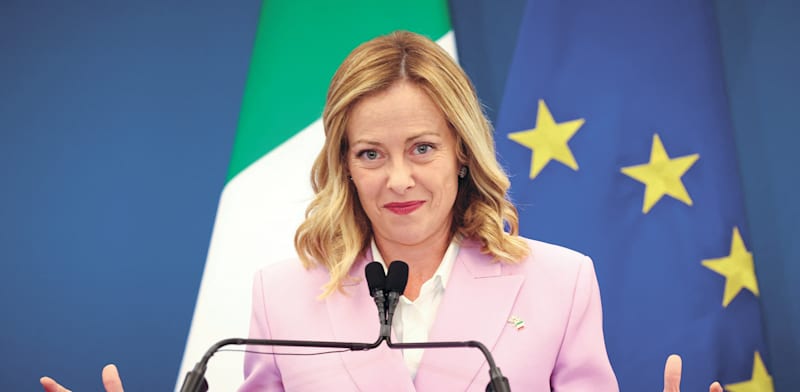
Meloni herself refrained from commenting on the issue. In the past, when she was the leader of “Brothers of Italy” in the opposition, she expressed support for the use of Italian gold treasures to finance the current budget, but these positions have changed since she was chosen to form the coalition about three years ago. Since then, it has been trying to act in coordination with Brussels, among other things due to the huge grant that the Union has transferred to Italy in recent years.
“The proposal raises the possibility that gold will become a victim of political decisions”, the “Corriere della Sera” summarized the planned move, “such a change in activity is a serious matter”.
For your attention: The Globes system strives for a diverse, relevant and respectful discourse in accordance with the code of ethics that appears in the trust report according to which we operate. Expressions of violence, racism, incitement or any other inappropriate discourse are filtered out automatically and will not be published on the site.