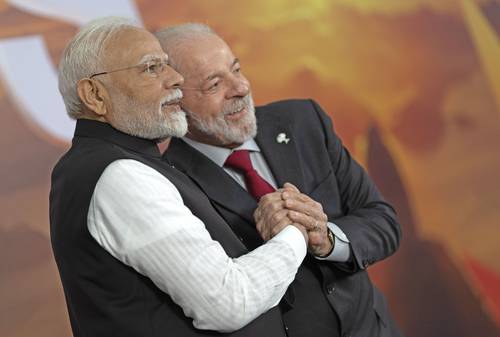
One of Brazil’s greatest achievements at the head of the BRICS group was the defense of multilateralism, in the midst of a very complex world scenario, ambassador Mauricio Lyrio indicated yesterday.
At the end of the year, the rotating presidency of the South American country also ends, passing the baton to India.
Brazil – the largest economy in Latin America – exercised leadership of the group of developing economies this year, in the midst of a trade war unleashed by the imposition of tariffs by US President Donald Trump, who applied the highest tariff rates to the main countries in this group.
The Brazilian Foreign Minister, Mauro Vieira, indicated that one of the group’s challenges is the need to strengthen ties in people’s practical lives. “The BRICS group must be seen not only as a forum for dialogue between governments, but also as a platform capable of generating tangible benefits for our people,” he stated.
During a two-day meeting, representatives of the member countries analyzed Brazil’s management at the head of the group, which this year increased to 11 members, which focused on six key areas: global health cooperation; climate change; trade, investment and finance; multilateral architecture for peace and security; governance of artificial intelligence, and institutional development.
Upon assuming the presidency, the Foreign Minister of India, Sudhakar Dalela, indicated that his country is committed to carrying out the approved collective agenda and sustaining the momentum that Brazil has generated in the pillars of cooperation.
“Our presidency will continue to be guided by the fundamental principles of continuity, consolidation and consensus, while continuing to respond to world events and the changing priorities of the Global South.”
Sudhakar Dalela also presented the priorities of the BRICS presidency for 2026, which will be structured around four pillars: resilience, innovation, cooperation and sustainability.
Within the objectives of each area are resolutions already agreed upon during the Brazilian presidency that will have continuity, such as the development of systems to reduce climate disasters, cooperation for the equitable use of artificial intelligence, the exchange of scientific knowledge and research, among others.
In addition, the political debates of extreme relevance for the Global South that guided the Brazilian presidency of the BRICS will continue: a more inclusive and diverse global governance, as well as the reform of the United Nations Security Council.
BRICS is the acronym used to refer to the group of developing economies, initially made up of Brazil, Russia, India, China and South Africa. Between 2024 and 2025, Egypt, Ethiopia, Iran, the United Arab Emirates, Indonesia and Saudi Arabia joined. In addition, Belarus, Bolivia, Cuba, Kazakhstan, Malaysia, Nigeria, Thailand, Uganda, Uzbekistan and Vietnam are partner states of this economic alliance.
The BRICS countries represent 36 percent of the world’s gross domestic product and 45 percent of the global population. Among its plans is the creation of a currency for global use, as an alternative to the US dollar.