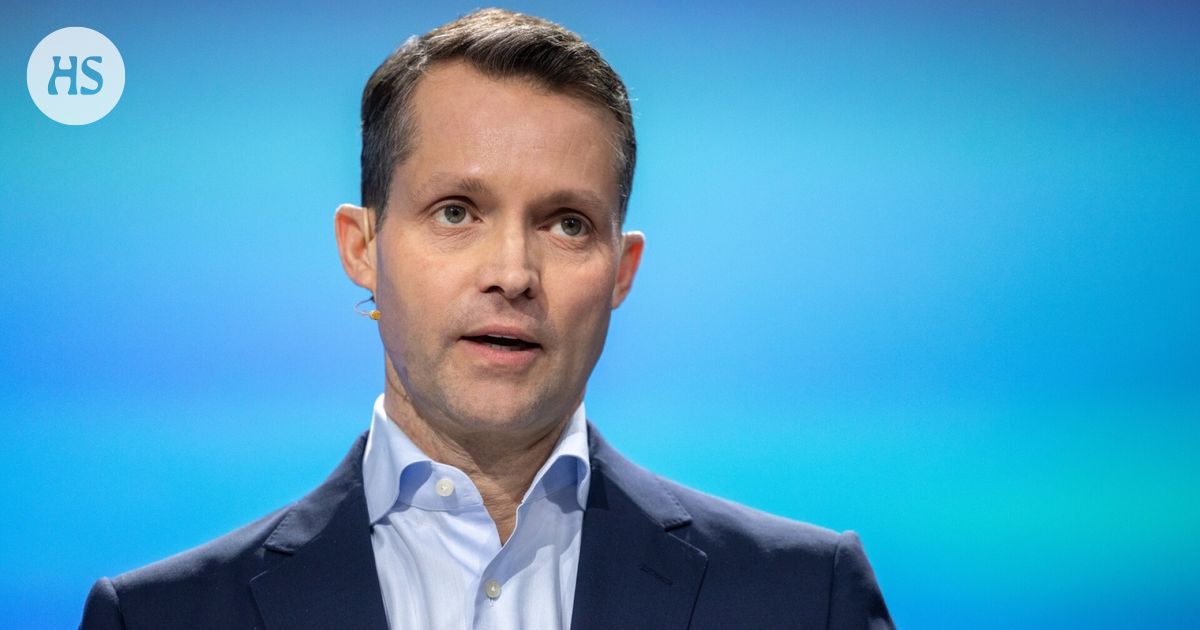
Rewarding|CEO Justin Hotard says in an interview with HS that Nokia’s purpose is not to categorize employees into good and bad. According to him, the company failed to communicate the matter.
According to Nokia CEO Justin Hotard, the company failed to communicate the new employee evaluation and reward guidelines.
In Nokia’s internal documents, superiors were ordered to classify their subordinates into five categories, which aroused exceptionally high levels of dissatisfaction.
According to Hotard, it was a matter of recommendation from the beginning and not of using forced distribution, but the matter was communicated in different parts of the organization in different ways.
Nokia’s European Business Council estimates that 25 percent of employees would be classified as weak, who would not receive the full remuneration, equivalent to about two months’ salary.
Network devices CEO of the manufacturer Nokia Justin Hotard tells HS that the company’s purpose is not to force superiors to classify their subordinates as good and bad.
Last week appearedthat Nokia’s new employee classification and remuneration guidelines have aroused exceptionally high levels of dissatisfaction in the company.
In the company’s internal document, it is said that each supervisor must classify his subordinates into five categories. The weakest are those requiring “significant development needs”.
“This was an error that we noticed early on and corrected in all of our materials. We have 77,000 employees and 6,000 front-line employees and unfortunately the materials have been interpreted and communicated in different ways across the organization.”
According to Hotard, Nokia has clarified the matter internally. In the updated materials, he says, supervisors are not ordered to classify employees according to a forced distribution.
“It was about a recommendation from the beginning, but we failed to communicate the matter to the superiors. The recommendations have also since been changed and they will be reviewed again when we get more information and feedback,” says Hotard.
“It is important for me to listen to feedback and continue developing the system.”
Nokian the european business council wrote a letter to CEO Hotard at the end of November criticizing the introduction of an exceptionally strong forced distribution.
According to the trustees’ interpretation, superiors were ordered to classify 25 percent of their subordinates as weak. That is, those who have “significant development needs” or “needs for development”.
Based on Nokia’s internal papers, those who perform less well do not receive the full reward, roughly equivalent to two months’ salary. Nokia has traditionally paid it to the vast majority of its employees.
“We have asked senior officials to use discretion in interpreting these recommendations. We will come again to reinforce this message to senior officials. We do not have [käytössä] no forced distribution, according to which a certain part of the employees would not receive any rewards at all,” says Hotard.
A trustee of senior employees and a member of the works council Jari Nummikoski according to CEO Hotard has also announced on the company’s internal chat channel that forced distribution is not used.
“I am satisfied that the matter seems to be clearing up. We will be wiser in the spring when we receive information about the payment of premiums.”
How about what is the point in the end?
About securing Nokia’s competitiveness, says Hotard. In the past, Nokia’s success was largely based on the extent to which telecom operators bought the company’s equipment and software.
In the future, customers other than telecom operators will have an equally greater weight. Companies that use artificial intelligence are now investing heavily in data centers that require ultra-fast and reliable fixed network connections.
In addition, Nokia plans to bring artificial intelligence together with the semiconductor company Nvidia as a central part of the sixth generation mobile phone networks. They will be introduced in approximately five years.
Reforms require new thinking from the people of Nokia, for which not all employees are equally well equipped.
“We continue from the basis that Pekka Lundmark Nokiaaan built, but as the competition gets tougher, we have to be even faster.”
According to CEO Hotard, Nokia strives on the one hand to ensure that the best performing employees stay with the company and to encourage them. Therefore, they are likely to be paid higher fees than before.
“On the other hand, we also want to identify those employees who need more support in order to succeed better in their work. We will offer this support even more because we want them to succeed.”
The company therefore tries to avoid the fact that bonuses are paid the same amount to everyone without an individual performance evaluation. When all employees were paid roughly the same amount of compensation each year, it tended to cloud people’s perception of success at work.
“The best employees are often also the ones who help others to be more successful in their work. If we lost these best employees, it would be a bad result.”
According to Hotard, the purpose is in no case to force work units to compete with each other. According to him, the possibility of supervisors to evaluate “freely and objectively” the performance of their subordinates can be seen in the individual evaluations already completed this year.
“The data obtained from this year’s personnel evaluations show that there is great variation between units in how superiors have evaluated the performance of employees. In some units, everyone performs very well.”
In Finland according to Hotard, will continue to be a major factor in Nokia’s business.
“We have invested in Finland and hired more employees here at the same time that jobs have been reduced relatively much more in many other countries. We have incredibly good employees and know-how in Finland, which we want to hold on to.”
The pace just needs to be increased, both in Finland and all over the world.
“Nokia has excellent opportunities to be a leading European company in the use of artificial intelligence, but we all have to work hard for that,” says Hotard.
https://www.blogger.com/profile/01422800812350407119
https://www.deviantart.com/spinmachosk
https://www.themoviedb.org/u/SpinMachoSK
https://myanimelist.net/profile/SpinMachoSK
https://bitcointalk.org/index.php?action=profile;u=3740063;sa=summary
https://slides.com/spinmacho
https://www.instapaper.com/p/SpinMachoSK/folder/5291762/spinmacho
https://www.weddingbee.com/members/spinmacho/
https://micro.blog/SpinMachoSK
https://able2know.org/user/spinmacho/
https://www.babelcube.com/user/spin-macho
https://hackaday.io/SpinMacho?saved=true
https://devnet.kentico.com/users/550297/spin-macho
https://repo.getmonero.org/SpinMachoSK
https://hashnode.com/@Alexxx1xxx
https://www.1001fonts.com/users/SpinMachoCOM/
https://forum.prusa3d.com/forum/profile/spinmachoo/
https://creativemornings.com/individuals/spinmacho
https://packagingoftheworld.com/members/spinmacho
https://www.dibiz.com/tojatep437
https://sad-ogorod.biz.ua/forum/user/166130/
https://www.deviantart.com/luckyhaunter
https://minus.lviv.ua/users/LuckyHaunter/
https://www.liraland.ua/forum/user/158757/
https://gortransport.kharkov.ua/forum/index.php?showuser=5420