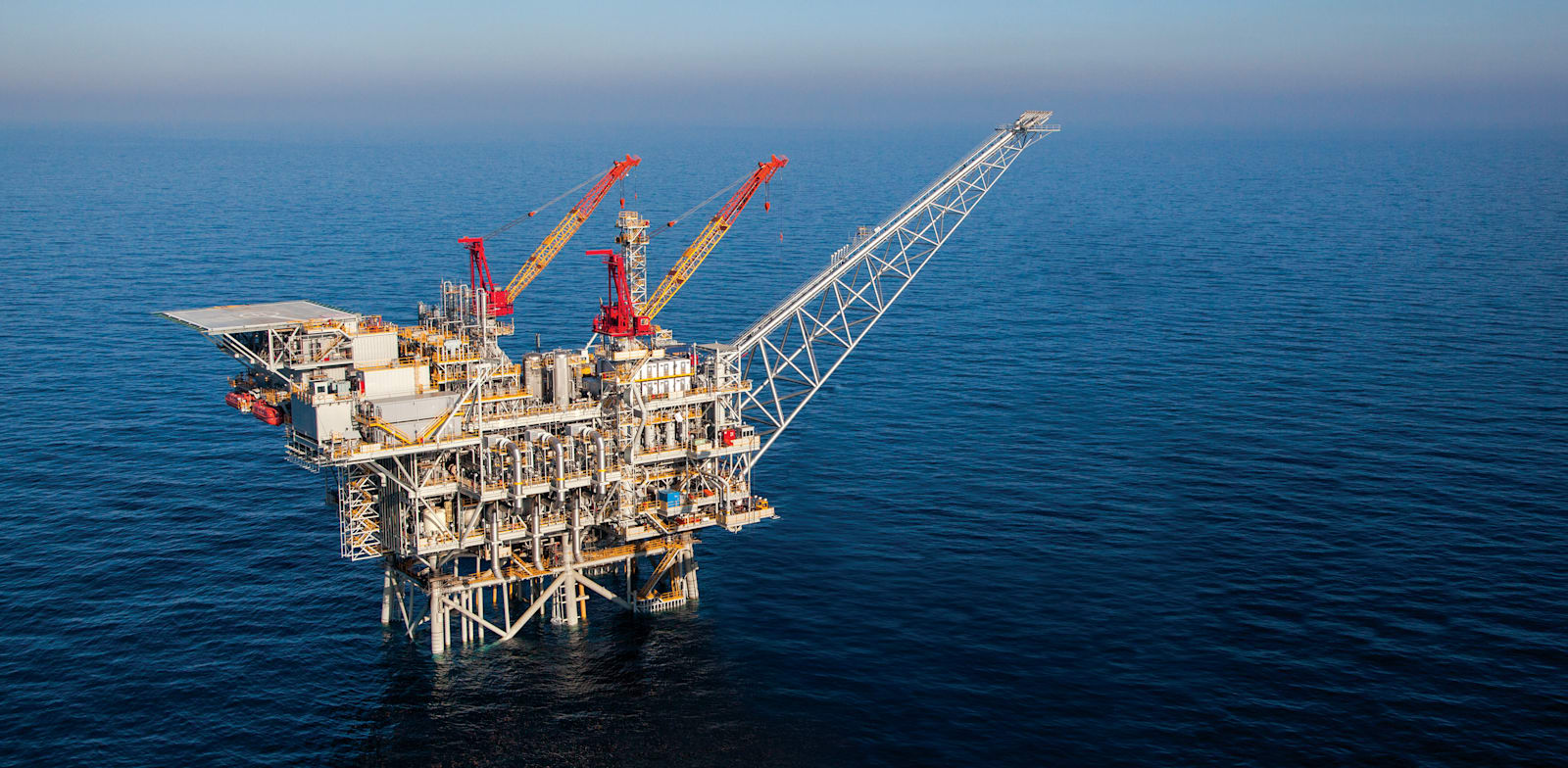
The tripartite Israel-Greece-Cyprus summit, which took place this week in Jerusalem, is causing echoes around the world, following the tightening of relations between the countries in the face of the common threat: Turkey. However, the meetings between the leaders of the countries and the ministers also produced significant economic summaries. One of them is the plan to connect the Israeli gas reservoirs, Leviathan, Tamar and Karish-Tanin, to the LNG (liquefied natural gas) facilities in Cyprus. This was learned by Globes from an Israeli and Greek official who were present at the summit.
The ambition of the parties is that the expected revenues from such gas exports will bring companies to finance the relatively short pipeline layout, so that the countries themselves will not be required to provide financing for the project.
This is a move that will take some time, when even before that, the deployment of the electricity cables between Israel and Cyprus is expected to start on the ground, as part of the interconnector project to connect the Israeli electricity grid with the European one, as reported in Globes. Since Eli Cohen assumed the position of Minister of Energy and Infrastructure, he has examined a series of options for decentralizing Israeli gas export capacities, such as LNG facilities on land or those floating in the sea (FLNG).
Today, Israeli gas is exported in only two directions: Jordan, which has a very small domestic economy, from which the pan-Arab pipeline (Fajar) exits, which branches south towards Egypt and to Syria and even Lebanon in the north. The other direction is a separate pipeline that goes from Israel directly to Egypt, which suffers from many challenges. Egyptian consumption stands at about 70 BCM of natural gas per year, with local production falling to 45 BCM in 2024, which creates a gap of about 25 BCM that is filled by imports, including from Israel.
At the same time, Cairo is facing a prolonged economic crisis, and wants to find a way to liquefy gas in its LNG facilities, and to profit from the difference between the price it buys from Israel and the price of LNG on the open market. These needs led Egypt, despite the harsh criticism at home and even in the entire Muslim world, to sign with the Leviathan partnership the huge deal to purchase 130 BCM for about 35 billion dollars.
Extensive export to Egypt
According to the data of the Ministry of Energy, last year Israel exported 13.2 BCM, and produced 13.9 BCM for the local economy. For comparison, in 2020 the ratio was 4.3 BCM for exports and 11.8 BCM for the domestic economy. The cause of that jump in exports is Egypt, which began importing natural gas from Israel in 2020 with an amount of 2.2 BCM, which grew consistently, including during the war, up to 10 BCM in 2024.
Unlike Egypt, exports to Cyprus are not intended for the Cypriot energy sector. All of it is intended to reach the LNG facilities that will be built and connected on the island to the Israeli reservoirs, for the purpose of liquefaction. The advantage of the process over pipelines is that liquefied natural gas can be transported in tankers, like oil. Thus, along with the price advantage, there is no restriction on the export range, and the LNG can be sold on the open market all over the world.
“We are determined to promote joint energy projects,” the Cyprus government said at the end of the summit, “including the development of natural gas, electricity connections and renewable energy initiatives, as the foundations of regional cooperation, which is based on international law, and respecting all the rights of the countries of the region over their exclusive economic waters and continental shelf.”
Eli Cohen, Minister of Energy and Infrastructure / Photo: Shlomi Amsalem, Deputy Prime Minister
The reference to international law is a direct message for the common threat to Israel, Greece and Cyprus: Turkey. Ankara is divided with all the countries of the region except Libya over the borders of the economic waters in the Eastern Mediterranean, first and foremost because Turkey is not a signatory to the Convention on the Continental Shelf and the UN Convention on the Law of the Sea.
While the prevailing view in the international community holds that islands are independent units entitled to a continental shelf and territorial waters of up to 12 nautical miles, Turkey sees the islands as a direct continuation of Anatolia. In their view, earthquakes caused water to enter between the mainland and the islands, including Cyprus. These differences in perception actually led to a sort of compromise, according to which each island is currently entitled to only six nautical miles.
regional turkish fury
Another issue concerns the status of Cyprus itself. Following a Greek-nationalist military coup in 1974, Turkey invaded Cyprus, and in 1983 led to the establishment of the Turkish Republic of Northern Cyprus – an entity recognized only by Ankara. Based on this recognition, Turkey claims economic water rights to which it claims Northern Cyprus is entitled.
The connection of the Israeli gas infrastructure to Cyprus is expected to add to the regional Turkish anger that already exists, but specifically on Beirut. Recently, Ankara has expressed strong opposition to the ratification of the maritime border agreement between the Republic of Cyprus and Lebanon, and it is even holding talks to form a Turkish-Syrian maritime border agreement with Ahmed al-Shara, the president of Syria who operates under the auspices of Erdogan. Such an agreement may come at the expense of Cypriot maritime areas, including those where the connection from the Israeli reservoirs is expected.
For your attention: The Globes system strives for a diverse, relevant and respectful discourse in accordance with the code of ethics that appears in the trust report according to which we operate. Expressions of violence, racism, incitement or any other inappropriate discourse are filtered out automatically and will not be published on the site.
https://knigi.fun/17041-nelyubimaya-ghena-doktora-bagirova.html
https://knigi.fun/17042-tancy-na-myatyh-prostynyah.html
https://knigi.fun/17043-travnica-dlya-orka.html
https://knigi.fun/17044-lyubovnica-s-principami.html
https://knigi.fun/17045-vstrecha-vypusknikov-magicheskoy-akademii.html
https://knigi.fun/17046-taynyy-naslednik-kriminalynoy-imperii.html
https://knigi.fun/17047-razvod-iskusstvo-slaty-vseh-na.html
https://knigi.fun/17048-strannik-moy.html
https://knigi.fun/17049-dghigit-na-«behe».html
https://knigi.fun/17050-zalet-po-drakonyi_-ili-vedyma_-ispolni-prorochestvo.html
https://knigi.fun/17051-vtoroy-shans-na-schastye-lana-stendere.html
https://knigi.fun/17052-dvoynaya-izmena.html
https://knigi.fun/17053-kot_-ego-vedyma-i-proklyatyy-princ.html
https://knigi.fun/17054-sosed-budet-sverhu.html
https://knigi.fun/17055-naslednica-sirotskogo-priyuta.html
https://knigi.fun/17056-izmena-okolycovannaya-ptica.html
https://knigi.fun/17057-ego-devochka-vynughdennyy-brak.html
https://knigi.fun/17058-ty-prigrezilasy-mne.html
https://knigi.fun/17059-izmena-vernu-mugha.html
https://knigi.fun/17060-vverh-tormashkami.html
https://knigi.fun/17061-izmena-oshibka.html
https://knigi.fun/17062-bedovaya-popadanka-dlya-generala-drakonov.html
https://knigi.fun/17063-derevenskoe-schastye-opera-morozova_-ili-operaciya-ghenity-papu.html
https://knigi.fun/17064-ya-budu-tvoimi-glazami.html
https://knigi.fun/17065-izmena-kak-verevochke-ne-veysya.html