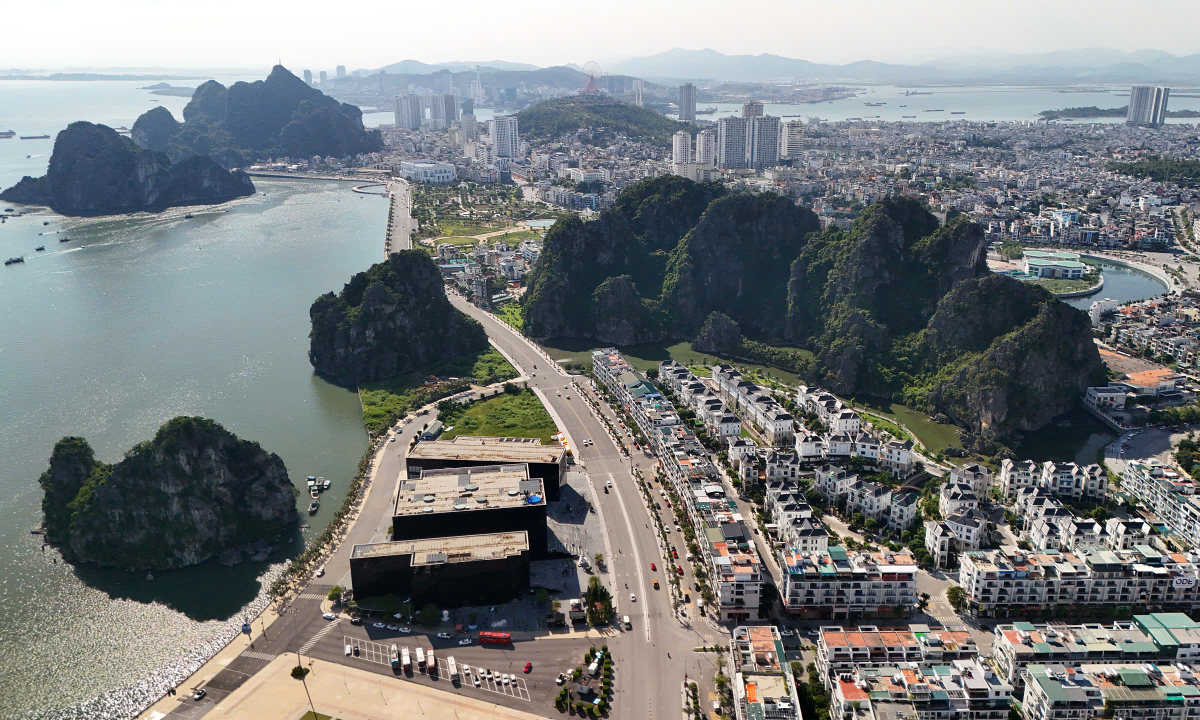
The GRDP of Quang Ninh and Hai Phong increased the highest, 11.89% and 11.81% respectively, reflecting the ability to effectively utilize investment capital flows, especially FDI.
According to data just released by the Department of Statistics, GDP in 2025 will increase by 8.02% compared to 2024. This level is only lower than the growth rate in 2022 (8.12%) if calculated over the past 15 years. In particular, the growth rate of gross regional product (GRDP) of localities ranges from 5.84 to 11.89%.
Ha Long ward, Quang Ninh province viewed from above. Image: Le Tan
Six localities achieved growth of over 10%, of which Quang Ninh and Hai Phong were the highest, at 11.89% and 11.81% respectively. In addition, this group also includes Ninh Binh, Phu Tho, Bac Ninh and Quang Ngai.
Localities with double-digit growth have in common a relatively solid industrial and service foundation. They also have solutions to reform institutions, the investment environment, and effectively use investment capital flows, especially FDI. Growth in these localities is associated with the operation of large-scale industrial complexes and FDI projects.
In addition, some localities take advantage of their small economic scale to make a leap through disbursement of public investment capital and development of new fields.
In addition to the above localities, the group with stable growth of 7-10% accounts for the majority, with 23 provinces and cities. The remaining five localities are below 7%. According to the statistical agency, there are no provinces with negative growth, but the gap between the top and bottom groups requires more reasonable regulation and resource allocation. This is to limit the risk of localities in the lower group being left too far behind in the general economic development process.
In terms of contribution to national GDP growth, Hanoi, Ho Chi Minh City, Hai Phong, Dong Nai and Bac Ninh continue to play a pivotal role in the economy. These are the 5 localities with the largest economic scale in the country, contributing 55.4% to national growth.
Hanoi and Ho Chi Minh City reached 8.16% and 7.53%, respectively, contributing 12.94% and 23.11%. The main driving force comes from the service sector, especially high value-added industries such as trade, banking and finance, transportation, logistics, tourism, information technology and support services.
Dong Nai recorded a growth rate of 9.63%, being one of the key industrial localities of the Southeast region. In the growth structure, the industrial and construction sectors continue to play a key role, increasing by 11.52%, contributing about 67.15%. Many key industries increased by over 10% such as leather production, prefabricated metal, and electrical equipment.
After merging with Bac Giang, Bac Ninh became a large-scale, highly competitive industrial and manufacturing center in the Red River Delta and Northern Midlands and Mountains. This combination creates complementary advantages, in which Bac Ninh is inherently the capital of the electronics industry with the presence of large corporations, while Bac Giang emerges with the strength of supporting industries and high growth rate. Thanks to that, the locality forms a diverse, large-scale production center, improving international competitiveness.
Next year, Vietnam sets a double-digit growth target, requiring localities to achieve corresponding positive increases. According to the Statistics Department, maintaining the GRDP growth momentum of localities in the coming time will face many difficulties, stemming from both external and internal factors.
For example, fluctuations in input material prices, increased logistics costs and the risk of local supply chain disruptions still exist. This factor directly impacts localities whose economic structures depend heavily on industrial production and export, especially the group of provinces with a large proportion of FDI. In addition, global consumer and investment demand has recovered unevenly, continuing to limit growth space in the short term.
Domestically, the progress of disbursement of public investment capital in some localities is still slow, reducing the spillover effect of investment on economic growth. The real estate market recovered slowly, with low liquidity, negatively impacting related industries such as construction, materials and financial services. In addition, natural disasters in some localities cause disruption to production and business.
This agency recognizes that maintaining macroeconomic stability while promoting new growth drivers is an urgent requirement. Therefore, localities with average growth rates or lower than the 2025 target need to focus on quickly disbursing public investment and solving problems for businesses. They also need to stimulate domestic consumption and more effectively exploit available growth opportunities.