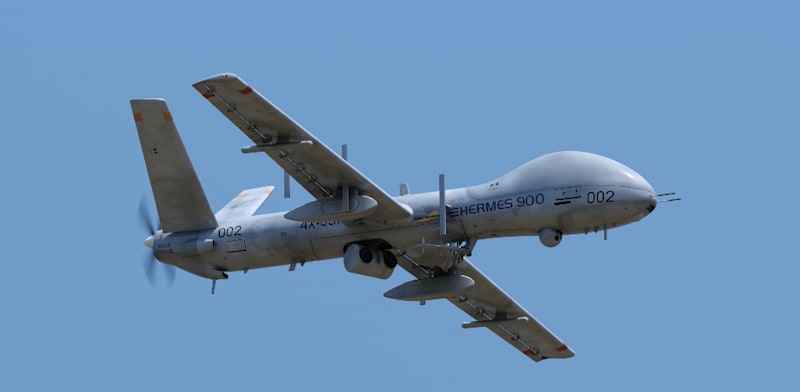
Colombia is considering the replacement of the manufactured drone fleet Elbit in Turkish systems. According to a report in “El Universo”, the state is considering replacing the Israeli Hermes 450 and Hermes 900 models with Baykar TB2 and TB3 UAVs. According to the report, examining the alternatives was one of the main reasons for Baykar’s participation in the Expo Defense exhibition last month.
Under the leadership of President Gustavo Petro, Bogotá is currently considered one of the most prominent anti-Israel capitals in Latin America. However, for many years, Colombia was a stable customer of the defense industries from Israel, a relationship that was manifested in the operation of Kafir model aircraft. Last April, at the end of four decades of cooperation with the aerospace industry, the Colombians decided to abandon the Israeli connection and purchase Griffin aircraft produced in Sweden and Brazil. The use of the Israeli Kfir planes in Colombia was extensive beyond the planes themselves: according to the TWZ website, they were equipped with Elta radar systems, Elbit helmets, and “Derby” missiles, “Python” missiles and Rafael “Spice 1000” bombs.
Despite this, and although President Gustavo Petro accused Israel of “genocide” and even called for the establishment of an “army for the liberation of Palestine”, the opposite reality is taking place on the ground. According to a report on the ZM website, Colombia continues with the strategic implementation of the Israeli air defense systems of the IAA’s Barak MX model – a project in which the company won a tender of approximately 131.2 million dollars in 2022. According to a report, the Colombian Air Force is currently in the middle of the process of carrying out the first battery, which includes the command, control and radar systems. Full delivery of the purchased batteries is expected by 2026, with the full operational deployment completed by 2032.
The world is buying Turkish weapons
The potential addition of the Turkish drones to Colombia’s night of innovations could be significant. The Israeli Hermes 450 and Hermes 900 models, purchased in 2012, are aircraft for extended missions (20 and 30 hours in the air respectively), which have demonstrated impressive offensive capabilities. However, according to reports, the versions supplied to Colombia were limited to intelligence, surveillance and reconnaissance capabilities It is the lack of built-in offensive capabilities that is now pushing Bogota to test Turkey.
Jerusalem and Ankara are waging a direct struggle for the global arms market. Thus, from the data of the Stockholm Peace Research Institute (SIPRI) it appears that between 2020-2024 Israel was ranked eighth in the table of defense exporters (3.1% of world trade), while Turkey was ranked 11th (1.7%). However, the trend shows that while Israel maintains a stable share, the Turks recorded a tremendous jump – from only 0.8% in the five years preceding that to more than double today.
The main engine behind the Turkish ascent is Baykar, which is responsible for a quarter of the country’s defense exports in 2024. The Bayactor TB2 UAV is considered a direct competitor to Elbit’s Hermes 450 due to their close characteristics, and the Turks will have no problem supplying them in an offensive model to Bogota. TB2’s customers include Qatar, Ukraine and Azerbaijan. The TB3 model is significantly larger, capable of carrying heavier weapons, reaches a speed of 290 km/h and offers a stay time of about 24 hours in the air. No response was given from Elbit.
Elbit wins in Europe
While Turkish alternatives are being considered in Bogotá, Elbit Systems records a series of successes in Europe. This week the company announced that it had won contracts in the amount of approximately 150 million dollars for the supply of the Iron Fist defense system. The system will be supplied to BAE Systems Hägglunds for integration into the CV90 APCs of NATO countries.
The new contracts were signed due to a significant milestone registered in September: Elbit held a live shooting demonstration in Europe, where the system’s capabilities were presented against advanced kinetic tank shells. In the test, the system successfully intercepted more than a dozen APFSDS tank shells with a diameter of 120 mm – a rare achievement. The test, conducted in the presence of senior officials from the world’s security systems, confirmed the effectiveness of the system against complex anti-tank threats.
Darvan Arrow is an advanced active defense system of the “Hard-Kill” type, designed to improve the survivability of armored platforms. The system provides a 360-degree protection envelope against a variety of threats – rockets and anti-tank missiles, through drones and roving weapons, to the interception of kinetic tank shells in an urban environment. A day before the report on the spur arrow, Elbit revealed another deal totaling about 150 million dollars to supply DIRCM systems to Europe. As part of the contract, Elbit will equip the aircraft fleet of a European country with defense technology against heat-guided missiles. The system is designed to protect aerial platforms against shoulder-fired missiles using advanced laser technology and thermal imaging capabilities.
For your attention: The Globes system strives for a diverse, relevant and respectful discourse in accordance with the code of ethics that appears in the trust report according to which we operate. Expressions of violence, racism, incitement or any other inappropriate discourse are filtered out automatically and will not be published on the site.