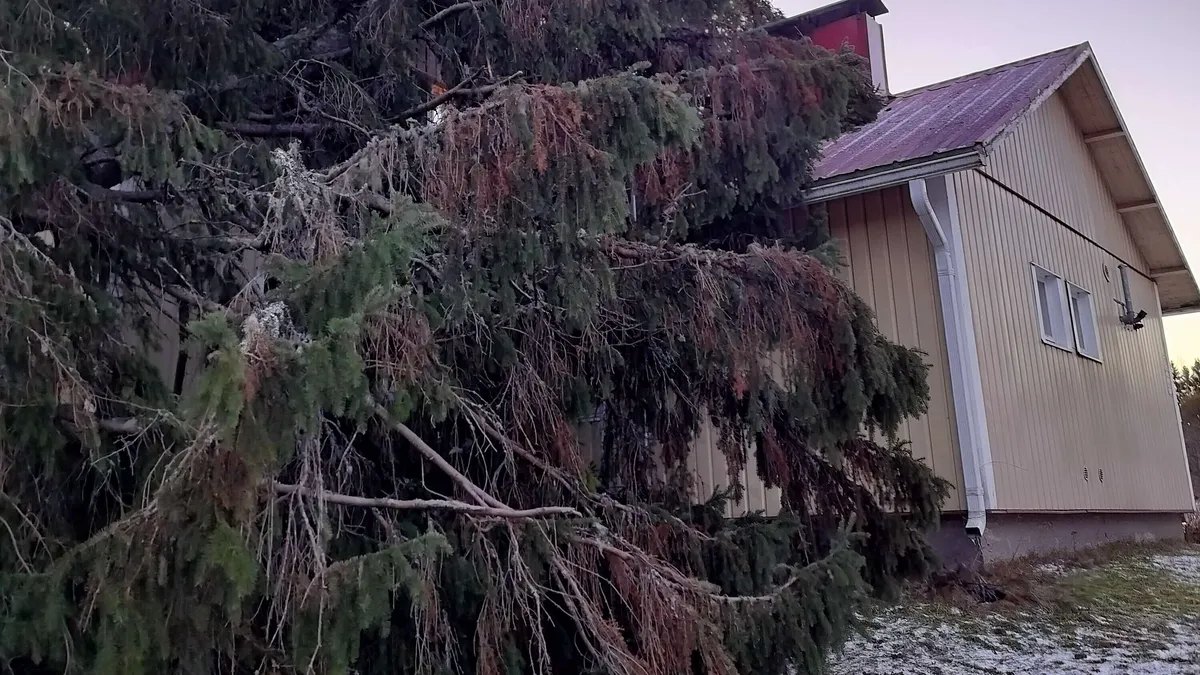
The people woke up again to confusion and confusion, when the storm Hannes, which hit after the Christmas holidays, felled trees along the west coast and inland. At its worst, there were even 187,000 customers without electricity.
Forest director of MTK Marko Mäki-Hakola estimated that hundreds of thousands of cubic meters of trees fell (IL 30.12.). Hannes’s destruction was increased by the fact that the ground was thawed due to the warm early winter, which made it easier for trees to fall.
Hanne has already been compared to the infamous Tapani and Hannu storms in 2011, and for no reason. At that time, it was the worst storm in Finland’s modern history, which caused power outages that took weeks to be repaired. At worst, several hundreds of thousands of customers were without electricity.
The return promise set billions in motion
The Boxing Day storm eventually led to a change in the law, where politicians obliged the companies to build significantly more weatherproof electricity networks. It was estimated that there were up to 360,000 kilometers of networks in poor condition or at least in need of repair. The incentive for investments was a princely “reasonable” return, and the stick was the compensation paid to electricity users for the time without electricity.
The princely return set the investment billions in motion. Cables were dug underground, main streets were widened, substations were renewed and power lines were brought from the forests to the sides of the roads, which improved their readiness for repair.
So the years go by and the dispute continues.
However, it was not immediately said exactly that the bill for everything came to electricity users. There was more talk about how network companies invest in a weatherproof network. Poru started when a reasonable return brought an unreasonably large bill to many payers.
The return could have been calculated differently
One might ask, should the authorities have made a more detailed distinction between security of supply investments and other investments when calculating the return to the companies? A better return would have been given only for improving supply security and a reasonable return for other investments.
In this way, there might have been less arguing about the income. Now all the electricity grid companies have appealed to the Supreme Administrative Court against the market right from the November decisionin which the court found the Energy Agency’s decision to lower the yield given to network companies from the beginning of 2024 to be legal.
So the years go by and the dispute continues.
And has improving delivery reliability been beneficial? Absolutely. For example Leppäkoski Sähkö states that as a result of the destruction caused by the Hannes storm, the number of customers without electricity would have been twice as high as in the Tapani storm in 2011.
Without the investments, the situation would have been a complete disaster.
The author is the editor-in-chief of Kauppalehti.