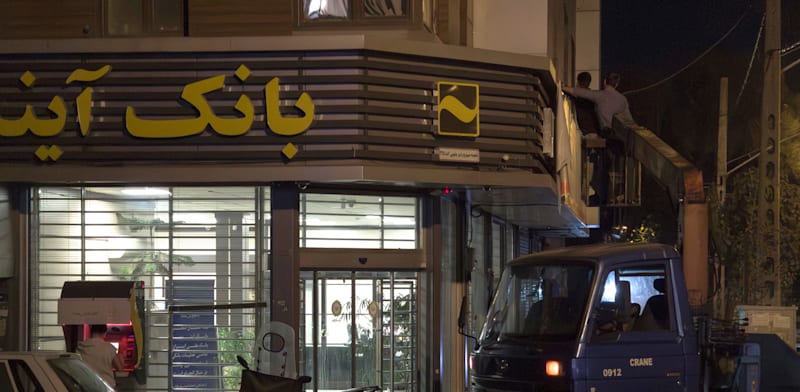
The clearest sign that Iran is on the brink of collapse has not come from the suppressed anger of the country’s opposition or the dashed hopes of young people thirsting for greater personal freedom. It came from a bank collapse.
At the end of last year, the Ayandeh Bank, which was run by close associates of the regime and suffered losses of almost five billion dollars on a pile of failed loans, went bankrupt. The government merged the firm into a state bank and printed a huge amount of money to try to cover all the losses. The move buried the problem, but did not solve it.
Instead, the failure became both a symbol and a catalyst for an economic disintegration that eventually led to the protests that are now the most significant threat to the regime since the founding of the Islamic Republic half a century ago. The collapse of the bank made it clear that the Iranian financial institution, under pressure after years of sanctions, bad loans and reliance on inflationary printed money, is becoming increasingly insolvent and illiquid. Five other banks are considered similarly weak.
Worst timing
The crisis hit the country at the worst possible time. The credibility of the Iranian government has already been damaged by a 12-day war with Israel and the United States in June, which showed that the government cannot protect its population from attack. The leaders refused to compromise in negotiations on the country’s nuclear program, and therefore did not receive any relief from the sanctions imposed on the country. In November, Israel and the US threatened to strike again if Iran tried to revive its ballistic missile arsenal or its nuclear efforts.
The unstable currency of the state, the real, began to spiral downward again and the state was unable to stop it. US enforcement actions cut off Iran from its vital flow of dollars coming from Iraq, significantly reduced its hard currency revenues from oil sales, and put its foreign exchange reserves abroad out of reach through sanctions.
After decades of engineered solutions to circumvent the problem and of using secret cash flows to keep the country’s battered economy functioning, Tehran has reached a dead end, and has no tools to deal with a deepening economic crisis or meet the needs of a population that is becoming increasingly desperate. Hundreds of merchants, who usually do not join the mass protests in the country, took to the streets of Tehran to demand aid.
“It was a well-connected, corrupt bank, which emphasized that banking itself is a means of increasing the wealth of the well-connected,” said Adnan Mazari, former deputy director of the Middle East and Central Asia Department at the International Monetary Fund. The bank’s failure added to what he called “the high point of the regime’s loss of legitimacy after the Israeli attack.”
“corrupt banker”
Ayanda Bank was founded in 2013 by Ali Ansari, an Iranian businessman who merged two state-owned banks with another bank he founded earlier, to establish the new body. He is a member of one of the richest families in the country, and owns a mansion worth millions of dollars in North London. Politically, he is seen as close to the former conservative president Mahmoud Ahmadinejad.
Britain imposed sanctions on Ansari last year, days after Ayanda’s collapse, calling him a “corrupt Iranian banker and businessman” who helped fund Iran’s multi-pronged elite military and business organization, the Islamic Revolutionary Guard Corps. In a statement in October, Ansari blamed the bank’s failure on “decisions and policies that were made and were not within the bank’s control.”
Ayanda offered the highest interest rates of any bank in Iran, attracted millions of depositors and borrowed a lot of capital from the central bank, which printed money to prevent its collapse, economists said. Like other troubled Iranian banks, Ainda had a large number of non-performing loans, one of a variety of factors that ultimately led to its failure.
His biggest investment was the Iran Mall, which opened in 2018. The project was magnificent to a degree that did not match the stagnation in the Iranian economy as a whole. The mall, which is twice the size of the Pentagon, is a city within a city with its own IMAX cinema, library, swimming pools and sports facilities, and has indoor gardens, a car showroom and a hall of mirrors in the style of a 16th-century Persian imperial palace.
Economists and Iranian officials said the project was one of the self-loan dodges, in which Ansari’s bank effectively lent money to companies it owned. When the bank was closed, a report in the semi-official news agency ‘Tasnim’ cited by a senior official at the central bank stated that more than 90% of the bank’s resources were related to projects under its management.
They pushed to close the bank
Ayanda has been criticized for years by some conservative and reformist politicians, who pushed for the closure of the bank and claimed that the central bank’s support for the institution would increase inflation due to its need to print money to finance it.
These calls peaked at the end of last year. The head of Iran’s Judiciary, Gholam-Hossein Mohsani Azhai, publicly called on the central bank to take action in October, and threatened on social media to take legal action if the banking authorities did not intervene. The central bank announced the liquidation of Ainda Lemohart.
The government took over the bank’s debts and forced it to merge with the country’s largest government lender, Bank Mali. At least five other Iranian banks are now facing a similar fate, according to economists and a statement by an official at the central bank last year. Among them is also included the “Spa” bank, one of the largest in the country, which previously merged other failed banks into it.
The director of banking supervision at the Central Bank of Iran called Ayanda last year a “Ponzi scam.” For many Iranians, he was a symbol of a country whose meager resources were diverted to the well-connected few while they themselves suffered.
“This is another example of stories of corruption or unfair practices that give many ordinary citizens the impression that the Supreme Court has been distorted against them, or at least distorted to serve a small number of elite members,” said Espandiar Batmangelij, CEO of the Bourse & Bazaar Foundation, an economic research institute.
perfect storm
Ayanda was at the center of what economists call a broader crisis in the financial sector, accelerated by the reimposition of American sanctions in 2018.
Lacking funding, Iranian banks relied on loans from the central bank through an emergency liquidity mechanism that charged high interest rates but lent money without requiring collateral. The banks then misinvested the funds, often lending to connected elites to engage in speculation and large construction projects.
The central bank printed money to finance the loans, although bank officials and economists have long warned that these actions create an inflationary cycle and weaken the currency.
The result was a shaky financial tax dependent on the country, at a time when Iran was about to be hit by a series of increasingly serious shocks: waves of sanctions, the fall of regional allies such as Hezbollah and the Assad regime in Syria, and a direct confrontation with Israel and the US. As of 2019, the government actually controlled about 70% of the banking tax in Iran, according to an analysis by Mazari, a former senior official at the International Monetary Fund.
Ayanda’s collapse turned on warning lights. “It reinforced the feeling that banking is very fragile and vulnerable,” Mazari said. “If something goes wrong, the results will go to the public purse.”
Iran’s economic collapse has been brewing for years, but the process has accelerated in recent months. The national currency lost 84% of its value compared to the dollar in 2025. Food prices rose at an annual rate of 72%, almost double the average in recent years. The country is also facing an energy and water crisis so severe that President Massoud Pazkhian has proposed moving the capital out of Tehran and closer to the Indian Ocean coast.
Wages did not keep up with the rising prices, and the rapidly rising prices pushed ordinary Iranians to the breaking point. People said they could no longer afford food. With the decline in the value of the riyal from hour to hour, shop owners were unable to set prices. Importers lost money even before they could offer their goods for sale. “The Iranian middle class has been destroyed,” said a 43-year-old artist and resident of Tehran. “When you can’t even try to get food anymore, you have nothing to lose.”
When the government spent money to stabilize Ayanda, it cut public support. The budget proposed by the government in December included a number of austerity measures. He called for the abolition of an exchange rate that encourages imports, the removal of part of the bread subsidies and the sale of imported gasoline at market prices. The government proposed to cut a total of 10 billion dollars from government support to the public and to central interests such as importers, according to an analysis by Bijan Hajpour, managing partner at the Vienna-based Eurasian Nexus Partners consulting company.
The budget was officially presented to the parliament on December 23, but rumors about the coming wave of austerity spread even before that, which raised concerns about further economic pressure at a time when the riyal had already fallen. Economists said the growing financial crisis reached its peak at the same time when a perfect storm of pressures – the tightening of international sanctions, the results of last year’s war with Israel and years of economic mismanagement – eroded the government’s ability to deal with it.
The tightening of American and European sanctions has forced Iran’s oil industry to rely on an international “shadow fleet” of tankers to export its products, resulting in a larger portion of oil revenues flowing to middlemen and less reaching the state coffers and the wider Iranian economy.
The increased American enforcement against money laundering by Iraqi banks deprived Iran of one of its most important sources of dollars. Iraqi banks became known as the “lungs” of the Iranian financial institution, providing liquidity to Iran’s isolated banks.
The war with Israel also caused a significant shock and increased the government’s need to increase defense spending, in order to rebuild its military capabilities and strengthen allies such as Hezbollah.
Military pressure began to increase again in late 2025, after a six-month lull. The US and Israel have warned of new attacks on Iran’s missile program, a threat exacerbated by the US raid on Caracas to capture Venezuela’s president in early January.
Fears of a new attack accelerated capital flight from Iran, which began with the 12-day war with Israel last summer. Iranians got rid of the Rial and shifted their money to foreign currency, gold and assets such as cryptocurrencies.
Javad Salehi-Esfahani, an economist at Virginia Tech University, estimated Iran’s total capital flight last year at between $10 billion and $20 billion. It created what he called “a bad situation that doesn’t seem sustainable.”
An energy crisis stemming from a shortage of natural gas, which began in 2024, caused long power outages. The outages occurred despite the country’s vast oil and gas wealth, and raised questions about the government’s dangerous decades-long efforts to enrich uranium for what it called a non-military nuclear energy program.
The increasing power outages, the worsening water shortage, and the dwindling currency – all of these will fuel the impression among many Iranians that the country is beginning to collapse.
The government tried to calm the protesters by introducing a monthly cash subsidy of 10 million riyals per person – about seven dollars, although in Iran this amount is worth more – and vowed to act against excessive price increases. The governor of Iran’s central bank resigned at the end of December and was replaced by Abdulnasser Hamati, the former economy minister who was ousted by parliament last year when the country was caught up in its currency crisis.
It didn’t work. The protests began at the end of the year and for two weeks escalated, spreading to dozens of cities throughout the country. Thousands have demonstrated in recent days, despite shutting down the Internet and worsening the suppression of the protest by the government, during which hundreds of people were killed, according to human rights organizations.
Regardless of the results of the protests, the pressure on the regime caused by deep internal financial problems, with heavy pressure from the outside, will not go away.
“If they could have solved the problems with money, they would have done it earlier, and not had to resort to this kind of violence,” said Erik Myerson, chief emerging markets strategist at Swedish bank SEB. “The situation is really making it difficult for the regime.”