The Director of the Department of Startups and Technology Enterprises believes that startups not only need capital, but also need a testing environment, supported by large businesses.
Sharing at the innovation festival on the afternoon of January 15, Mr. Hoang Ngoc Nhan, Director of the Department of Startups and Technology Enterprises (Ministry of Science and Technology), emphasized the importance of testing opportunities with Vietnamese startups, that is, having the first customers on board.
According to Mr. Nhan, innovative solutions are only truly effective when they come from practical needs. Many Vietnamese startups have good technology, but face difficulties because of the lack of an environment to test in real operating conditions. Meanwhile, many large businesses have a clear need for innovation, but find it difficult to find flexible solutions.
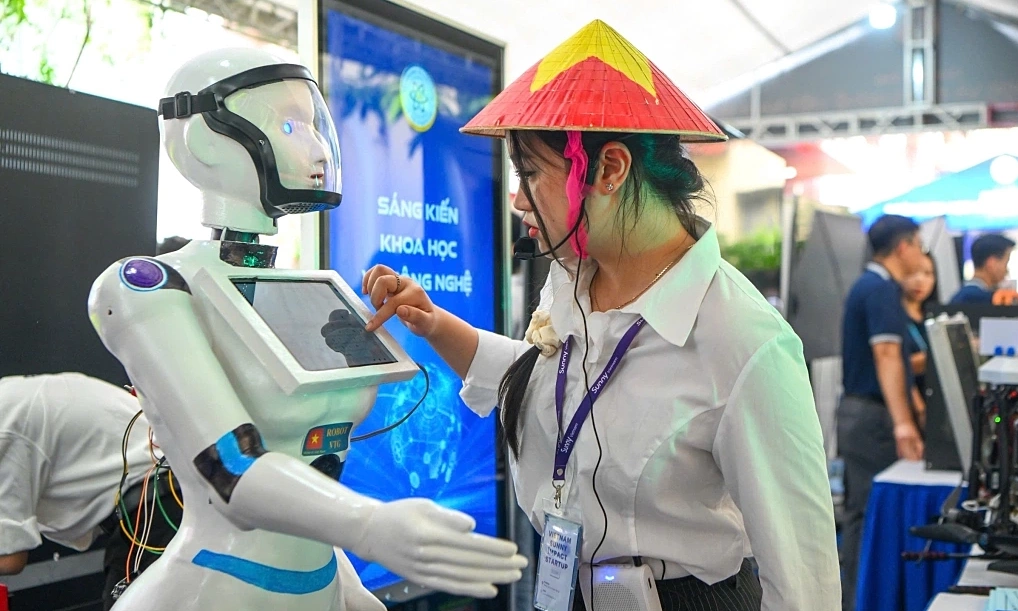
A product displayed at the 2025 Science and Technology Festival, May 2025. Image: Giang Huy
Commenting on the relationship between the two components mentioned above, the Director said that the role of large enterprises in the innovation ecosystem is not only as a buyer of solutions. They can be a place to help verify and perfect new ideas of startups. To do this, Mr. Nhan recommends that businesses be willing to share their problems in operations, data management, and customer experience, creating conditions for startups to experiment within the scope of control.
More importantly, they need to be willing to continue creating opportunities for startups if the solution proves effective.
From a management perspective, Mr. Nhan recognizes that startup support policies often mention capital, but the opportunity to experiment for them is also very important. “If we want Vietnamese startups to reach the world, we need to form a home market open enough for them to grow,” said the Director. “Home turf” here is not protectionist, but rather creates a transparent environment, ready to receive new solutions.
When startups are big enough, Vietnam proactively opens the door for them to test and deploy. At that time, early-stage companion businesses also benefit from appropriate solutions.
Mr. Hoang Minh Hung, General Director of Tasco, said that units in their ecosystem have proactively published more than 30 problems from real operations, to attract technology solutions from startups.
Representing the startup “pedestal”, Mr. Do Tien Thinh, Deputy Director of the National Innovation Center (NIC), suggested that the young technology business class needs to “take advantage” of relationships in the ecosystem, including large businesses, institutions, and the State.
For example, with universities, lecturers and researchers can act as mentors, suggest ways to optimize technology solutions, or take advantage of their existing reputation to vouch for a startup’s new product. “The nature of every business transaction and investment decision is to look at people, not products,” Mr. Thinh added.
With the State, startups are ignoring many support policies. For example, submitting an application to the Department of Finance to request support will help startups reduce 50% of the cost of renting a coworking space, renting equipment, premises… Foreign corporations NIC is working with such as Amazon and Google also support capital or technology solutions.
Talk to VnExpressMs. Vy Le, co-founder of Do Ventures, acknowledged that the number of startups certified as private technology enterprises in Ho Chi Minh City is still small. Even with certified units, fewer startups understand the processes and procedures to enjoy incentives. Ms. Vy said that the authorities have recognized the importance of policy communication and details of the beneficiary process, but need to promote it further.
According to the Startup Ecosystem Assessment Report released by the Ministry of Science and Technology last month, Vietnam currently has more than 4,000 startups and two unicorns. The lack of professional R&D (research and development) and “mentor” human resources is also a barrier that makes it difficult for Vietnam to develop core technology. However, policies to support women, students, and startups are expected to help improve the situation.