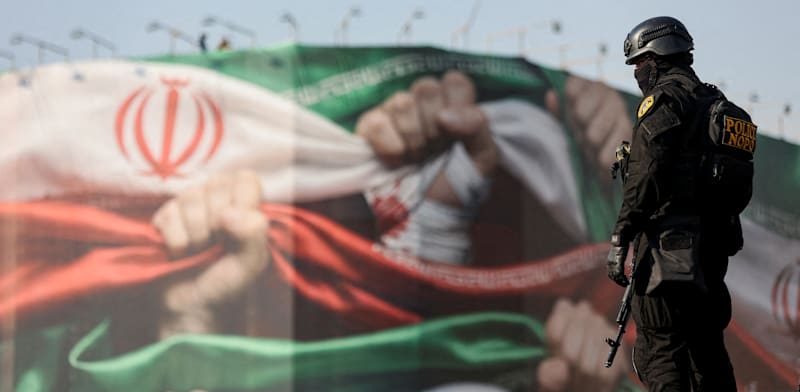
Iran is facing the most serious crisis in its history: a faltering economy, protests throughout the country, thousands of protesters murdered and many arrested, hundreds of regime officials killed, a local and international image at a low ebb, and above all – a real threat by the United States to a significant attack on the Islamic Republic. All of these create a situation where the “day after” scenario of the Ayatollah regime seems more tangible than ever.
“Such an event, if it occurs, will change the region from end to end,” clarifies Dr. Yoel Gozhansky, who previously coordinated the handling of Iran and the Gulf at the National Security Headquarters (NSS), and currently serves as a senior researcher and head of the Gulf Program at the Institute for National Security Studies (INSS). “There is no country in the region that is not affected by Iranian intervention or an Iranian threat of one kind or another, especially the Gulf states, Israel and Iraq. This is a massive change that may shake the Arab world. If there is a revolution in Iran, it may lead to a renewed Arab Spring wave.”
Oil sanctions and restrictions: what brought down the economy
One of the clearest expressions of the Iranian situation in general and its economic situation in particular is the local currency: the Iranian Rial. During the Islamic revolution in 1979, 70 riyals were enough for the dollar, while now the exchange rate stands at 1.4 million riyals – about 20 thousand times. The great acceleration of the process was since US President Donald Trump decided in 2018 to leave the nuclear agreement, when 42 thousand riyals “only” were enough for the dollar.
Today, Iran is more isolated than ever because since September 2025 not only has it been subject to American sanctions, but also to those of the United Nations – after the Security Council did not approve the continuation of the reliefs. The sanctions include, among other things, an arms embargo, restrictions on products that help the ballistic missile program, and asset freezes. However, the Iranian economy is particularly affected by oil restrictions.
In the Iran Open Data project, we examined the consequences in depth, and found that the Ayatollah regime is losing close to 20% of its potential oil export revenues, despite the use in recent years of China and Malaysia as stations to bypass the American sanctions. In the research program, they noted that in the Persian year that ended in March last year, Iran brought in about 23.2 billion dollars from oil exports, but they estimated that it could have reached more than 28 billion dollars. The calculation was made on the basis of monitoring tankers and oil prices, and indicates how much an Iran without the Ayatollah regime may benefit immediately from exiting isolation.
How trade partners will deal with a revolution
At least for the moment, Iran’s dependence on China is absolute, as it imports more than 90% of Iran’s exported oil. From the opposite past is the Chinese “Belt and Road” program, in the framework of which Beijing has already invested more than a trillion dollars in building strategic infrastructures around the world. The plan brought China about five years ago to sign an agreement in the amount of 400 billion dollars for 25 years for investments in Iran in the fields of trade, investments, energy, infrastructure and security.
Ella Rosenberg, an Iran expert at the Jerusalem Center for Foreign and Security Affairs (JCFA) and a senior advisor for the prevention of terrorist financing, explains that the mere fall of the Ayatollah regime will not necessarily lead to a change in Sinai’s plans. That is, a revolution in Iran may actually be a bonanza for Beijing, through the cultivation of the relationship based on the Belt and Road, creating debts, and turning Tehran into a protégé.
“Geographically, Iran is right in the middle and will remain there, and the minerals will also remain. Iran may become the second base of the Belt and Road after Kazakhstan, which is significant as a logistics base and a hub for the transfer of goods to Russia. If the regime falls, then as soon as they know the configuration of the new regime – the Chinese will be able to adapt or try to influence the next administration, so that it will be in favor of the plan.”
The one who maintains a unique relationship with Iran is India, which about a year and a half ago even won the operation of the strategic Chabahar port in Iran. The unique Indian foreign policy poses great challenges to it, as reflected by the aggressive tariffs imposed by Trump following its insistence on purchasing oil from Russia.
“India has a special relationship with Iran. It is interested in complying with American and European regulations, but it is also important for it to work with Iran – especially on the issue of oil,” says Rosenberg. “In recent months, the issue of Pakistan has come to the fore, because there was a fear that Iran has five separatist Islamic elements in India. Therefore, India will strive for Iran to have fewer ties to Pakistan, which is close to those separatists.”
The Iranian nuclear threat still hovers
A substantial part of the concerns about Iran stems from its nuclear program, which would not exist in the absence of Russia. These ties have only gotten tighter in recent years, when last September the parties signed an agreement totaling $25 billion to build four nuclear reactors in the south of the Islamic Republic. If they had thought that the nuclear ambitions of Supreme Leader Ali Khamenei and his men amounted to civilian uses, the US probably would not have attacked the nuclear facilities in June as it did.
However, in the International Atomic Energy Agency’s quarterly report published last May, they warned that Iran had reached about 408.6 kg of uranium enriched to 60%, an increase of 133.8 kg since the report that preceded it in February. In the US, they internalized that there is no reason to enrich to 60% if they do not aspire to reach a nuclear bomb. A routine civilian nuclear power plant requires enrichment to a rate of 3-5%, significantly less than the 90% used for nuclear weapons and submarines.
“There is no certainty that the fall of the regime will bring a better Iran.” A poster with a picture of Khamenei in Tehran / Photo: Reuters, Morteza Nikoubazl
For a nuclear bomb, about 42 kg of uranium enriched to a rate of 90% is required. That is, if the same amount that was attacked at the nuclear facilities in Isfahan, Natanz and Purdue were enriched to a relevant rate, Iran might have enough uranium for about ten nuclear bombs. Despite the damage, Tehran did not say despair, and a report by the “Financial Times” from November indicated that a delegation of Iranian scientists made a secret trip to Russia, as part of the effort to obtain dual-use technologies that can be used for nuclear needs.
Anna Namkov, an expert on Russia and Eastern Europe from the Israel Center for Greater Strategy (ICGS), says that in the eyes of Moscow, regime change in Iran is a factor that must be followed but not one that undermines its strategic fundamental concept. “Russia and President Vladimir Putin have already experienced regional events that affected their interests, such as the collapse of the Assad regime, which was a close ally in the Middle East. Regime change in a partner country may have a tactical effect, but does not require a deep strategic change of direction. This, in contrast to Russia-China relations, is a much more significant strategic and economic partner.”
The spokeswoman for the Russian Foreign Ministry and the secretary of the Russian National Security Council commented on the protests in Iran on Tuesday, condemning what they define as “external interference in Iran’s internal affairs”. The same claim that characterizes the references of Tehran’s senior officials to the growing protests throughout the Islamic Republic, and the finger of blame at the US and Israel.
“The Russian rhetoric compared the protests in Iran to ‘color revolutions’, with an implicit reference to the Orange Revolution in Ukraine in 2004 – a founding event that was seen in retrospect as one of the main stages that led to the invasion of Ukraine in February 2022,” Nemkov explains. “Through this comparison, Moscow not only expresses solidarity with the Iranian regime, but mainly uses the Iranian arena for the purpose of deepening the legitimacy of its own actions.”
Dr. Gozhansky does not rule out a situation in which regime change in Iran would give it access to Western civilian nuclear technologies, and he reasons this with the fact that the US gave the Iranian monarchical regime access to nuclear technologies in the 1950s, at the same time as Israel. This is within the framework of President Dwight Eisenhower’s Atom for Peach program, which allowed various countries in the world to purchase nuclear research reactors and included a grant to participate in the purchase of the reactor. The cooperation between the US and Iran even progressed into plans for nuclear power plants in the 1970s, which were canceled due to the Islamic revolution.
“If there is a completely different regime, let’s say a future regime in a democratic Iran open to the West, then why not nuclear?” wonders the former senior member of the MAL. “Of those who developed nuclear capabilities, Iran was one of the first. What sits at the top of the decision-making tier is the ‘red button syndrome’: the question of who is on the red button. When there are responsible, acceptable forces that do not want to harm the stability of other countries, then we agree. Therefore, in the United Arab Emirates, nuclear power plants operate with great success.”
About a third of the population is poor, inflation is over 50%
The close relations with China, India, and of course Russia did not prevent what is defined in the World Bank as a “lost decade of economic growth”. The organization’s data shows that between 2011-2020, the GDP per capita in Iran decreased at an annual rate of 0.6%, while close to 10 million Iranians fell below the poverty line. Thus, the poverty rate jumped in just a decade from 20% to 28.1%.
The economic situation is so dire that almost no social group is immune. So, for example, not only is the annual inflation rate at 52.6%, its engine is the areas of food, beverages and tobacco (72%). In other words, the price increases affect everyone including everyone, when in the absence of isolation Iran will be able to benefit from extensive supplies from outside that will ease the prices.
Part of the Iranian inefficiency stems from the failed management of the water sector, which also affects agriculture. When you combine global warming and lack of knowledge about desalination, the “perfect storm” is created. About two months ago, the Ayatollahs’ regime already reached a real panic, because a decrease of about 40% of the seasonal precipitation average brought the five water reservoirs of Tehran to about 11% of the capacity.
Similar to the inflation and currency situation, the failure to manage the water sector affects all 92 million citizens of Iran, the country with the 17th largest population in the world that occupies an area equal to one-sixth of the US. Data published in “Al Jazeera” based on UN data, make clear how diverse this population is: about 61% of it are Persians, and the other large groups are the Azerbaijanis (16%) and the Kurds (10%), each of which has separatist organizations.
Other groups include the Lors (6%), the Ahwazi Arabs (2%), non-Azerbaijani Turkic groups (2%), and the Baloch, who also have an underground that carries out routine guerrilla operations against the Ayatollahs’ regime. In the religious aspect, according to the minority rights group, about 90% are Shiites, about 9% are Sunnis, and the remaining percentage includes about 300,000 Baha’is, about 300,000 Christians, about 35,000 Zarathustra, and about 20,000 Jews.
Demonstration of support for the exiled Crown Prince Reza Pahlavi / Photo: Reuters, Isabel Infantes
The minority groups have a fallout with the Islamic Republic that does not allow them cultural freedom, and does not permit the study of their languages in school. However, this is not an unprecedented situation in Iran: the Pahlavi royal family acted very aggressively, for example, against Azerbaijani separatism in the 1940s, giving a significant touch to the glorious heritage of Persia. Therefore, although many in Iran and abroad are pinning their hopes on the return of the exiled Crown Prince Reza Pahlavi, there are also those who do the opposite.
“This is the last battle, Pahlavi is coming back,” read one of the protests that took place in Urmia. On the other hand, there were Azerbaijanis in Iran who shouted in recorded protests “Azerbaijan is an honor, Pahlavi is a disgrace.” Moreover, in a protest held in Los Angeles, expatriate Iranians who support Pahlavi clashed with expatriate Azerbaijani Iranians who oppose the possibility of the royal family returning to the country.
“There are many ethnic groups in Iran,” emphasizes Dr. Gozhansky. “There is no certainty that the fall of the current regime will lead to a better Iran.” The fall of the Ayatollah regime may create, in contrast to the fall of the Pahlavi family and the rise of the Ayatollah regime, a governmental vacuum that Kurdish, Azerbaijani and Baloch separatists will try to exercise in favor of attempts to create independent bodies, and in this way a war may arise Persian citizens on a scale not seen in the Arab Spring.
In the meantime, says Gozenski, the events in Venezuela, in which the Americans kidnapped the dictator Nicolás Maduro but did not replace the regime, show that it is not obvious that in a situation where the USA decides to overthrow a leader – President Trump’s final goal will also be regime change.
“The events in Iran and a potential American attack may lead to a situation in which democracy will be established in Iran, but it is also possible a scenario in which they take someone else from the same regime,” says Gozhansky. “There is a high chance that they will also take the Venezuelan model, where someone else from the same regime will take the reins, with the hope that he will play by the rules of Trump and the West. This suits Trump, when Israel has no ability to control, but only a certain influence.”