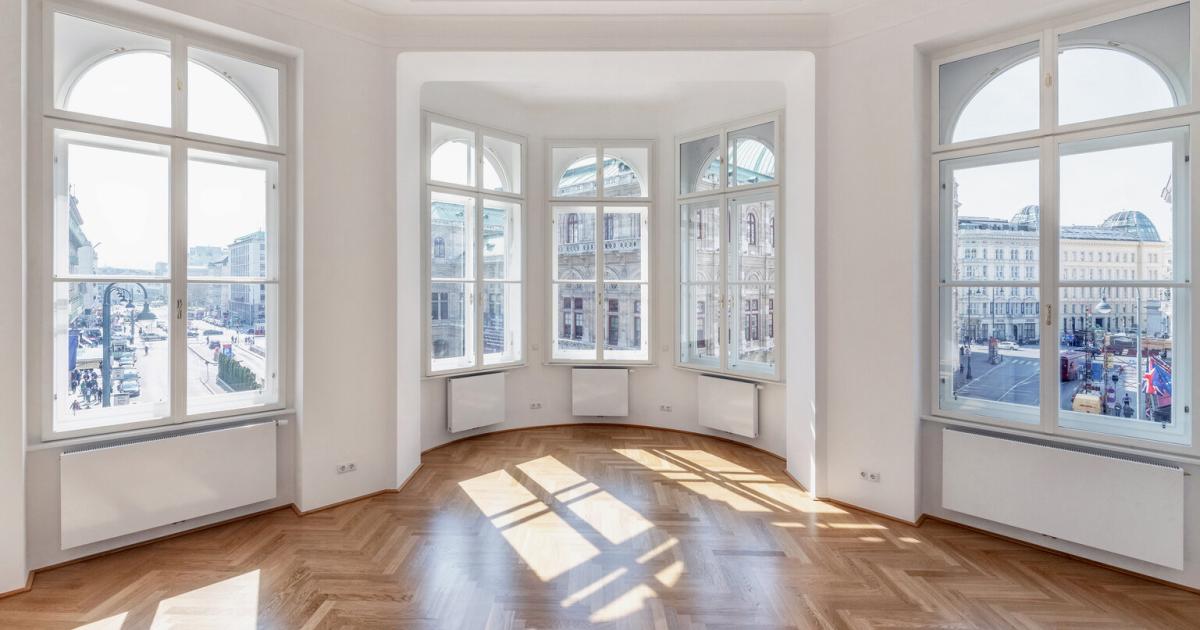
The Vienna City Hall has them, as does the Mirabell Palace in Salzburg. But also numerous apartment buildings in Austria’s cities as well as palaces from the Wilhelminian era: Box window are among those silent protagonists Austrian building culturewhich have held their ground for centuries. Two wings, two levels, around 13 centimeters of air between them – a construction that seems traditional at first glance, but is surprisingly modern at second glance. Because behind their often handcrafted wooden frame is a small air conditioning system that has worked reliably for centuries. And that’s exactly why box windows are a topic again today, “because they can do more in terms of energy and ecology than many people realize,” say the experts.
Thoughtful craftsmanship
The basic principle is quickly explained: a wing that is sealed on the inside and ventilated on the outside in a controlled manner, with a space in between that works like a natural buffer zone. “The construction is very simple, but offers everything you need. This is craftsmanship with grand skills,” says Christopher Schaden of the Window workshop. This simplicity makes the system robust and modernizable. Nowadays, box windows can be optimized to achieve astonishing insulation values without changing their historical shape. Damage: “For casement windows, you can easily assume a lifespan of around 100 years. Modern insulating glass windows are designed for 30 to 40 years.”
Georg Luxarchitect and expert from Viennese comfort windowexplains how the energy improvement works in concrete terms: “Inside, the window should be as tight as possible. Outside, however, you need a moderately ventilated level. This is particularly important in the heating season – for component safety as well as to avoid condensation.” This balance creates a system that retains heat but allows moisture to escape – an advantage that many modern designs only achieve with great effort. “Optimizing the tightness has the greatest effect,” adds Helga Noack von DenkMalNeo. “Almost tight on the inside, controlled open on the outside: This increases energy efficiency without losing the physical character of the building.”
One of the biggest misunderstandings is the assumption that historical windows cannot be saved from an energy perspective. In fact, if they are properly renovated, using insulating glazing or new vacuum glazing, they can achieve U values of around 1.0 W/m²K, as Lux emphasizes. “In combination with modern technology in the interior window, the box window can be largely preserved and energy consumption can be reduced by up to 60 percent.” Many houses achieve efficiency standards that are hardly visible from the outside.
More harm than good
Things sometimes become critical when well-intentioned personal initiative comes into play. “The box window then quickly ends up in the rubble container,” says Noack. And this is usually only because “the functional principle of the box window was ignored, incorrect sealing profiles or coatings such as synthetic resin paints were applied or the sashes were even replaced prematurely. “All of this can be avoided by following a simple basic rule: care for, repair and only work with breathable, suitable materials.”
And what about comfort, operation and suitability for everyday use? Ultimately, many owners want solutions that preserve the historical character but function as easily as modern windows. Georg Lux: “The interior window can now be designed to be very slim, with concealed and adjustable fittings and two sealing levels.” This creates a hybrid component: historical substance on the outside, contemporary comfort on the inside. Also the topic Sun protection – a problem for a long time – can be solved. “Sun protection on the facade is ideal because then the heat input doesn’t even get into the component,” explains Christoph Schaden. “Here, window bars (shutters) or roller blinds can drastically reduce the overheating of interior spaces. This knowledge is not new either, it just needs to be reinterpreted.” Where this is not possible, internal roller blinds or fabric systems that do not hinder moisture circulation can help. In any case, external blinds require careful planning to ensure that the frames and reveals are not damaged.
At its core, it all comes down to one attitude: preserving what has substance and improving where it makes sense. For Noack, box windows are a key component of sustainable renovation of old buildings. “They are not the compromise, but the best solution.” Both in terms of ecology and aesthetics.
https://fairygodboss.com/users/profile/seEum9Mtax/Tahie-Rat
https://coolors.co/u/tahie_rat
https://leetcode.com/u/1x619yrQFJ/
https://anyflip.com/homepage/azugo
https://www.slideserve.com/Tahie
https://doodleordie.com/profile/tahierat183
https://www.openstreetmap.org/user/tahierat183
https://www.skillshare.com/en/profile/Tahie-Rat/818634183
https://www.futurelearn.com/profiles/23007181
https://www.fuelly.com/driver/tahierat183
https://kuula.co/profile/kl45201
https://app.smore.com/n/sh7rj-the-weekly-update-4
https://www.gps-sport.net/users/tahierat183
https://wallhaven.cc/user/tahierat183
https://slides.com/tahierat
https://s.id/V0be0
https://www.mindmeister.com/users/channel/129591450
https://linklist.bio/minikmucize
https://www.demilked.com/author/tahierat/
https://telegra.ph/minikmucizecom-02-01
https://www.domestika.org/en/tahierat183
https://band.us/band/101456920/post/1
https://www.longisland.com/profile/tahierat183
https://www.mixcloud.com/tahierat183/
https://twitback.com/0888ba175