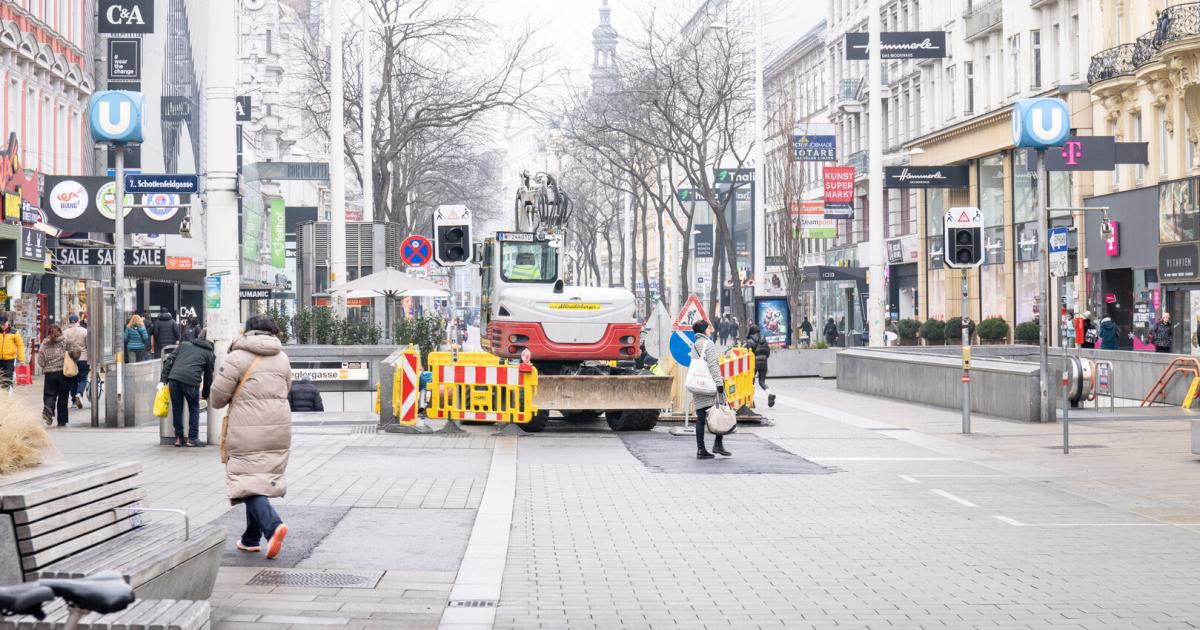
The machines are rattling, the building rubble is gathering dust. Up to the place of human rights at the bottom of the Mariahilfer Street The construction site of the former Lamarr shell can be heard. The oversized gap dominates the streetscape on Austria’s most important shopping mile – and Mariahilfer Straße also has to contend with construction sites elsewhere.
For example, with a whole row of empty shops on the other side of the street. Here only the old signs remind you of the Caritas shop Carla, the design shop Kare or the decoration retailer Butlers. A business premises is daubed with graffiti. On the other, “commercial space for rent” is emblazoned on the windows in large letters.
Construction site as a neighbor
Nevertheless, one person was specifically drawn to this area: in June 2025, the local bookstore chain Morawa opened a three-story branch – including a coffee house. “A strategic step,” says managing director Klaus Magele to KURIER. The shop currently has a large construction site next door. The construction project by the Viennese investor Georg Stumpf is scheduled to be completed at the end of 2027. “A whole neighborhood is being created. We have secured a location for the future.”
Open/close copyright notice
© kurier/Martin Stachl
Klaus Magele, Morawa managing director.
A consideration that Regiodata managing director Wolfgang Richter can also understand. “The average purchasing power of customers is definitely higher in the lower part, near the inner city, than in the direction of Westbahnhof,” says the head of the market research company. The vacancies are particularly noticeable at this end of the street. Calculated on the entire “Mahü”, this is in the Austrian midfield at 6.5 percent (not taking the former Leiner House into account), according to figures from Regiodata Research. In recent years, however, the vacancy rate has increased – by 2.5 percentage points within five years.
Mariahilfer Straße in numbers
Kilometers of road: Mariahilfer Straße, 1.8 kilometers long, is the most important shopping street in Austria.
70,000 passers-by visit Mariahilfer Straße every day, according to figures from the Vienna Chamber of Commerce (WKW). The direct catchment area includes around 92,800 residents and around 82,200 employees. The side streets are also becoming more popular because of the high rental costs, but are significantly less frequented.
350 shops is available on the inner “Mahü”. In 2024 there were 35 vacancies, in 2025 there were 24. The industry mix is colorful, according to WKW: In addition to clothing (26 percent) and other selection needs (18 percent), gastronomy (16 percent) also plays an important role. It is increasing especially in the fast food sector. 10 percent of the ground floor locations are service companies, 9 percent serve short-term needs. Added to this are food, health, housing, culture and leisure.
118,000 square meters is the entire sales area on the inner Mariahilfer Straße.
Just a few house numbers away from Morawa is the traditional Walter Weiss business, where personal hygiene products have been sold since 1923. Managing director Daniel Weiss is happy about the new bookstore. “Everything that opens here brings life to life. There’s nothing sadder than empty shops.” His shop relies primarily on regular customers; sales have been stagnating for some time. Moving is still out of the question for Weiss, who is the third generation to run the company: “If I’m not on Mariahilfer Straße, I can close it straight away.”
Sports retailers are bustling above Stiftgasse. Next to Intersport is JD Sports, opposite Hervis. From here the “Mahü” seems more lively. New openings bring movement to the streets. The discount sports chain Decathlon is due to open in the coming months. The Danish drugstore chain Normal is also opening a branch here in March.
Quadruple the rent
Opposite, “Technik Modern”, a small company is fighting for its business at the location. The tool business has existed since 1971 and is about to be taken over again. This is made more difficult by the landlord – an insurance company – says employee Aleks Ikic: “They want to quadruple the rent.” The retailer could not afford the increase despite growing (online) sales. “That’s why we’re fighting the rent increase in court,” says Ikic, who introduces himself to KURIER as the successor to the current shop operator.
Open/close copyright notice
© kurier/Martin Stachl
Aleks Ikic, “Technology Modern” employee.
He points to a clipboard next to the cash register. “Save local suppliers” is written on the petition. Some traders in the neighborhood have already fallen victim to the high rents. The party outfitter next door has been closed for a long time. A Steffl outlet or the Mr. Spex glasses shop were only rented on the “Mahü” for a short time.
According to the Vienna Chamber of Commerce, high rents are one of the biggest challenges facing retailers. In a prime location, they would have to pay between 150 and 200 euros per square meter. That is why there is also a trend towards smaller business premises. Areas between 30 and 400 square meters are particularly in demand. There is nothing politicians can do to protect small businesses from excessively high rents. The pricing “is the responsibility of the free market,” says a spokesman for Julia Lessacher, district leader of Mariahilf.
While the little ones are struggling, the chain stores are apparently doing better. The fashion chains H&M and C&A each have two branches on the inner Mariahilfer Straße. The shoe retailer Humanic operates three locations. In the building of the former Zentralsparkasse, on the corner of Neubaugasse, the H&M brand Arket opened its first local store last spring after years of vacancy. Tchibo also opened a renovated branch opposite last autumn. The chain wants to meet changing customer needs. Mariahilfer Straße is increasingly developing from a shopping street into a place where people spend time and stroll. Today, customers “want more than just shopping, they are looking for experiences,” says the KURIER.
Open/close copyright notice
© Kurier Graphics
A map of Mariahilfer Straße
Short-lived gastronomic trends
The development is also reflected in the industry mix. According to Regiodata research, the catering share has increased in the past. However, there are only very few high-quality gourmet establishments. Instead, fast food joints and small trendy restaurants are spreading. From Korean snacks to Hawaiian bowls and matcha tea to lavishly decorated cinnamon rolls, there is everything that can be photographed well for social media.
In the middle of these trendy restaurants is the oldest shop on the street: the Miller stationery store, which has been in the same location for 160 years. A cost advantage, as managing director Georg Mosler reports: “We have an old, comparatively cheap rental agreement. We couldn’t pay the current standard rent.” And that despite the fact that he is satisfied with his sales. He has regular customers from different generations. When the KURIER visits his shop, a mother and her young daughter are choosing the very first fountain pen. When asked why she prefers to go to a specialist store rather than to a large chain, she says: “Here you get personal advice.”
Open/close copyright notice
© kurier/Martin Stachl
Tommy Waldes, employee M. Gibian.
These are also available in the two M. Gibian skate shops on Mariahilfer Straße. Nevertheless, times are “tough,” says Tommy Waldes, who has been working here since the 1990s. Online competition in particular is causing problems for traditional businesses. “For us, the frequency depends on the weather. If it rains or snows, there’s quickly nothing going on. You don’t have that problem on the internet, where the sun always shines.” Waldes is in the shop above Webgasse six days a week. “We used to have several employees. Now it’s just me.” The personnel costs are too high. Now only his dog Milo keeps him company on bad weather days.
At the Mauerer hat shop, managing director Michael Runge is satisfied with the customer frequency. He is bothered by the declining purchasing power of people on the “Mahü”. This is related to the opening of several discount chains. For example with the low-cost provider Action in the Gerngross department store or the Woolworth branch. “If another discount store opens here, then the street will be dead,” says Runge.
Open/close copyright notice
© kurier/Martin Stachl
Michael Runge, boss of Mauerer Huts.
Runge is also annoyed by inconsiderate cyclists and demonstrations that take place regularly on Saturdays. Both problems are also known to the district leader of Neubau, Markus Reiter (Greens). To slow down bicycle and electric scooter riders, the city installed floor markings in November. “Drive slowly,” is written in blue on the ground next to the subway construction site that narrows the road. Regarding the demonstrations, Reiter refers to the state police department: “The problem affects all inner-city shopping streets. You would have to exert more influence on the applicants so that they choose a different demo route.”
Ikea brings frequency
The belt forms the end of the inner Mariahilfer Straße. Since 2021, Viennese people have been able to shop car-free furniture in a seven-story Ikea store. The concept “worked very well,” says Ikea. The surrounding businesses would also benefit from the frequency that the furniture store brings. At the same time, Ikea is hardly dependent on developments on the inner and outer Mariahilfer Straße.
Open/close copyright notice
© Kurier Graphics
The latter wants to make the city more attractive through renovations since 2024 – for example with more trees or cycle paths. The first construction phase was completed in July 2025, and the second phase is scheduled to continue from spring. But it will probably take some time before a promenade is built here. Also because there are no large, well-known dealers. Unlike within the Belt, small businesses still dominate here today.
The problem with the homeless on the Mahü
The residents are only partially satisfied with the situation on Mariahilfer Straße. In a KURIER regional survey, less than half of those surveyed from the sixth and seventh districts said they were satisfied with the mix of shops and the quality of stay on the “Mahü”. Many residents are bothered by vacancies, the often dangerous traffic situation in the meeting area and construction sites whose completion has been delayed for years.
There is also the issue of homelessness, which has been discussed for years. Homeless people in building entrances or in front of shops repeatedly lead to complaints from neighbors and business people. According to Caritas, the situation is quiet in the winter months. Only a few homeless people would spend the night on Mariahilfer Straße. They are all well equipped and are regularly looked after by street work teams.
The situation will worsen again in the spring when the emergency shelters close, said Markus Reiter, Neubau district leader. Then more homeless people would be seen in the city again and would primarily seek protection in heavily frequented areas. The situation can only improve by solving structural problems.
The district council from the sixth district says that Mariahilfer Straße is one of the places in Vienna best looked after by street workers. We are constantly working on reducing the number of nights spent on the streets.
https://justpaste.me/pZMR1
https://apunto.it/user/profile/611798
https://jbcasinobe.com/fr-be/football/
https://pinco-canada.net/pinco-aviator/
https://doc.dcrich.net/s/8oyZaR0KdG
https://hedgedoc.dezentrale.space/s/26gQ2f1xpd
https://justpaste.me/qAZX2
https://pinco-ca.net/fr-ca/politique-de-confidentialite/
http://www.neighborhoodlink.com/people/KeelydgRichards
https://writexo.com/share/fb843972710f
https://forum.lexulous.com/user/farmacias24horas
https://md.cortext.net/s/ecMQNsfa5
https://penalty.in.net/penalty-predictor/
http://megapari-egypt.org/live-casino/
https://jbcasinobe.com/nl-be/android/
https://hedgedoc.dn42.eu/s/kyge-3x4h-
https://vortexgame-argentina.com/juego-responsable/
https://jbcasinobe.com/fr-be/connexion/
https://www.newsocialbookmarkingsite.com/story/el-ajo-un-ingrediente-que-une-a-productores-y-consumidores
https://hackmd.hub.yt/s/U9sZK7Usr
https://ssnote.skku.edu/s/Vm9kuV2RN
https://pinco-canada.net/app/
https://trueluck-global.com/de-de/registrierung/
https://www.credly.com/users/clubzephyr1
https://www.pinterest.com/pin/1062075524638746294