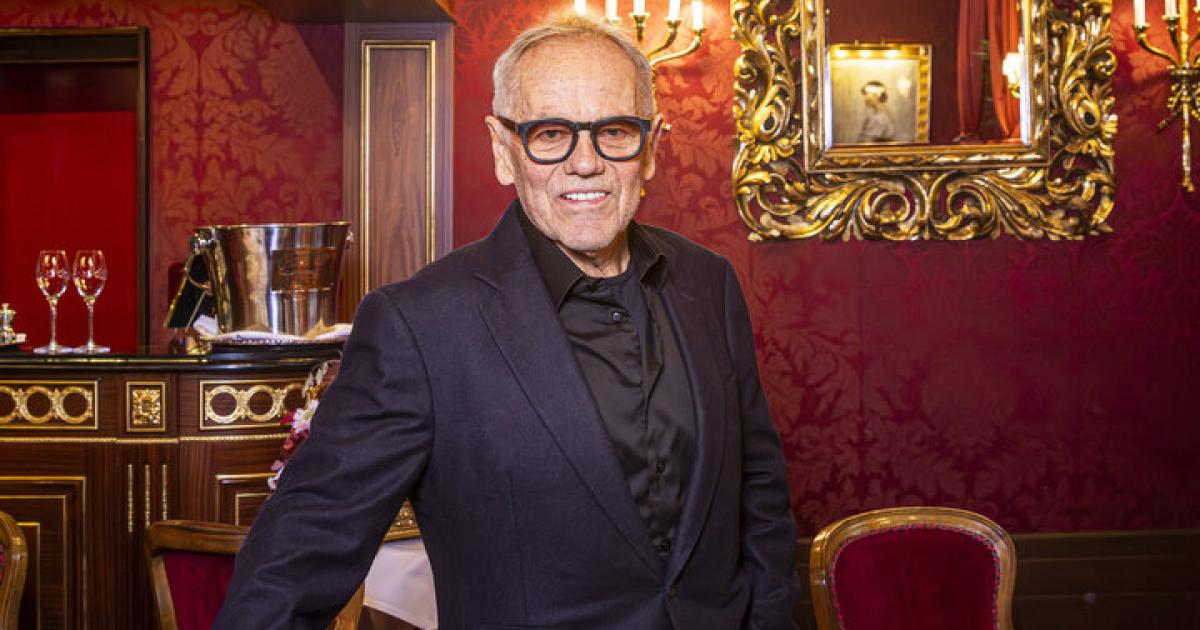
Wolfgang Puck is an Austrian gastronomy legend. He created Spago in Los Angeles, cooks for Hollywood stars, and caters for the Oscars and the Superbowl. He came to Vienna via London, and every time he lands he visits one of his restaurants – they are all over the world.
KURIER: Mr. Puck, you moved out in the early 1950s – is Austria still home for you?
Wolfgang Puck: Much more now than when I was young. I was a rebel back then. I never wanted to come home because of my stepfather. I thought to myself at the time: If I had a Mercedes, I would drive it through the front door and through him. I left when I was 14, I had to.
Are you still Austrian?
Yes, of course. I don’t feel like a foreigner in Austria. But because I always speak English or French, it takes a few days until I find my way back to Carinthian.
How do you find the food in Austria?
There are great restaurants here, the Steirereck, the Landhaus Bacher. But you know: I’m not sitting around eating a 24-course meal. This is taking too long for me. I have to be gone again in two hours, I don’t have any more time.
You’ve been catering at the Oscars for over 30 years: What was served in the early days and what today?
The difference is that it used to be a black tie dinner. Very formal, sedate, stiff. It was also determined who sat where. We then made it more relaxed, no longer satiated, and served chicken pot pie with truffles. Everyone loved it and it became our standard. You can also easily cook it for 1,500 people. Today we serve macaroni and cheese, chinoise lobster or pizza with smoked salmon and caviar. Food is constantly served. Most people are very hungry because they don’t eat lunch.
Open/close copyright notice
© courier/Wolfgang Wolak
Is it easy to please Hollywood celebrities?
Probably. Some are demanding, especially because they want everything quickly and immediately. I always make sure there is enough Dom Perignon and enough caviar. That always works. We often go into the kitchen with the stars and eat there. Like at home.
There are also trends in kitchens. There was Nordic cuisine for a long time, now Latin American cuisine is there. What’s next?
I can only speak for Los Angeles and Asian cuisine is very present there. I do that too, but in my own way. Add my style. Asian was really big many years ago and it’s getting stronger today. This also has to do with the fact that Los Angeles is closer to Asia than to Europe. We don’t have anything French at all in LA, it doesn’t suit us either, it’s not fun enough.
They have built an empire. With fine dining, catering, franchises and products. What works best?
I must correct you: I have a small family business, not an empire. The most lucrative for me is fine dining. That’s where my full passion lies. Catering has become very big, we were at the Super Bowl and cooked for 9,000 people. We’re at Formula 1, cooking for Google, Apple, Sony, Netflix. It’s lucrative, but it’s not me. My brother runs the airport restaurants, the franchise. Yesterday we went for a schnitzel in Vienna-Schwechat.
How much puck is in their chain and is the franchise dangerous for quality? We have different areas and each category has different requirements. But the same applies at the airport: We have to make a really good pizza and a really good Caesar salad. People realize that it’s not the luxury place at the airport. Although it is already expensive there now. In LA I pay at least $30 an hour for staff, which is my lowest salary for the dishwasher. Personnel costs have also risen immensely in America.
They have 500 million euros in sales, more than 100 restaurants, more than 5,000 employees. You are a passionate entrepreneur. Where does that come from? I opened Spago in 1982 and it went well from the start. The food was good, the kitchen was open, it was always fun. People have to feel comfortable. It was always pretty loud in Spago and there was always something going on. With this atmosphere and the guests came the offers to open more restaurants – even in Japan. I declined at the time and was of the opinion that I couldn’t even run a restaurant properly. Others convinced me. So one thing led to another. So I just took advantage of opportunities.
When you left home at 14, who or what opened the world to you?
I went to France because there was a French week at the Villach Parkhotel and we were poached. It was fascinating: Back then they cooked with wine, with snails, they made pies and brought salmon. Not just Wiener Schnitzel, natural schnitzel and Jägerschnitzel. I wanted to go to France because I wanted to see how it all works. Then I went to Raymond Thuillier’s at Baumanière. I was with him in a small village in Provence. He opened my eyes. He became my mentor, I wanted to be like him.
The Empire of Wolfgang Puck: Restaurants, Oscars and Superbowl
Wolfgang Puck isn’t big, but he’s one of America’s greatest chefs. He’s not loud, but he always has the best atmosphere. And he seems humble, even though… Dom Perignoncaviar and Fiji water are important – not just for the guests, but also in your own fridge.
“It has to be funny,” says Wolfgang Puck. With his openness and warmth, he has attracted Hollywood stars since the 1980s. But his gastronomy empire was created primarily through his flair for business. Spago in Los Angeles, which opened in 1982, quickly developed into other restaurants around the world. Today, Spago has locations in Las Vegas, Maui, Singapore, Budapest, Istanbul and Riyadh. Other restaurants include Chinois, Cut, Carama, Merois and Ospero. Often on Puck’s menu: Wiener Schnitzel and Carinthian Kasnudeln.
Puck is also known for his catering. Over the years, the Oscars have created a branch of the company that caters for huge events and well-known companies. Most recently, Puck hosted the Super Bowl at Levi’s Stadium in Santa Clara, California. At the upcoming Oscars on March 15th, he will be catering the so-called Governors Ball with 1,500 guests again for over 30 years now. Then there is the franchise chain that the brother runs. These are cheaper places in airports, hotels, shopping centers. The portfolio is rounded off by products such as tableware and knives.
Half a billion
The Puck empire, with more than 100 restaurants, fine dining and catering, has annual sales of more than $500 million. The companies employ 5,000 people. The Carinthian, who moved to Los Angeles, is estimated to have a net worth of $120 million. Puck’s son Byron works with us and could one day take over.
Wolfgang Puck is currently implementing a new project. A ship-shaped beach house designed by Frank Gehry is scheduled to go under construction at the end of the year. To do this, Puck signed a 50-year lease on a beachfront property in Pacific Palisades, where the famous Gladstone’s Restaurant stood. Investment costs for the construction with two restaurants: 60 million dollars.
Nevertheless, you soon left high French cuisine and went to America. Why actually?
Because it fascinated me. The climate is different, everything is possible in America. I could serve raw tuna in Los Angeles, which was unavailable anywhere. Or lobster spring roll or Chinese Peking duck my way. It was difficult at the beginning, but we have reinvented Californian cuisine: down-to-earth, with influences from all over the world, reinterpreted.
Where do you get the strength to keep going? You could also lie comfortably by the pool.
That’s boring. If you don’t work, you get old. When you are no longer interested, no longer curious, no longer want to learn, what do you do? On Saturdays I get five paper newspapers home. This is my only break. Otherwise I keep moving and follow my passion.
They have a lot of drive and have achieved great things. One has the feeling that this drive is sometimes missing today.
Young people often miss that today. I still have the drive, but I also understand that not every person is the same, wants to be an entrepreneur or wants to take risks.
Speaking of risk: They’re building a new restaurant on the beach in LA.
True. I was friends with the architect Franz Gehry, who has just died. He designed our restaurant on the beach and we will start construction at the end of the year. I signed a 50-year lease on the property – even though I know I probably won’t live to see it.
We’re talking about a hundred million dollar investment.
It’s about $60 million. Hopefully not anymore, otherwise we’ll be bankrupt before we start.
In Austria there is a lot of talk about the high prices in the catering industry. How much can good food cost? Today, fine dining is more casual and relaxed, but there are people sitting there who still drive Mercedes or Rolls Royces. You have to create an experience for them that they say was worth the price. If you really feel comfortable, the price is not important. And to be honest: it’s usually the wine that causes the bill to explode. I have a friend from Canada, when he eats at my place with his family the bill is always between $15,000 and $20,000. But because of the wine, because you can’t eat that much.
44 years of Spago in LA. What makes the restaurant still successful? We have tradition and innovation and redesign the ambience every ten years. It’s important that people always find something new on the menu, otherwise they’ll get bored.
In the past, kitchens worked with drill and a lot of staff. Is that still the case today?
In the higher end, yes. But the boys don’t learn to cook in places like Noma or Eleven Madison in New York. You only do a tiny area of a plate at a time. The drill like there used to be no longer exists. When I learned it was very strict. With punches and kicks. The boss didn’t care if they were girls. Fortunately, that has changed.
Do you find chefs easily?
Cooking has become a popular profession thanks to television. People see that a chef can have his own business. Now you get young, smart people, that wasn’t the case before.
When you look back on your life’s work: Why have you been so successful?
If I knew that, I would bottle it and sell it. In the end it’s always a lot of work, risk and the desire for more. You also have to be able to hand things over to others and have trust. A bit of talent and passion are certainly part of it. I’m flying home on Friday and going straight to my restaurant. On Saturday and Sunday we’re doing events and of course I’m there too.
http://ask.mallaky.com/?qa=user/jewelhair7
https://intensedebate.com/people/toyrat6
http://muhaylovakoliba.1gb.ua/user/jewelpaste9/
https://a-taxi.com.ua/user/carrotrat9/
https://aryba.kg/user/donnasun5/
https://yutoriarukyouikujouken.com:443/index.php?burmaregret8
http://csmouse.com/user/puffindream0/
https://skitterphoto.com/photographers/2219335/hendricks-ernstsen
https://p.mobile9.com/stickkevin5/
https://sonnik.nalench.com/user/puffinpower4/
https://apunto.it/user/profile/599892
https://platform.joinus4health.eu/forums/users/forcepaper1/
http://humanlove.stream//index.php?title=thyssenmays8031
https://panoptikon.org/user/mailreason5/
https://actualites.cava.tn/user/thronepaper4/
https://tvoyaskala.com/user/seaoil0/
https://atesoglusogutma.com/user/maidoil7/
http://uchkombinat.com.ua/user/maidrat0/
http://semdinlitesisat.eskisehirgocukduzeltme.com/user/donnashorts8/
http://dudoser.com/user/stickpart8/
http://kriminal-ohlyad.com.ua/user/burmafight9/
https://itkvariat.com/user/weaponcent3/
https://mehmetnuriarslan.com/user/goatspruce5/
https://invastu.kz/user/actionjune4/
https://oren-expo.ru/user/profile/831396