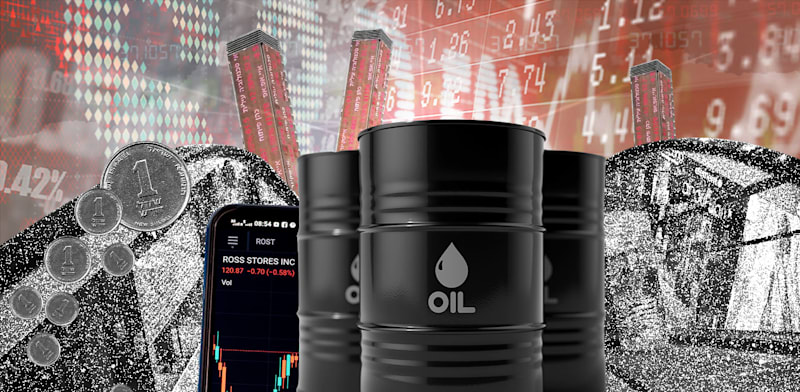
The world trading week opened with sharp declines against the background of a daily jump not seen in almost 40 years in the price of oil. At a time when oil is already crossing the $110 mark, a free fall was recorded in Asia and in the USA trade opened with declines. The declines in oil moderated to around $102 after a report that the finance ministers of the G7 countries are discussing the possibility of a joint flow of oil from the strategic reserves, in coordination with the International Energy Agency.
According to Ronan Menachem, Chief Market Economist at Mizrachi Tefahot, the danger that brings down the markets is the return of inflationary pressures. “The containment of inflation – which was achieved with great effort by a series of sharp and continuous interest rate increases – could be eroded by a jump of a few days in energy prices. As a result, the black gold may turn into a black swan and bring the world economy closer to a situation it has not known for years – stagflation.”
Menachem explains that: “After sharp increases, which reflected a working assumption that the best result – the removal of Iran and its metastases from the political-security and economic equation – would be achieved within a period of time, the military personnel and experts are signaling that the campaign could take several weeks and take a toll. As a result, the markets began to falter, the enthusiasm was curbed and in some cases we are witnessing significant declines, which now reflect the obstacles that may appear on the way.
Aside from the fear of obstacles, the lack of knowledge of how the fighting will develop – with an emphasis on the short term – causes the economic agents – households and companies – to delay large expenditures on sustainable products, equipment, machinery, expansion of production lines, and more – until the picture becomes clearer.
The world is also reacting to the upheaval. Senior strategist Ed Jordany raises his probability of a collapse on Wall Street later this year to 35% amid what he describes as “quickly changing times.” In the previous forecast, Jordan gave only 20% to this.
“The US economy and the stock market are currently stuck between Iran and a difficult place. So is the Fed,” Yordani wrote. “If the oil shock continues, the Fed’s dual mandate will be stuck between the growing risk of higher inflation and rising unemployment.”
For your attention: The Globes system strives for a diverse, relevant and respectful discourse in accordance with the code of ethics that appears in the trust report according to which we operate. Expressions of violence, racism, incitement or any other inappropriate discourse are filtered out automatically and will not be published on the site.