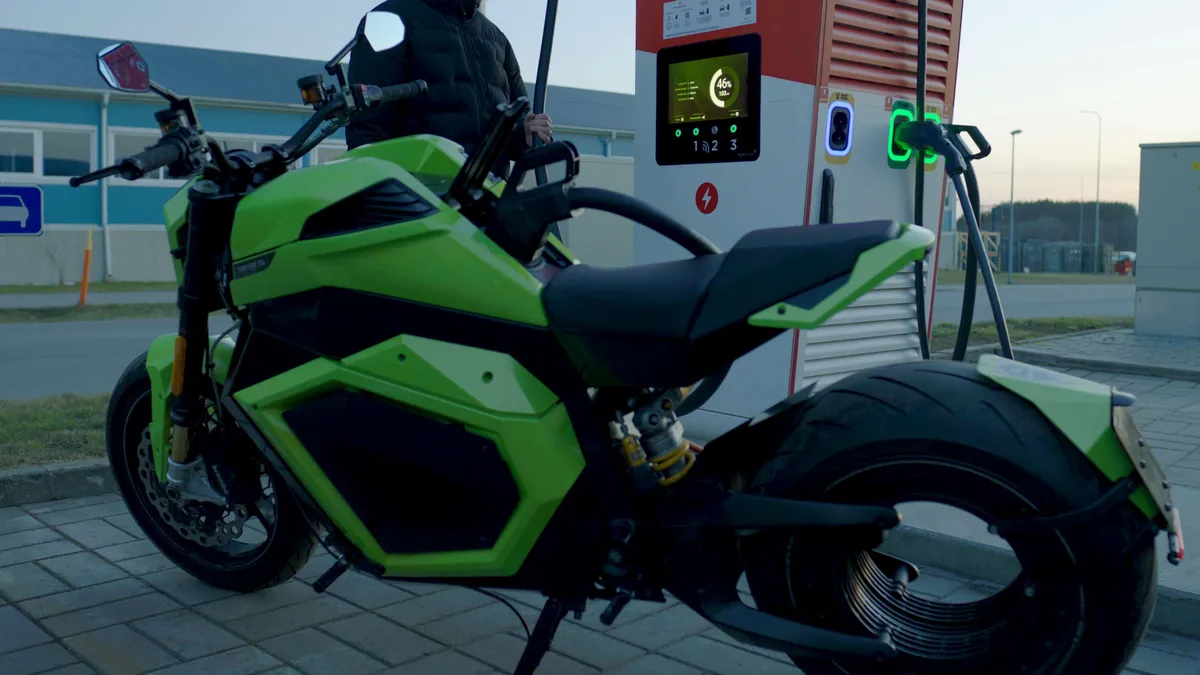
Now, in the fourth announcement, the company is publicly presenting for the first time the functionality of the battery in a vehicle at the battery pack level, in other words, in the Verge electric motorcycle connected to Donut Lab.
In its announcement, Donut Lab boasts that exceptionally fast charging of less than ten minutes is possible for a motorcycle. In the fast charging test, Verge’s previous generation motorcycle was used, with a new year model battery pack installed, in other words, the miracle battery from Donut Lab.
The nominal capacity of the battery pack is multiplied by 18 kilowatt hours. Donut Lab says that the battery pack charges three times faster than Verge’s previous battery. According to the release, the results will be even better after the optimization performed by Verge.
In Donut Lab’s test, the motorcycle battery was charged with a public fast charger. The company says that the temperature of the battery pack at the beginning of the test is around 20 degrees Celsius. During the charging session, a peak charging power of more than 100 kW (5C charging speed) is maintained for five minutes, during which the bike’s battery charge rises from 10 percent to 50 percent charge level.
Charging curve.
The picture shows the charging curve published by Donut Lab for the Verge TS Pro motorcycle. The charging curve looks like a fairly typical fast charging curve for an electric car battery. In the initial phase, the power has been cut, because the speed remains exactly at the 100 kW level.
KUVA: Donut Lab / Youtube
The release states that a charge level of 10-70 percent is reached in just over 9 minutes, and 10-80 percent is reached in 12 minutes. In the test, the bike reached a speed of 5C, which is a really creditable reading for an air-cooled motorcycle battery.
– This is the first test we have released to the general public, which demonstrates the performance and behavior of several battery cells in a real vehicle environment. The high energy density of our battery technology enables flexible design of battery packs and superior performance even in more challenging applications, such as motorcycles, where space is limited and system simplicity is key. We are able to offer vehicle manufacturers packages of different sizes in terms of energy capacity in the same physical size, even the smallest of which are very large in capacity, says Donut Lab’s technology director Ville Piippo.
Download session with video
The video published by the company shows how the charging process goes. The behavior in the video corresponds to the figures in Donut Lab’s announcement. The battery reaches 80 percent charge level in 12 minutes. Donut Lab does not tell you the average charging power, but it can be calculated based on the amount of energy charged and the time used. In this case, the average power of a 10–80 percent charging session will be 69.3 kW.
Measurement.
In the attached screenshot taken from a Donut Lab video, it is shown how Verge’s motorcycle is charged with a fast charger.
KUVA: Donut Lab / Youtube
The download session looks believable in the video at first glance. According to our experience, the charging screen of the charger brand in question is just shown in the video. The close-up camera of the loading screen is not visible in the shot from further away, which would indicate that the sessions were recorded at different times.
Verge’s factory is located in Estonia. Judging from Donut Lab’s video, the motorcycle charging test was done at the Irun Circle K station in Tallinn, which is the geographically closest station as seen from the Verge factory building.
No VTT report at all
Donut Lab previously strongly implied that the company’s test series would only apply to VTT test reports. Now, however, the fourth test is not related to the VTT report in any way, and this time the VTT report cannot be downloaded at all on the company’s Idonutbelieve website. A new counter started on the website after a week, which means that even more video reports are coming.
The report published last week was quite anticlimactic in the eyes of the general public. The report only proved a single myth, namely that the Donut Lab battery is not a supercapacitor. Analysts agreed on the tests. Research and development manager of Seinäjoki University of Applied Sciences Juho Heiska already stated based on the first report that it is not a supercapacitor. In other words, the third test was pointless in retrospect.
Problems in previous tests
In the tests conducted by VTT, everything did not go exactly according to the script set by Donut Lab. In the first test, which measured the charging speed of the battery, the Donut Lab’s battery got very hot, and the test had to be stopped. In another, hot-condition charging test, the Donut Lab’s battery pouch cell lost its tightness.
In VTT’s laboratory tests, there have been variables that Donut Lab itself had not expected. However, points must be given to Donut Lab for having made the reports public as they are, and also told openly in their own communication about, for example, cheating the bag cell.
In Donut Lab’s battery test, something happened that was not expected or hoped for – “A side reaction triggered in the cell”The Verge motorcycle needs a new battery more than everDonut Lab’s third battery test disproved a persistent myth – Expert: It could have been said from the first test