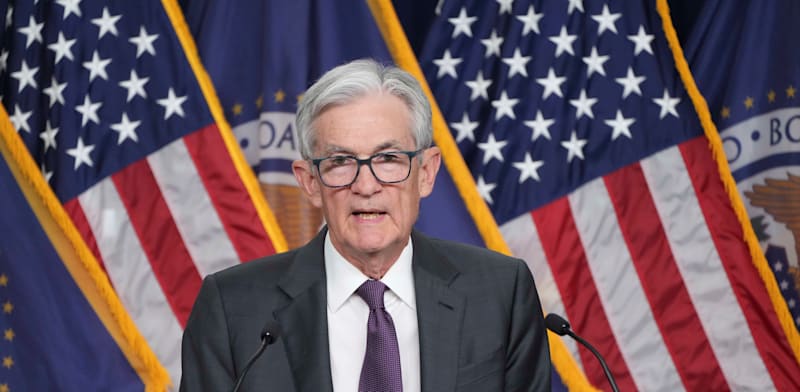
The Federal Reserve announced this evening (Wednesday) its decision to leave the interest rate unchanged at a level of 3.75%, in accordance with early estimates. The market is now waiting for the press conference with chairman Jerome Powell that will start soon, in which he is expected to address the possible inflationary effect of the rise in oil prices and the bank’s forecasts regarding inflation, the labor market and the entire American economy.
At the press conference following the decision, Fed Chairman Jerome Powell noted that “near-term indicators of inflation expectations have risen in recent weeks, apparently as a reflection of the significant increase in oil prices caused by supply disruptions in the Middle East. In the near term, higher energy prices will push up overall inflation, but it is too early to know what the extent and duration of the potential effects on the economy will be.”
Powell clarified that “our monetary policy is not on a predetermined course, and we will make our decisions based on the information we will have from meeting to meeting.” As for inflation, he noted that “the forecast is that we will make progress in dealing with inflation, not at the level we were hoping for, but some progress with inflation. This should happen when in the middle of the year we begin to see progress on the issue of tariffs… a one-time effect that goes through the system, followed by a decrease in inflation resulting from the tariffs.”
Powell added that “the interest rate forecast depends on the performance of the economy, so if we don’t see this progress, then you won’t see this interest rate reduction.”
The decision to leave the interest rate unchanged was accepted by a large majority of 11-1, with the only one opposing the decision being Fed Governor Stephen Mirren, who preferred a quarter percent interest rate cut. In its decision, the committee noted the uncertainty arising from the war against Iran, and wrote that “the consequences of the developments in the Middle East on the American economy are unclear.”
Despite the increased level of uncertainty, Fed members signaled that they still expect several interest rate cuts in the coming period. The Fed members’ dot plot, which reflects their outlook for the interest rate outline, indicated one rate cut this year and one more during 2027, although the timing of these moves remains unclear.
CNBC reports that out of the 19 members of the committee, seven signaled that they expect the interest rate to remain unchanged this year. While in the context of the years ahead, Fed members presented a relatively wide range of forecasts, the average forecast is for a further reduction in 2027, after which the interest rate will stabilize around 3.1% for the long term.
Expectations in the markets for interest rate cuts this year have been cut dramatically
Among the analysts there was a broad consensus that the central bank would adopt a “wait-and-see” approach, in view of the war against Iran and the fears of an inflationary outbreak – these were recently intensified by the surge recorded in world oil prices, as a result of the blockade of the Straits of Hormuz. Deutsche Bank analysts wrote in a message to investors this week that the bank’s economists expect the central bank to emphasize in its decision an “increased level of geopolitical uncertainty”, but believe that it will “avoid responsibility for a significant change in the policy outlook for the near term”.
Following the sharp jump in oil prices, the concerns registered in the markets about a scenario of stagflation – a combination of an economic slowdown alongside rising inflation – have increased in recent days. In light of this, expectations in the markets for further interest rate cuts this year were almost completely cut. The Financial Times reported at the end of last week that according to trading in futures contracts on the Federal Reserve interest rate, the markets are now not pricing in a full interest rate cut until the summer of 2027.
Gennady Goldberg, head of US interest rate strategy at TD Securities, told the financial website that “it was a crazy change. The market went completely crazy and decided to cut a lot of interest rate cuts in its pricing. This huge move is a function of the fact that the market is betting that it will be difficult for the Fed to cut interest rates while oil prices remain high.”
The wedge between the hammer and the anvil
Before the outbreak of the war against Iran, the markets priced in at least two interest rate cuts during 2026, when there were also analysts who expected three interest rate cuts. These expectations were based on the premise that the Fed would prefer to focus in the coming period on addressing the recent weakness in the American labor market, rather than on the recession of inflation. We will remind you that the weakness in the labor market was also the main reason thanks to which the Fed made three consecutive interest rate reductions at the end of last year.
The employment report for the month of February published in the US was a surprise, with a decrease of 92,000 jobs, compared to analysts’ expectations of an increase of 50,000 jobs. At the same time, the unemployment rate rose by one-tenth of a percent to 4.4%. Although the decrease in the number of employed people was partly technical, following a strike in the health sector, which subtracted over 30,000 workers from the report, many analysts pointed out that even if there had not been occurs, it was a weak report.
Thomas Simmons, an economist at the investment bank Jefferies, earlier this month called the decrease in the number of employed in February “a perfect storm of temporary inhibiting factors that came together, after a figure higher than the trend in January.” According to him, “When you look beyond the sectors that were affected by the weather and the strike, which ended on February 23, this is still a weak employment figure. We do not think that this is a preliminary sign of a continued deterioration in the employment reports down the road, but the risk of a recession has certainly increased.”
Alan Zantner, the chief economic strategist at Morgan Stanley, wrote in a message to investors after the publication of the report that “the data may put the Federal Reserve between a rock and a hard place. A significant weakening in the labor market will support interest rate cuts, but given the risk that higher oil prices over time could ignite another wave of inflation, the Fed may feel the need to remain on the fence.”
On the inflation front, the latest data painted a mixed picture. The consumer price index for the month of February indicated that the annual inflation rate remained at a level of 2.4%, in accordance with early estimates. However, January’s PCE, the Fed’s preferred inflation measure, painted a different picture. On the one hand, the annual inflation rate dropped slightly to 2.8%; On the other hand, core inflation, which excludes the volatile energy and food prices, actually rose to 3.1%.
Ronan Menachem, the chief economist of Mizrahi Tefahot, commented on the data and noted that “the Fed has several problems. First of all – the distance to the target level of 2% (even though it is set for the consumer price index) has not been shortened for a long time. Second, the core index – which excludes the food and energy items – actually accelerated slightly to 3.1% and rose faster than the general index. Moreover: the rate of increase in the price of the service items – which are supposed to respond to the interest rate – pulls the index upwards, so that the effect of monetary restraint fades quite quickly. To this, we must add the latest employment report – which was weak on the bottom line (the line of jobs), but on the salary line it remained strong.”
Menachem added that “now, when the prices of crude oil are soaring and affecting the gasoline and fuel sections, if the goods section also raises its head, and joins the rise in the prices of services, inflation may rise again. To this, we must add the consequences of the new tariffs imposed by President Trump – despite the tariffs that the court canceled – when they too may have an expanding effect on inflation, at least in the short term.”
The word that central banks regretted in the past is coming back
The Federal Reserve is not the only central bank to meet for an interest rate decision this week, as tomorrow (Thursday) interest rate decisions are also expected to be published in Japan, the United Kingdom and the European Union. Reuters reported that this is the first time that these four important central banks meet in the same week, in over four years.
Mike Dolan, an economic commentator at Reuters, referred to the war against Iran and wrote this week that policymakers are “trapped between two competing historical narratives.”
According to him, “one lesson from the oil and inflation crises of the 1970s and 1980s was that they forced central banks to re-establish greater credibility regarding their willingness to eradicate inflation over time. Once they regained this credibility, this ultimately allowed them to ‘see beyond’ the temporary spikes in oil prices that followed, and focus instead on the economic damage.”
“The second lesson comes from the renewed momentum after the corona epidemic and the energy surge associated with the war in Ukraine four years ago – when central banks were criticized for not acting quickly enough to curb rising inflation. As a result, they had to reorganize to tighten monetary policy quickly, after Russia’s invasion of Ukraine worsened the post-pandemic inflation ‘hump’ that banks were trying to ‘see past'”. Dolan added.
In his column, Dolan also noted an “extraordinary” directive from the Bank for International Settlements (BIS), the body that advises central banks in the world, to treat the jump in inflation resulting from the current rise in oil prices again as “transitory” (originally: transitory) – a word used by central bank governors in 2021 to describe the jump in inflation after the Corona, which they have since regretted. “If it’s a supply shock, and certainly if it’s temporary, these are the classic examples of situations where you have to ‘look beyond’ and not react through monetary policy,” said the BIS’s senior economic advisor, Yoon Song Shin, upon the publication of the bank’s quarterly report.
For your attention: The Globes system strives for a diverse, relevant and respectful discourse in accordance with the code of ethics that appears in the trust report according to which we operate. Expressions of violence, racism, incitement or any other inappropriate discourse are filtered out automatically and will not be published on the site.