The war between the United States and Israel and the rise in energy prices are now having significant adverse effects on the world’s sea and air traffic, which is widely felt by sea and air freight companies.
The sea transportation of oil, fuel, natural gas and other commodities from the Red Sea is mostly at a standstill, the airspace of many countries is closed or significantly restricted, and the sharp increase in the cost of ship and aviation fuel is reflected in the price of transport routes.
“The situation is that air cargo has a lot of exceptions in terms of airspace. Airspace has been closed, and it affects the overall air cargo capacity. There (in the crisis areas of the Middle East), a lot of truck transport is currently used to cross land borders, and thus it has been possible to replace part of the air and sea transport”, the transport company’s Kuehne+Nagelin managing director Hanna Korvenpää said on Thursday at the event of the International Chamber of Commerce ICC and the Central Chamber of Commerce.
According to Korvenpää, sea freight in the region has switched to using alternative ports in the Arabian Peninsula, India and Southeast Asia, and through them the cargo is transported by trucks. This has locally started congestion at border stations, for example in Kuwait. For example, from Jeddah in Saudi Arabia, truck transports are now being carried out throughout the Middle East region.
In the Strait of Hormuz, a big obstacle to the continuation of shipping traffic has been the fact that insurance companies have refused to issue insurance for the area since the start of the war.
“The continuation of sea transport in the area also requires that the ships can be insured. Standard cargo insurance does not usually cover war risks. In the current situation, several insurers have limited or completely canceled risk coverage in the Strait of Hormuz area and the surrounding sea areas. Delays are also not insured,” says Korvenpää.
Geographically, an alternative transport route would be in the Red Sea, but in recent years the area has been largely excluded from transport use by large freight companies due to the risk of terrorism. Korvenpää says that there have been experiments to restore traffic to the Red Sea, but now that the Iran war has started, they have also ended. Even before the end of February, almost all container ships between Europe and Asia were still going through the southern tip of Africa.
The availability of bunker oil, which ships use as fuel, has seriously weakened in some regions, for example in Asia and Africa. Next week, a global surcharge for marine fuel will come into effect, for which shipping companies will also have to pay an additional price to oil refiners.
Maritime consulting company Drewry has presented a time span assessment according to which the closure of the Strait of Hormuz will cause a serious disruption to the logistics of Qatar, Bahrain, Kuwait and Iraq during the first half of the year, as well as a special risk for foodstuffs and products with regulated temperatures. A duration of 6–24 months would mean a significant increase in logistics costs and permanent uncertainty in supply chains. Construction of structural replacement routes would take more than two years.
Air traffic based on a narrow corridor
The closure of Iran’s airspace leaves air traffic between Europe and Southeast Asia on a narrow path.
Between Iran and Russia, which has already been closed to flights for a longer time, there is a route of about 170 kilometers at its narrowest, which goes over Armenia and Azerbaijan. Air traffic over this area between Asia and Europe is now very congested, as is the area’s air traffic control.
“When you want to fly to Southeast Asia, there have been two options: through the Persian Gulf or through Turkey, Armenia and Azerbaijan. At the moment, when the airspace of the Persian Gulf is closed, the narrow route between Azerbaijan and Armenia is really congested. You also fly at high altitudes there, and that also means that more fuel is needed.” Finnair Cargo manager Gabriela Hiitola said at Thursday’s event.
“This area is currently really important to us at Finnair when we talk about flights to Southeast Asia.”
Hiitola says that the strip over Armenia and Azerbaijan is now calm, but in recent years the two countries have had mutual unrest, where shots have also been exchanged.
Hiitola did not directly answer the question about whether Finnair’s flights to South-East Asia would become unprofitable if this route were also taken out of service. However, he said that it would force Finnair to plan flight routes again.
For example, on flights to Japan and Korea, especially on return flights, Finnair also uses a route from the north of Russia and over the North Pole. However, it cannot be used for destinations located further away in Southeast Asia, because they are too far away, says Hiitola.
Airlines are already canceling flights en masse
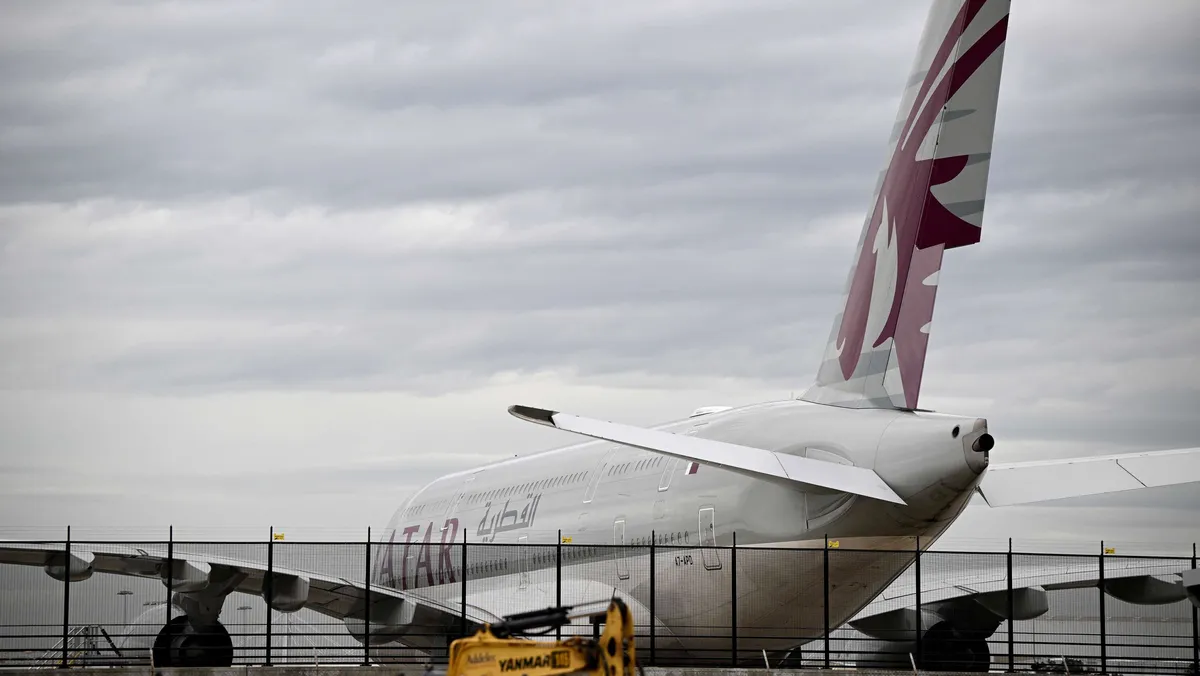
Air cargo has seen major effects on demand, as a significant part of cargo capacity has been used by Middle Eastern airlines, such as Qatar Airways, Emirates and Etihadinto be treated. Now, for example, in India and Bangladesh, a lot of air cargo remains in the queue. Freight prices on the most vulnerable routes have multiplied.
All airlines around the world are significantly disturbed by the fact that the price of jet kerosene has risen significantly, in the Far East even clearly more than the world market price of crude oil.
For example, an airline SAS announced that it would cancel hundreds of flights in March and approximately a thousand flights in April due to too expensive fuel. In Asia, for example, Vietnam estimates that it will have to cut flights in April.
According to Hiitola, SAS is one of the airlines that have hedged fuel price developments with derivative products quite a bit, i.e. about 40 percent.
“At Finnair, an average of 72 percent of the fuel price is hedged per year, but the proportion decreases towards the end of the year. This means that we will also be hit by high fuel prices later.”
THE FACTS
The Strait of Hormuz is the hub of world maritime traffic
The Red Sea connects the most important export ports of the Arabian Peninsula to the open sea, and the narrowest bottleneck is the Strait of Hormuz, largely closed due to Iran’s deterrence.
Approximately 20 percent of the world’s oil traffic and 38 percent of marine oil traffic pass through the Strait of Hormuz, as well as a significant share of liquefied natural gas and liquefied natural gas.
About 3.5 percent of global container traffic passes through the Strait of Hormuz, but up to 10 percent of the world’s cargo ship traffic.