The Donut Lab, which has raised its eyebrows with its miracle lights, has published the results of the fourth VTT test, and this time they might be unpleasant for the company. The battery has not withstood the tests, but has already lost part of its capacity after 50 charging cycles. And worst of all, a battery expert familiar with the latest results Juho Heiska is of the opinion that the results prove that the battery is probably not even a solid state battery, even though it is promised.
In the fourth test report published by VTT, the battery cell DL2 delivered to VTT was tested. The same cell was used in a high-temperature test previously published in another report. In the 100 degree temperature test, it was found that the DL2 cell had lost its vacuum at the end of the test.
Now, in the fourth VTT test, cycle tests were performed on the same DL2 cell, says Donut Lab’s press release. Donut Lab says that the structure of the battery cell used in the test uses materials and adhesives borrowed from the lithium-ion battery industry, which are not originally designed to operate at temperatures of one hundred degrees Celsius.
Donut Lab says that in the test, the battery cell was first subjected to five standard 1C level charging and discharging cycles. The battery cell worked perfectly normally and safely during these times, even though its vacuum structure was broken. Next, the cell was charged at a 5C fast charge rate for 50 cycles. During these times, the capacity of the battery cell stabilized at around 11 ampere-hours from the original 25 ampere-hours level.
Donut Lab states in its press release that many assumed the battery had completely broken down and gone into thermal runaway, which would be the likely outcome if it were a lithium-ion battery. To demonstrate battery safety in practice, Donut Lab decided to continue cycling the damaged battery cell.
“If a similar breakdown were to occur in a traditional lithium-ion battery, the consequences would be serious. The liquid electrolyte would leak out and the active materials would come into contact with oxygen, which could lead to a fire or thermal runaway. Lithium-ion batteries would no longer be able to operate after the vacuum structure breaks down. Because the Donut battery is a completely solid-state battery, it is not prone to such reactions,” says Donut Lab’s technology director Ville Piippo.
According to Donut Lab, a safe cell
Based on the test, Donut Lab wants to show that the company’s battery is exceptionally safe, even though the cell is scattered.
“The test shows that in a situation like this, even if damaged, the Donut Battery does not pose a danger to the user. Instead of catching fire like a traditional lithium-ion battery in a similar situation, it continues to operate safely at a reduced capacity. This is a concrete demonstration of the safety benefits of solid-state battery technology,” Piippo continues.
Electrochemically Game Over
Research and development manager of Seinäjoki University of Applied Sciences Juho Heiska one wonders why the hell Donut Lab went to publish this VTT report. According to him, Donut Lab’s battery behaved really badly in the test.
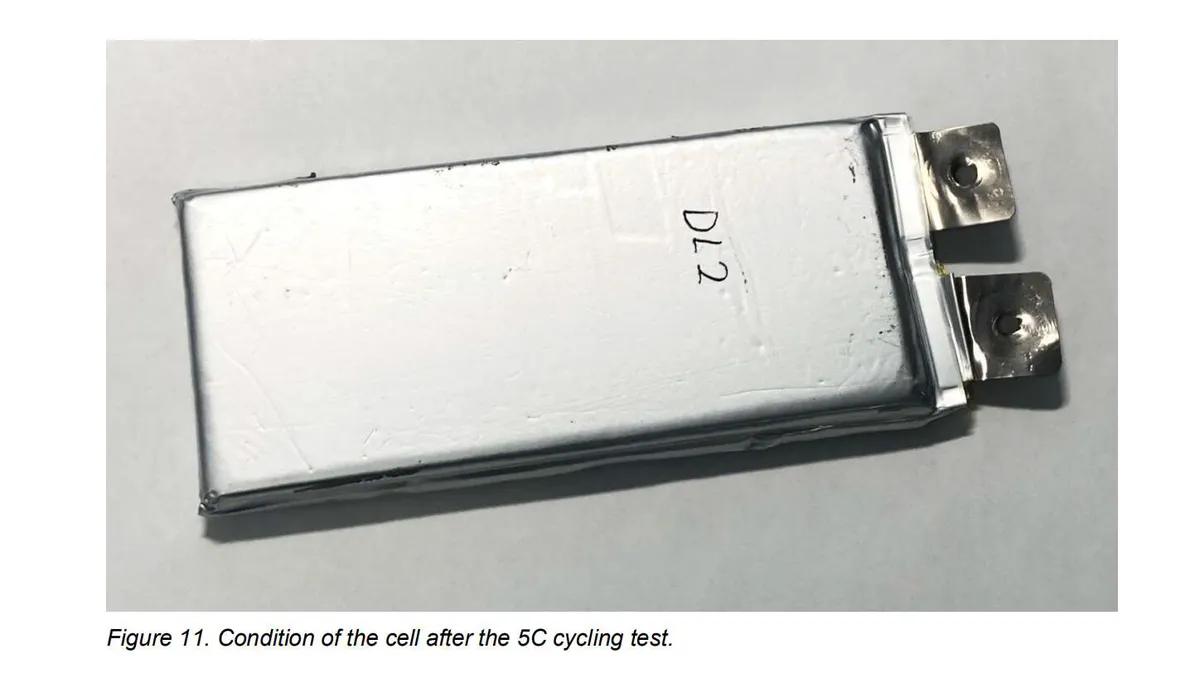
Heiska particularly drew attention to section 3.5 of the VTT report, which described the cell’s physical condition:
“Before the test, the bag cell had lost its vacuum in the previous high-temperature test at 100 °C, and the bag cell was loose and wrinkled. After the test, the cell thickness had increased by 17 percent, and the bag was stiff,” says an excerpt from VTT’s test report.
We asked Heiska what actually happened to Donut Lab’s battery in the previous test there.
“If we forget the marketing talk and look at this as a normal pouch cell, the loss of vacuum simply means that the electrolyte or SEI has already started to break down there in the previous 100 °C test. In a normal pouch cell, the purpose of the vacuum is to allow air pressure to squeeze the electrode pack (anode, separator, cathode) tightly together. When side reactions produce gas in between, the pack delaminates, i.e. the layers separate from each other. It is electrochemically, it’s game over for that part of the cell: the ions don’t swim through the gas. When the active surface area decreases, the remaining intact part has to accept all the current,” Heiska explains the chemical events that happened to the cell in the previous test.
The adhesives on the bag did not fall apart
Contrary to what Donut Lab claims, according to Heiska, the adhesives on the cell bag did not actually fail.
“According to VTT’s report, even after the 5C storm, the thickness of the cell had increased by 17 percent and the bag was “hard”, i.e. pink. This proves 100% that the bag is still completely gas-tight. So the previous “loss of vacuum” was not caused by any mechanical tear or seam failure, but purely by the gas generated inside the cell,” Heiska points out.
Heiska has suspected that the cell used in Donut Lab’s tests is a solid-state battery, and according to him, this test is the final straw:
“And honestly: if the cell produces such a freezing amount of gas, there must be a significant amount of volatile liquids or solvents. “Solid-state” in this case is mostly a fantasy of the marketing department,” Heiska bangs in the direction of Donut Lab.
This is how Donut Lab is responsible for bag fraud
Kauppalehti reached the company’s CEO Marko Lehtimäki to tell why the bag was thick after the test, even though its adhesives had failed. This is how Lehtimäki answered:
“During the heat test, the bag got a hole when the glue failed at the weakest point. The bag glue never fails 100% all at once, but gives way at the weakest point when the temperature is higher than what the bag’s adhesives are designed to withstand. When the bag loses its vacuum, it becomes a little loose (as we can see in the picture taken after the heat test) because the bag is never completely tight around the active materials of the cell before it is pulled into the vacuum and will be closed”, Lehtimäki explains.
Lehtimäki says that there has been a hole in the bag all along.
“When there is a hole in the bag and the active materials come into contact with oxygen and air humidity, the cell materials change their shape in this kind of 5C cycling. So the bag itself has not changed its shape, but the materials inside the bag have grown, causing the bag to become tight again. So there is still a hole in the bag, but it is tight because its contents have expanded.”
Lehtimäki also emphasizes battery safety in the latter answer:
“When there is a hole in the bag and the active materials come into contact with oxygen and air humidity, the cell’s materials change their shape in this kind of 5C cycling. So the bag itself has not changed its shape, but the materials inside the bag have grown, causing the bag to become tight again. So there is still a hole in the bag, but it is tight because its contents have expanded,” concludes Lehtimäki.
What really happened in the fourth VTT report?
In the most recent battery test, Heiska explains the behavior of the battery in detail.
“The data shows that the capacity started to melt into the hands after six 5C cycles (130 A) and continued its sharp decline for about 15 cycles. The whole charge cost a measly 54.66 percent of the cell’s original capacity,” Heiska recounts the report.
According to Heiska, in the tests, an already weak cell was damaged.
“A current of 130 amperes hits the partially delaminated cell so hard that the chemistry simply squats, more gas is produced and more and more active material is released from the electrochemical game.”
At the end of the test, the cell stabilizes and keeps its capacity well until the end. Even for this, Heiska finds a natural explanation.
“Why the cell stabilizes: The collapse stops because only the “hard core” of the cell remains. That remaining 11 Ah (11,194 Ah) represents the part of the electrode pack that is still physically tightly clamped and where the contact is at play. This surviving group can handle 5C currents, while the rest of the cell has become nothing more than expensive dead weight. And here you take into account that the cell in this test were squeezed quite hard.”
Donut Lab’s latest announcement is both really impressive and a giant flopWaiting for miracle batteries, Verge talks about the 1.2 billion euro sales pipeline and listing – We went through the company’s investor materialIn Donut Lab’s battery test, something happened that was not expected or hoped for – “A side reaction triggered in the cell”Overheating buzz battery: This is all we know about Donut Lab’s battery nowThe Finnish buzzer gets a cold ride from the professor – “As far as I know, there is no one in Finland who can”
Update 3/23/2026 at 5:40 p.m.: Added Donut Lab CEO Marko Lehtimäki’s comments to the article and updated the introduction.
https://50623014.hs-sites.com/glasgow-roofmasters
https://www.bizbangboom.com/glasgow/professional-services/glasgow-roofmasters
https://pinkpages.com.au/businesses/glasgow-roofmasters-gladesville-po-11458667
https://www.netu.ai/companies/glasgow-roofmasters
https://www.kayak.co.uk/trips/!AK11TWhA_xZz1Ief
https://www.trustlink.org/Reviews/Glasgow-Roofmasters-207649731
https://freebusinessdirectory.com//search_res_show.php?co=645182
https://addyp.com/listing/north-lanarkshire/glasgow/roofing-services/glasgow-roofmasters
https://www.find-us-here.com/businesses/Glasgow-Roofmasters-Glasgow-Aberdeenshire-United-Kingdom/34383612/
https://www.a-zbusinessfinder.com/business-directory/Glasgow-Roofmasters-Glasgow-Aberdeenshire-United-Kingdom/34383621/
https://glasgow.infoisinfo.co.uk/card/glasgow-roofmasters/1476651
https://glasgowroofmasters.freeindex.co.uk/
https://www.healthstaffdiscounts.co.uk/biz/a/145282-Glasgow-Roofmasters
https://britishforcesdiscounts.co.uk/biz/a/180130-Glasgow-Roofmasters
https://keyworkerdiscounts.uk/biz?a=125454-Glasgow-Roofmasters
https://zumvu.com/glasgowroofmasters/
https://siccode.com/business-profile/glasgow-roofmasters-gak6ic
https://www.apsense.com/user/glasgowroofmasters
https://lemon-directory.com/Glasgow-Roofmasters_512284.html
https://www.linkcentre.com/profile/glasgowroofmasters
https://viesearch.com/255t3/glasgow-roofmasters
https://www.callupcontact.com/b/businessprofile/Glasgow_Roofmasters/9850774
https://find-open.co.uk/glasgow/glasgow-roofmasters-4800262
https://firmania.co.uk/glasgow/glasgow-roofmasters-6569131
https://www.contractors1000.com/XX/Unknown/812063095326758/Glasgow-Roofmasters