Russia’s war of aggression in Ukraine has revealed how decisive rapid technological development has become in modern warfare.
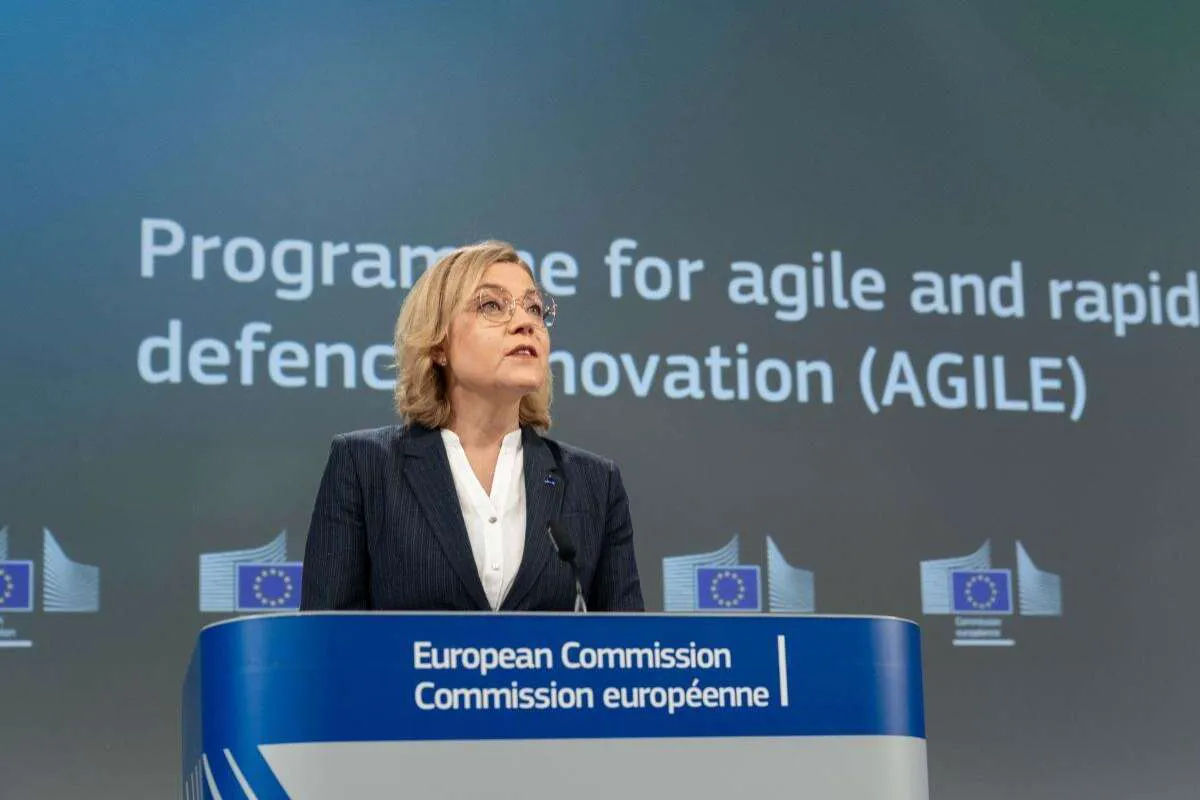
The deployment of drones, artificial intelligence systems and cyber technologies now takes place in weeks and months – not decades. This was the starting point when the Vice-President of the Commission and Commissioner for Technological Sovereignty, Security and Democracy Henna Virkkunen presented a new EUR 115 million AGILE funding channel for defense startups on Wednesday.
“Russia’s war of aggression has shown that success on the battlefield depends on the ability to introduce new technologies on a schedule of weeks. That’s why we have to change the entire operating culture,” Virkkunen tells Kauppalehte.
AGILE is supposed to bring the speed that the European defense industry needs.
Virkkunen says that AGILE differs from traditional EU defense funding, because funding decisions are supposed to be made in four months, and the goal is for new technologies to be used by the armed forces in 1–3 years, which is exceptionally fast in the defense sector.
Virkkunen says that the plan is to support 20–30 projects through the program. It offers companies up to 100 percent financing, which is also rare in EU defense projects.
“We need to finance more startups directly so that defense solutions can be put into real use quickly.”
In addition, companies can apply for compensation for costs that have already been incurred before the end of the application round.
Processes should be accelerated
The foundation of AGILE is based on the long-known structural problems of European defense: fragmented markets, slow procurement processes and insufficient joint planning.
“The defense industry is particularly fragmented. The member countries traditionally procured from their own companies, and we still don’t do enough together,” says Virkkunen.
At the same time, the need for investments is growing. The European NATO countries should increase their spending by hundreds of billions of euros annually, but EU-level funding is still low.
For the next financial period (MFF 2028–2034), the Commission proposes a fivefold increase in EU defense funding to 131 billion euros. The goal is to speed up joint projects, improve the protection of critical infrastructure and strengthen European defense readiness.
“After all, this (AGILE) is a small patch compared to the whole. The member states mainly finance defense, and the EU is above all able to encourage more procurement to be done together,” says Virkkunen.
“Many times we are still conservative on the defense side. But technologies have changed warfare and we have to change with it,” he continues.
AGILE aims to respond to this by creating a mechanism by which member countries can identify common challenges and appropriate technological solutions. In addition to funding, it is also about building a new kind of ecosystem.
Breakthrough technologies in focus
Funding for startups.
The commission promises money for startups that develop top technologies suitable for defense, such as artificial intelligence solutions, quantum computing, space technologies, cyber security, drone systems and sensor technology. The illustration is from the EU Commission’s JRC Geel drone research center.
PHOTO: Kreeta Karvala
AGILE connects to the commission’s broader plan, in which member countries are encouraged to allocate at least 10 percent of their defense investments to new technologies: artificial intelligence, quantum technology, space solutions and cyber security.
Virkkunen emphasizes that it is precisely in these areas that small companies are often at the forefront of development.
“New innovations come specifically from small companies. However, it has been difficult for them to get involved in defense procurement, when the procurement chains are traditional and closed,” describes the vice-chairman of the commission.
AGILE aims to bring startups closer to the European defense industry. Virkkunen believes that Finnish startup companies have good opportunities to succeed in AGILE.
“Finland has a very wide field of startups in these dual-use technology fields, i.e. artificial intelligence, quantum technologies, space technology and cyber security,” he says.
The Commission’s goal is for member countries to be able to make procurements directly without separate bidding from companies that have received funding from AGILE, which will speed up the introduction of technologies.
Virkkunen’s message to European and Finnish startups is clear:
“Now is the right time to bring new ideas to the fore. We need you, and a stronger ecosystem will improve the defense capabilities of Europe as a whole,” he says.
THE FACTS
AGILE
A new 115 million euro funding program for defense start-ups established by the European Commission.
The goal is to speed up the development, testing phase and introduction of new technology in the European armed forces.
To whom?
For 20-30 startups that develop cutting-edge technologies suitable for defense, such as artificial intelligence solutions, quantum computing, space technologies, cyber security, drone systems and sensor technology.
Financing conditions:
Up to 100% financing of all eligible costs
Includes retroactive compensation option
An individual company can receive 3–4 million euros
Financing decision in four months
The technology is supposed to advance to the market or to the challenges of the member countries within 1–3 years
Next steps:
AGILE is established by regulation. The Commission has already prepared a proposal, which will next be passed on to the EU legislators, i.e. the Parliament and the Council.
The program is supposed to start at the beginning of 2027.
https://www.reuters.com/graphics/world-coronavirus-tracker-and-maps/es/countries-and-territories/tunisia/
https://www.reuters.com/graphics/world-coronavirus-tracker-and-maps/countries-and-territories/tunisia/
https://www.reuters.com/graphics/world-coronavirus-tracker-and-maps/en/methodology/
https://www.reuters.com/graphics/world-coronavirus-tracker-and-maps/fr/countries-and-territories/tunisia/
https://www.reuters.com/world-coronavirus-tracker-and-maps/countries-and-territories/tunisia/
https://www.reuters.com/world-coronavirus-tracker-and-maps/es/countries-and-territories/tunisia/
https://www.reuters.com/world-coronavirus-tracker-and-maps/fr/countries-and-territories/tunisia/
https://www.reuters.com/world-coronavirus-tracker-and-maps/ja/countries-and-territories/tunisia/
https://www.reuters.com/world-coronavirus-tracker-and-maps/pt/countries-and-territories/tunisia/
https://bioenergetic-therapy.com/index.php/en/bioenergetic-analysis/history-of-ba
https://www.startstemcells.com/loss-weight-treatment.html
https://www.uco.es/sia/paginas.php?pagina=bancos
https://www.intrinsicsearch.com/news/diversity-in-saas/
https://realbusiness.co.uk/news/beyond-the-blue-pill-holistic-approaches-to-erectile-dysfunction.html
https://www.iheart.com/podcast/269-terveyshetki-290182018/episode/etalaakari-kriittisessa-valossa-328022085/
https://edurescue.fi/
https://www.iheart.com/podcast/269-signals-of-tomorrow-311742369/episode/why-the-finnish-passport-is-one-328011158/
https://podcasts.apple.com/us/podcast/finnish-passport-explained-what-it-really-means/id1845868593?i=1000757245636