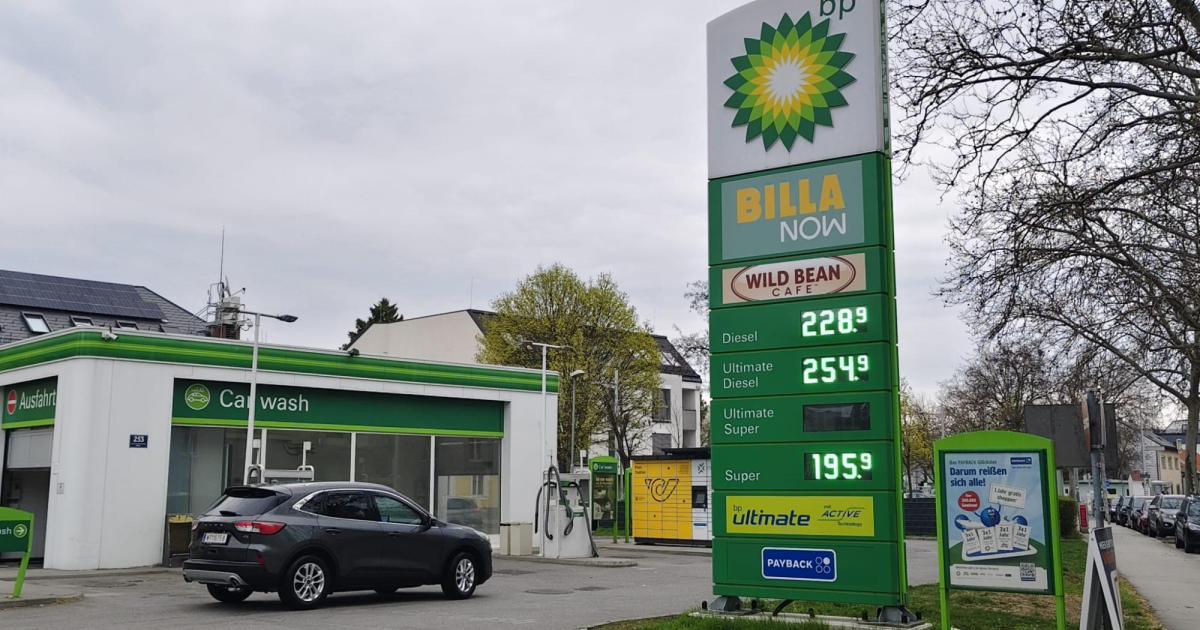
It’s always been like this. Prices at the pumps are rising just in time for the start of the holiday season. Nothing will change at Easter 2026, fuel price cap or not.
From Wednesday, April 1st to Thursday, April 2nd – the first day of the fuel price brake – the Austria-wide average fell as desired by the government. This is shown by the data from the regulatory authority E-Control: The price for a liter of premium gasoline fell from 1,866 euros to 1,748 euros. Detto for diesel: On April 2nd, a liter cost an average of 2,132 euros, which was slightly less than the day before (2,199 euros).
Up and down
According to the new regulation, gas stations are allowed to increase – but also reduce – their prices three times a week (Monday, Wednesday and Friday). The opportunity to increase prices was widely used on Friday. Precisely. Many people left for their Easter holidays on Friday.
This could not be proven in official figures on Friday afternoon; the new data from E-Control for the Friday average price will not be available until Saturday. ÖAMTC expert Martin Grasslober gave an example of three gas stations in the south of Vienna, where the increase was “sometimes very significant” by 20 cents. Grasslober’s conclusion: “You simply can’t avoid price comparisons.”
Federal Chancellor Christian Stocker (ÖVP) defended the price cap again. This saves you a good 5 to 6 euros for filling up once, “I think that’s an important measure,” said the politician ORF. In addition, their effectiveness is continually evaluated.
Using the various fuel price calculators from E-Control or ÖAMTC, drivers can find the cheapest gas stations in their area.
He also published ÖAMTC tips for the Easter weekend.
When traveling abroad, you should carefully check whether it is cheaper to fill up at a local gas station or at your destination:
- In Hungary and Slovakia, the cheaper prices due to government intervention usually only apply to the respective citizens. With an Austrian license plate you usually pay a significantly higher price. This unacceptable discrimination has already been identified by the EU Commission.
- As usual, prices in Germany are currently significantly higher than in Austria.
- Due to a significant tax cut, prices in Italy could currently even be cheaper than at Austrian gas stations.
- Slovenia and Croatia have state-regulated maximum prices away from motorways and expressways, which are usually well below the Austrian average prices.
- In neighboring countries with low fuel prices, longer waiting times can be expected at gas stations near the border.
- In general, it is advisable not to travel with a last reserve, as fuel tanks may occasionally be empty. In Slovenia there is therefore a maximum delivery quantity of 50 liters per car.
https://santasusana.org/
https://victoriaforcongress.com/
https://pin-up-casino.az/
https://pinup-casino.az/
https://bangsamoro.info/
https://casino-pinup.az/
https://pinupcasino.az/
https://dillontransport.com/
https://pin-up-official-casino.com/
https://pinup-casino-official-az.com/
https://pin-up-casino-az.net/
https://battroborg.com/
https://pinup.battroborg.com/
https://pin-up.battroborg.com/
https://pinup-az.battroborg.com/
https://pinup-casino-az.battroborg.com/
https://pinup-online-casino-az.com/
https://az.pinup-online-casino-az.com/
https://lineserved.com/
https://pinup.lineserved.com/
https://pinup-casino.zone/
https://pinup-giris.pinup-casino.zone/
https://authenex.com/
https://pin-up.authenex.com/
https://surflabuenavida.com/