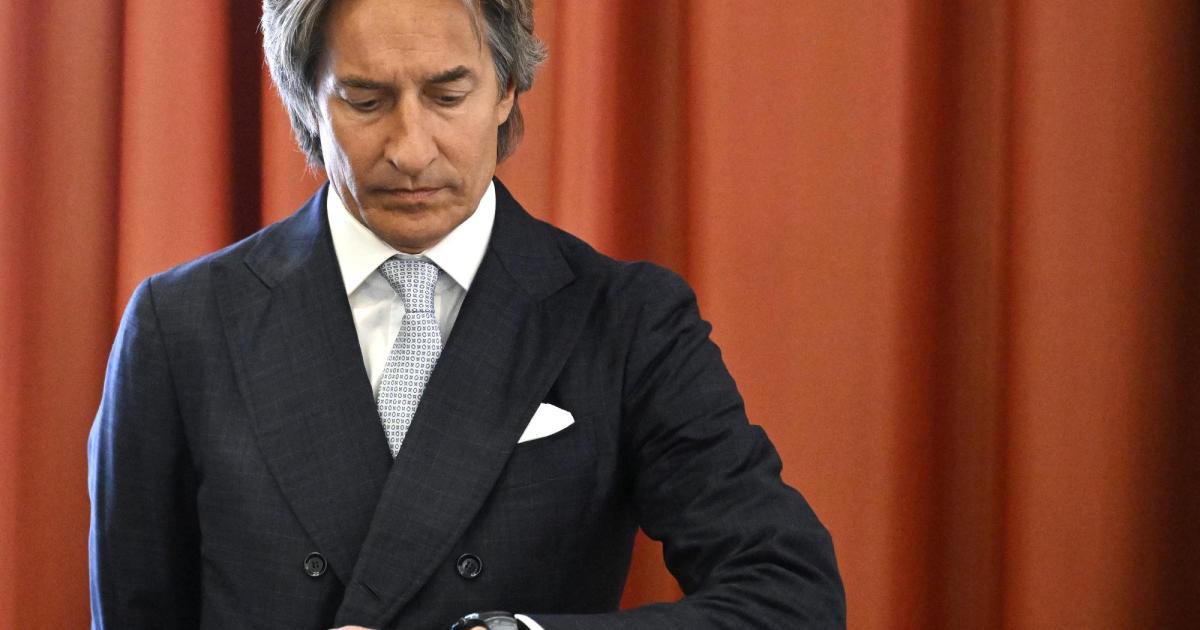
On Tuesday, April 14, 2026, the attention of the Austrian judicial public will be focused on a comparatively small courtroom: the Kitzbühel District Court. An examination meeting is taking place there that could decide on the further course of one of the most prominent private insolvency proceedings in the Republic – that of former Finance Minister Karl-Heinz Grasser.
What at first glance seems like a formal procedural step is actually a critical point in insolvency proceedings, the dimensions of which are extraordinary even for experienced creditor protectors. According to KSV1870 and Creditreform, more than 35.6 million euros in claims were registered, around 23.1 million of which are considered legitimate according to the insolvency administrator’s assessment. The Republic of Austria is the main creditor – and therefore the decisive power factor in the proceedings.
Meanwhile, the ankle bracelet wearer Grasser now works in an interior design company in Kitzbühel. He carries out administrative work there as an employee, does project calculations and commercial assistance work. His gross monthly salary is almost 2,200 euros.
Eight creditors, one debtor – and millions
Eight creditors submitted their claims to the court on time. The sheer size of the claims makes it clear that Grasser’s insolvency is not a classic case of private over-indebtedness, but rather the financial processing of a major political and criminal case with a decades-long history.
The Republic of Austria alone is asserting claims of over 23 million euros. Of this, more than 12.9 million euros relate to claims for damages in connection with the Buwog complex – the privatization process that has made Grasser a lasting symbol of political corruption in Austria. A further 10.1 million euros relate to tax claims from the tax authorities.
The Innsbruck insolvency administrator, lawyer Herbert Matzunski, considers these demands to be fully justified after a thorough examination. This means that it is already clear before the session begins: the majority of the registered liabilities are likely to actually be established.
Registered twice – a million-dollar dispute is on the horizon
But not all demands are accepted without objection. According to information from KSV1870, the insolvency administrator assumes that at least one claim worth millions was registered twice. This claim will be disputed – with potentially far-reaching consequences for the creditors affected.
Anyone who fails in the examination session must have their claim determined in a separate civil case against the insolvency estate. Such a procedure is expensive, risky and often not economically attractive: the legal costs are based on the total amount of the claim, while in the event of success only the insolvency rate beckons – a rate that, according to current estimates, is likely to be in the lower single-digit percentage range.
200,000 euros mass – a drop in the ocean
A look at the insolvency assets secured so far illustrates the imbalance between claims and assets. The insolvency administrator has so far been able to collect around 200,000 euros for the general public. Around 40,000 euros came from the cancellation of a life insurance policy, and another 25,000 euros from the sale of a high-quality watch.
The lifting of the confiscation of a bank deposit from which more than 150,000 euros flowed into the mass is particularly important. But compared to recognized liabilities of over 23 million euros, this amount is little more than symbolic.
Liechtenstein as a possible turning point
Accounts in Liechtenstein, which may be attributed to Karl-Heinz Grasser, provide new dynamics in the proceedings. The insolvency administrator is currently working intensively to make these credits available to creditors.
A payment still fails due to a court ban. The background is criminal proceedings pending in Liechtenstein on suspicion of money laundering. Only when this ban is lifted could there be a significant influx of mass.
“We are talking about several hundred thousand euros,” explains Klaus Schaller from KSV1870. For the creditors, this would be a significant, although by no means saving, contribution to the quota.
Payment plan or skimming – Grasser’s last resort
Parallel to the realization of assets, Karl‑Heinz Grasser pursues a clear goal: debt relief. In order to achieve this, he offered creditors a payment plan. In addition to the quota that is already expected from the masses, Grasser is promising an additional three percent. These approximately 700,000 euros are to be raised by third parties and could quickly flow to the creditors. But the plan has a catch – a crucial one.
The Republic tipping the scales
Without the consent of the Republic of Austria, the payment plan is doomed to fail. And it is precisely this approval that is considered extremely unlikely.
The reason lies in Austrian insolvency law: claims for damages from the Buwog complex amounting to 12.9 million euros would generally not be eligible for discharge of residual debt if the payment plan was rejected.
“In any case, he will only be granted discharge of residual debt if the payment plan is accepted by the majority of creditors, because debts that arise from criminal offenses are excluded from discharge of residual debt in a confiscation procedure,” says Tamara Vujic from Creditreform.
Even after a multi-year confiscation process, the Republic could continue to pursue this claim – until the statute of limitations expires after 30 years.
For Grasser this means: Even if he is able to settle around 10.2 million euros in the confiscation process, he would still be left with a massive amount of debt. Real financial “rehabilitation” would therefore be impossible.
Political dimensions of insolvency proceedings
Grasser’s bankruptcy has long been more than a legal act. It is a political signal, a precedent and a lesson about the long-term consequences of political responsibility. The Republic’s decision as to whether or not to agree to a payment plan will therefore be judged not only on economic but also on social grounds. In the next few months, Grasser will have to negotiate with the financial prosecutor’s office. It remains to be seen whether there will be a rapprochement. The Republic has little financial incentive to give in – but it does have a significant public interest in consistency.
https://verde-lucasino.com/mobile
https://verde-lucasino.com/payments
https://verde-lucasino.com/problems
https://verde-lucasino.com/promocodes
https://verde-lucasino.com/reviews
https://verde-lucasino.com/slots
https://verde-lucasino.com/support
https://verde-lucasino.com/withdrawal
https://verde-montenegro.com
https://verde-montenegro.com/apk
https://verde-montenegro.com/app
https://verde-montenegro.com/bonus
https://verde-montenegro.com/casino
https://verde-montenegro.com/deposit
https://verde-montenegro.com/download
https://verde-montenegro.com/faq
https://verde-montenegro.com/legal
https://verde-montenegro.com/login
https://verde-montenegro.com/mirror
https://verde-montenegro.com/mobile
https://verde-montenegro.com/payments
https://verde-montenegro.com/problems
https://verde-montenegro.com/promocodes
https://verde-montenegro.com/reviews
https://verde-montenegro.com/slots