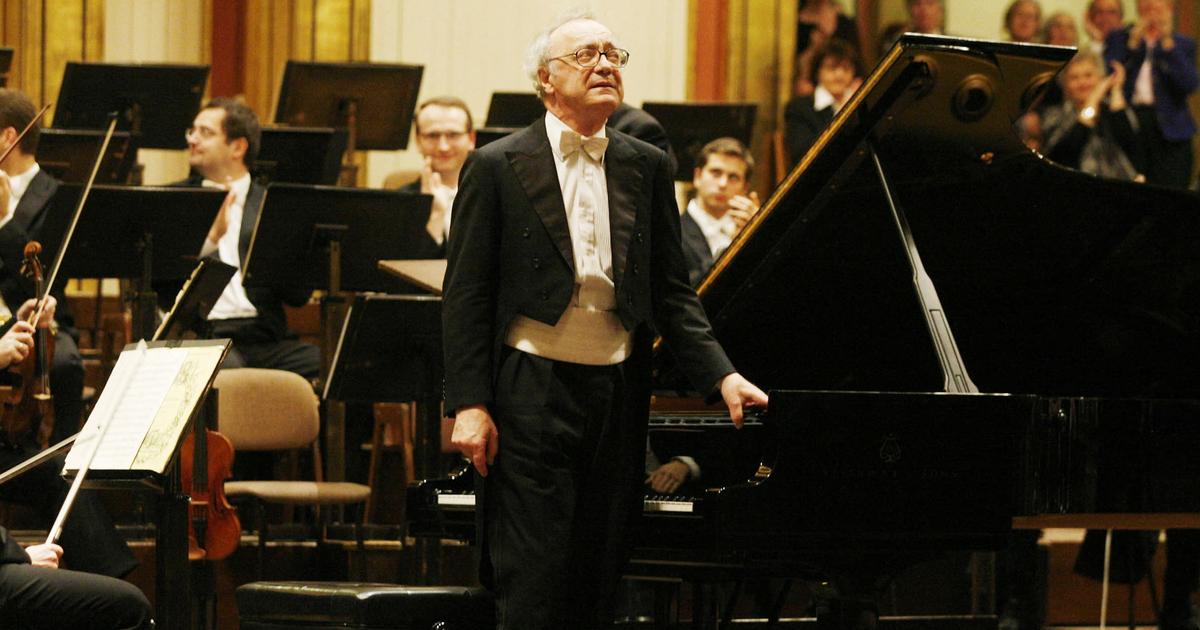
Healing by choice, the one who grew up between Balkans and Mediterranean embodied the sassy Mitteleuropa. Tireless worker, he was an intellectual on a laughing eye that evolved between rigor and fantasy. He died at the age of 94.
The death of Alfred Brendel not only deprives us of one of the greatest musicians in the XXe century, but also one of the last representatives of the Mitteleuropa, this notion with blurred contours which immediately evokes the cultural gold of a central Europe resulting from the Austro-Hungarian Empire. He was the embodiment of this Danubian Europe, not as a conservative identity and withdrawn from itself, but on the contrary cosmopolitan, sassy and cultivated, not being satisfied with any dogma. “I have always been wary of all those who believe they have the truth. And I am rather independent of nature, even if I have never learned either to drive or to cook. I feel in every European point in the center. Every chauvinism hates me. I am delighted to have lived as I lived : without homeland. »»
This stateless choice was born on January 5, 1931 in a German -speaking family in Moravia, which was Bohemian Austrian province before (re) becoming Czech. He is very small when his parents settled on the edge of the Adriatic to hold a hotel, where he discovers music by listening to 78-tours of operetta sung by tenor Jan Kiepura. Then it is Zagreb, in Croatia still Yugoslav, where his father, former architect, is film director. He receives piano lessons there. This childhood between Balkans and Mediterranean represents the opening and the crossroads of cultures, explaining the disgust that Hitler’s speeches give him on the radio, despite his young age. The war means the installation in Austria, in Graz, where he frequented the conservatory, interrupting to dig trenches in Yugoslavia. The post-war period takes place in Vienna. From the Viennese spirit, he takes insolence and modernity, surely not reactionary and small-bourgeois academism which then reigns and displeases it with its narrow provincialism.
Read too
The central coffee, in Vienna, emblem of the Mitteleuropa
Almost self -taught
It is by hearing Alfred Cortot that he has the revelation that one can make music a living art, by reading and interpreting the texts instead of sticking to sclerotic traditions. And it was in contact with Edwin Fischer that he learns to “Get away from the piano to find yourself”. Almost self -taught, he began a rather local career, but which attracts the attention of connoisseurs thanks to his recordings for a confidential and cheap firm. The Vox discs were founded after the war by George Mendelssohn, an American of Hungarian and German origin who, unable to pay the stars, put on artists who have no name but something to say. Brendel turns out to be a major interpreter from Liszt, a composer with which he is not spontaneously associated, but to which he will come back regularly.
He would undoubtedly have remained a pipe that we go back between Happy Few if he had not finally been closed by a “major”, Philips, who took him under contract in 1970. It is true that his Vox recordings had ended up being spotted beyond the small circle, and asserting him a rave review New York Timesas well as rounds outside Europe. But it is the exclusive contract with Philips which allows it to become an international star, guest of the most prestigious rooms (Carnegie Hall, Musikverein, Salzburg, Concertgebouw), with the greatest chefs (Haitink, Abbado, Levine, Rattle) and the best orchestras (Berlin, Vienne, Amsterdam, Chicago). Without forgetting Paris where he is faithful to André Furno and his 4 -star piano series, once a season. He then focused on the fundamentals of Viennese classicism: Haydn, Mozart, Beethoven, Schubert. He is now considered a specialist, at the risk of contradicting his eclecticism, which is still curious. He will come back tirelessly to the monuments which he considers that we have never gone around, recording three integrals of the Sonatas of Beethoven, and four of the Concertos.
Read too
Beethoven’s unspeakable secret revealed by his DNA
An intellectual in a laughing eye
However, there is a form of misunderstanding in this celebrity. First of all because it is the least attractive pianists: its sound is not soft or charming, it brings the truth of the text before the spells of the instrument. Then because his interpretations are severe, at the risk of sometimes leaving the listener on the edge of the path: everything for the score, nothing for the sleeve effects, a trait common to his students like Paul Lewis, Till Fellner or Kit Armstrong. Everything except sentimental, Brendel is an intellectual who constantly scrutinizes what the partitions reveal, by ridding them of everything that resembles clichés or prejudices. But an intellectual in the laughter! From classicism, he does not seek a supposed perfection and symmetry, but on the contrary the playful freedom which Haydn, Mozart or Beethoven showed. Applying the texts, such was his credo, not with the asceticism of the library rat, but with a delicacy and a devastating humor which allowed him, while being a tireless worker, not to take himself seriously.
This sparkling and irony intelligence, he also put it in his own writings, since this man with literary, pictorial, cinematographic and universal architectural culture practiced poetry. Once, on December 18, 2008, he officially announced his retirement, a rare approach among musicians and due to physical fatigue tenfold by arthritis, he devoted himself a lot to this activity, including during public readings which allowed him to find him on stage, with his dragging voice and his malicious eye, sometimes accompanied by a colleague on the piano, like Pierre-Laurent Aimard. Since 1971, he lived in London where he had found his home port. He loved cosmopolitanism and open -mindedness, and this mixture of rigor and fantasy which will remain his most durable lesson.