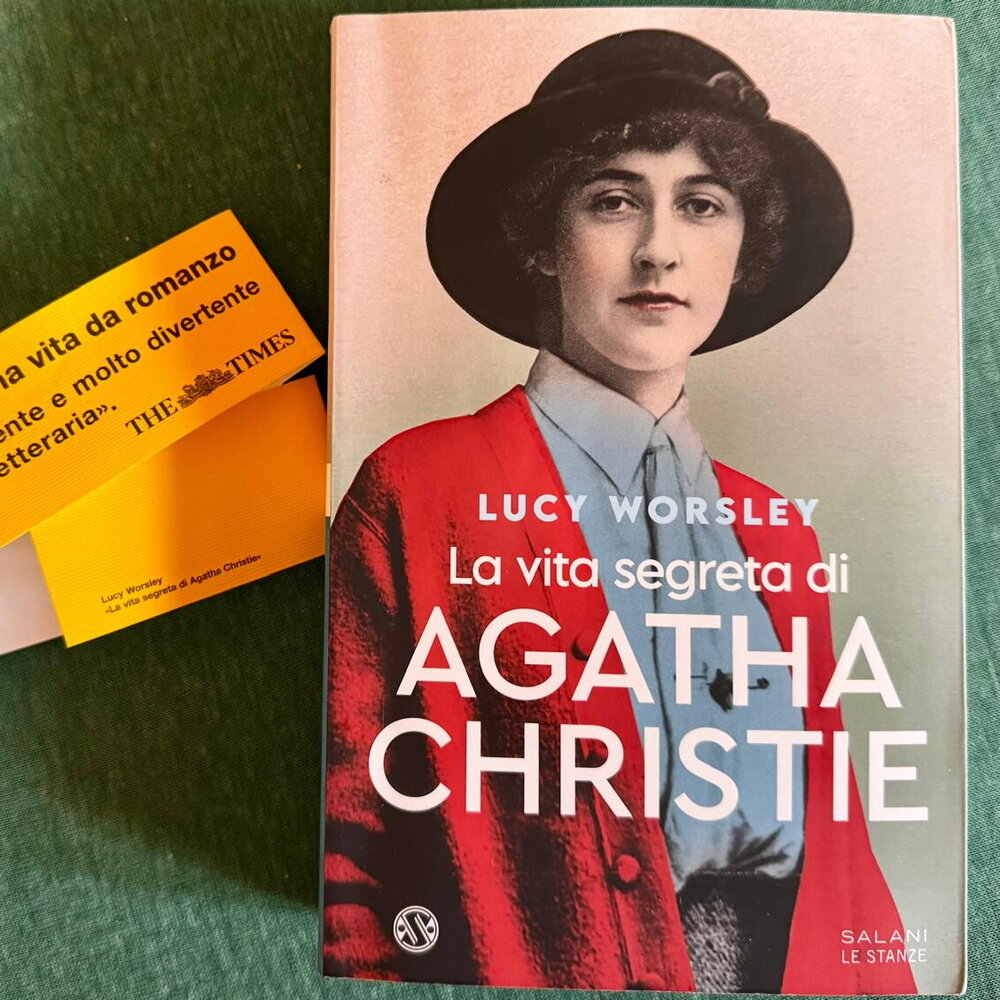
“Agatha Christie broke the rules imposed on women in the twentieth century women of her generation and social class were expected to be thin, to be housewivesblindly adore your numerous children and always give yourself to others. The only one of these imperatives with which he fully complied was the last. Effectively, he gave the best of himself – his energy, his creativity, his genius – to his readers. No wonder they are still grateful to her.” Thus in the preface of her latest book, ‘The Secret Life of Agatha Christie’ (Salani Publisherpages. 479; price 19.90 euros), the writer and author of important biographies of the Queen and Victoria and of Jane Austen,Lucy Worsleyintroduces the figure of the most importantmystery writerof history. Acontroversial, brilliant, sophisticated and a little crazy woman.
“Today we do not need to put women on a pedestal. In other words, we must accept the fact that, in that tangle of contradictions that it was Agatha Christiethere was also ablack heart– writes Lucy Worsley – not only did the writer invent stories in which even little girls could be murderers, but in her works she sometimes expressedviews on race and social classwhich nowadays we consider unacceptable”. Yet fortunately Christie has not yet been overwhelmed by the irrational and ideological wave of ‘cancel culture’.
The modernity of Hercule Poirot and Miss Marple
“We must accept reality – we read again in the preface – iprejudices of his class and his erathat often transpire from his works are part of the history ofTwentieth century Britain. Despite theconservative positionsexpressed in her literary creations – the author further underlines – I am convinced that, deep down, Agatha had a positive influencethe perception that his audience had of the world. After all, in his stories one short, effeminate foreigner with a ridiculous name he manages to defeat evil using his brain instead of muscles, while an old lady with unsteady legs always manages to get the better of evildoers. What’s more, these twosingle without children – né Hercule Poirot né Miss Marple sono sposati – show that they have no need to have a conventional family around them, to feel good about themselves,” he concludes. And precisely thisfreedom and modernity di Agatha Christiefascinated Lucy Worsley who dedicated this fictional biography to her also as a tribute to an exceptional woman who “lived a‘modern’ life: he surfed in Hawaii, he loved sports carsshe was fascinated by the new science called psychology. His novels are still relevant todaybrilliant and dynamic modernity”.
A journey into the soul of Agatha Christie
The book published now bySalani Editore is a compelling journey into the soulof one of the most mysterious and beloved writers of world literature. Much more than a simple biography, the book becomes ainvestigative novel that alternates literary discoveries, psychological flashes e unpublished detailsabout the woman behind the masterpieces of Hercule Poirot and Miss Marple.
Agatha Christie’s ‘revolution’
Worsley immerses the reader inEngland from Edwardian echoes to the post-war yearsshowing how Agatha, lived betweentroubled marriages, honeymoons in the Mesopotamian deserts e una society which did not foresee successful female crime writers, I have learnedrevolutionize the literary landscape.
The mystery of the disappearance of 1926
In the central part of the book the author retraces and gives her original interpretation to the sensational story of the famous womandisappearance of Agatha Christie from 3 to 14 December 1926, eleven daysin which the great writer disappeared from public life, leaving her daughter and family in dismay, only to reappear in a hotel under a false name. A such an enigmatic episode that still fuels doubts today between those who really believed in amnesia (the official explanation), those who think it was oneliterary stratagem or those who think that he disappeared from circulation with the specific intent to have her husband accused of uxoricide to take revenge on her husbandbetrayalwith a young woman, Nancy Neele, a story worthy of the pen of ‘queen of mystery’. So fascinating to push cinema to take an interest in it too: in 1979 the famous film was releasedfilm ‘Agatha Christie’ directed by Michael Apted with Dustin Hoffman, Timothy Dalton and Vanessa Redgrave (as the writer), who presented her as a woman determined to kill Nancy Neele.
About this matter Lucy Worsley’s position is different from all the others published in biographies so far of Poirot’s creator: “I collected a large number of statements made by her on the subject and, reading them carefully, I had the impression that the so-called ‘mystery’ was completely blurring,” she writes. And in fact his explanation is totally scientific: “It was likely depression, to which was probably added a tendency towards dissociative escape”, i.e. a mental condition caused by atrauma o dallo stressin which you literally forget your identity. And inHow much a stress Agatha Christie he had accumulated enough: his mother had died and had discovered that her husband, ColonelArchibald Christie (whose surname he will keep even after the divorce) was cheating on her with a woman younger than her.
The creative method and the adventurous life
In the book ‘The Secret Life of Agatha Christie‘among the most surprising curiosities collected by Lucy Worsley emerges thethe writer’s relationship with her audience: a woman emerges who is very attentive to readers’ reactionsand determined never to deceive them, but rather to involve them in oneintelligence competition, disseminating clues that anyone could have graspedbut only the most attentive could decipher. The book reveals, referring to letters and manuscripts, theChristie’s creative method: the discipline of writing every dayhis very dense notes, his passion for the puzzle and his almost childish fun in thechange endingsuntil the last moment. Worsley also dispels the cliché of the old English lady all lace and gossip: Agatha wasarchaeologist on Middle Eastern construction sites, surfer in Hawaii and nurse during the First World Wara cosmopolitan and adventurous woman.
The complex personality of the writer
Also noteworthy are the pages dedicated tosocial maskand worn by Christie, as in her novels – the ‘quiet and normal’ woman hid avolcanic mind always at work to observefilter and reinvent the world. In this biography, the figure of the writer is revealed much morecomplex: fragile, courageous, at times melancholicobsessed with the need to write but also to protect her ownindependence and one’s own personal mystery.
Agatha’s affections and rebirth
Worsley also pays great attention toAgatha’s emotional ties: her beloved mother, her first marriagewith Colonel Christie ended after the discovery of the betrayal (divorce from Archibald Christie in 1928) and therebirth with Max Mallowan, the much younger archaeologistwith whom he shared the happiest years between adventures in Mesopotamia and journeys full of inspiration.
The autobiography is a source of inspiration
To write ‘The Secret Life of Agatha Christie’, Lucy Worsleydid a lot of research but it was based onautobiography of the writer (‘My life’)which remains to this day one of themore sincere and exciting documents sulla personality of the mystery writerwhere, unlike his novels, he delivers to readersintimate reflections. The result is onenew biography che breaks down stereotypes e presenta una Agatha Christie more alive and authentic than ever.