Getting sick in the 19th century used to be synonymous with a fatal outcome due to the lack of hygiene conditions and the absence of antibiotics. Today one goes to the hospital with the idea of being cured, but then it was better to die.
The “kiss of death”, a phrase used repeatedly since the end of the 19th century in literature, mainly, which evoked shuddering, as well as seduction, animates the most recent exhibition at the National Museum of San Carlos (MNSC), The kiss of death: Mortuary representations in 19th-century art and visual culture.
Through some 180 pieces, including painting, sculpture, engraving, books, photographs, puppets, medical utensils and mourning clothing, the exhibition gives an account of the rites, customs and attitudes that the society of nineteenth-century Mexico assumed to face death and loss. That is, the artistic expressions of the so-called “high culture” are mixed with the popular. Apart from the MNSC, the works are from more than 20 public and private collections.
The exhibition is divided into four thematic cores, which go in chronological order: The anteroom of death, Face to face with death, Death portrayed and The places of memory.
The tour begins with the large format oil painting Episode of the universal flood (1851), by Francisco Coghetti, a renowned Italian painter who “almost does not sound today,” said Luis Gómez Mata, curator of the exhibition. The work was commissioned by the Mexican minister José María Montoya during a stay in Rome, with the aim that the students of the Academy of San Carlos would copy it and learn from the great Italian masters.
Dedicated to health and illness, the first core includes everything from a reproduction of a map of Mexico City, dated 1875, which indicates all the hospitals that operated, to medical instruments and votive offerings. in the oil convalescence (1954), the Jalisco native Josefa Sanromán executes a scene of her sister Juliana, also a painter, who died at the age of 26.
The exhibition includes paintings known and appreciated by the public, such as This is the mirror that does not deceive you or Allegory of death (1856), by Tomás Mondragón. In it you can see a life-size lady, one half dressed in luxury, while the other is her skeleton with remains of clothing. From the top hangs a thread that divides the painting, while a hand prepares to cut it.
Another striking painting, rotten body (18th century), by an unidentified author, shows a decomposing corpse. It is a “confrontational exercise that the Church put on with the faithful to remind them that material things were vain and what really mattered was life in the afterlife.” That is, “do not sin because things will go badly for you.”
Figures such as Manuel Manilla or José Guadalupe Posada “returned to these iconographies of the memento mori and they made them extremely famous. Even today, in the 21st century, these figures of skulls continue to be an identifying feature of the Mexican,” Gómez Mata pointed out.
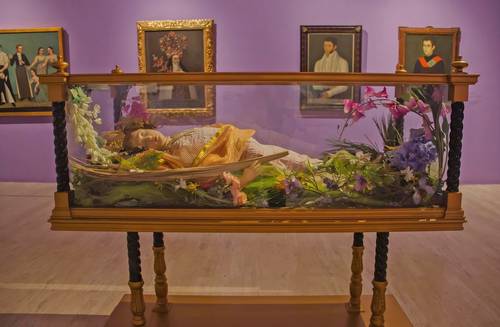
The centerpiece of the Face to Face with Death core is a display case that contains “the Santa Rosita reliquary body, 19th century,” from Italy. Made by the sculptor Michel Tripisciano and the wax artisan Domenico Faulo, the figure has its eyes half closed because “it awaits the resurrection.” The piece comes from the collection of the Casa de las Mil Muñecas Museum.
The section Death Portrayed contains a series of portraits, both in marble and wax, photography and painting, of the so-called “little dead angels.” It is the densest section of the exhibition because it includes “strong” images such as a set of photographs that show a sequence of the execution of Maximilian of Habsburg, including his bloody shirt. The death mask of Benito Juárez is displayed along with a photograph of then-president Porfirio Díaz visiting his grave in the San Fernando pantheon.
When faced with the loss of a loved one, one had to mourn for at least three years, if it was a husband. Women’s clothing in this regard is examined in the core The Places of Memory, from the dress, the hat, the gloves, the parasol and the fan with its funeral scene, all in black.
“Dressing black is a sign of solemnity and seriousness; however, some sources say that it was a way to hide from the death that was around. Women put on a black veil as a way to hide. Towards that effect we continued placing black bows on the doors. These rituals became true fashion phenomena,” Gómez noted.
Here the relief for the tomb of the pianist and conductor Carlos J. Meneses (1863-1929) also stands out: a smiling and “seductive” woman embraces the deceased.
In this core, we also reflect on the “symbolism” of flowers in the 19th century, through paintings, for example, by Germán Gedovius. White and purple flowers were associated with death and sleep. In a showcase, all kinds of artifacts are displayed such as lockets, objects made with hair, invented by humans to remember their loved ones.
The Kiss of Death: Mortuary Representations in 19th Century Art and Visual Culture It will remain until 2026 at the National Museum of San Carlos (50 México-Tenochtitlan Avenue, Tabacalera neighborhood).