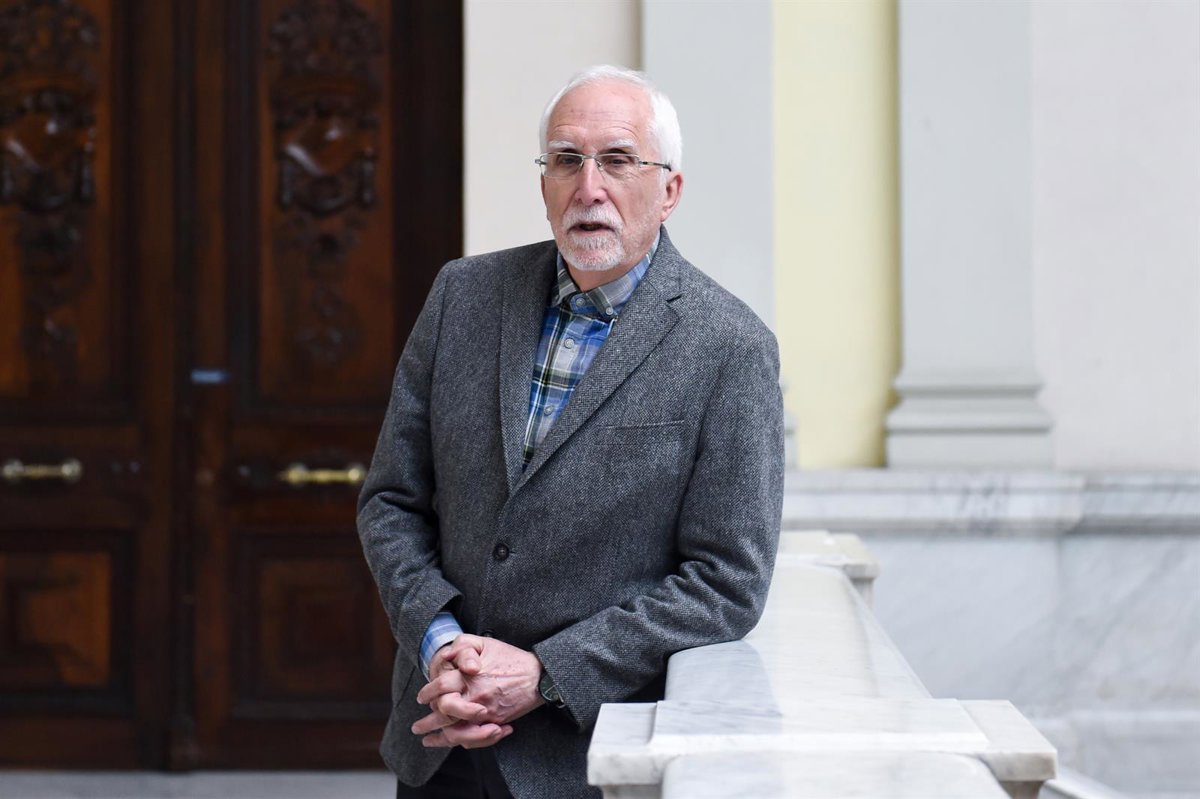
The writer Luis Mateo Diez This Friday he presented his latest novel, ‘The corner watcher’ (Galaxia Gutenberg), about a city in which “disorder” prevails and in which the authorities have fledand has reflected on the non-resignation of the president of the Generalitat Valenciana, Carlos Mazón, after the damage.
“This friend told me, look, this firecracker of a gentleman, the next day, aware that he was not where he should be and that he did not do what needed to be done.he leaves and apologizes — ‘I wasn’t where I should have been and I’m leaving’ –, well, we would have been dealing with other types of things, that news would have been a bit contained,” commented Luis Mateo Díez, this Friday, during a press conference at the Rafael Alberti Bookstore in Madrid.
This is how the writer has spoken when making a reflection on the “overwhelming” current events that generate “restlessness” and that serve “to give the deception of power more weapons.”
“The other day a friend told me, look, Mateo, the dana, this petard of a gentleman stays there, they keep him, there are all kinds of subterfuges; that he was there, that he came, that he didn’t, a newsworthy excess of analysis of all kinds, Ventorro, the mother who gave birth to himI was here at minute one, I was at minute 24. On the outside what there is is many dead, drowned and ruined and the great misfortune of that that traumatized us all,” he had begun.
In his novel, Díez presents a city “in decline” that reflects his concern for “disorderly current events” and “truly hard to bear in every way.”
“This dissolution, this disorder, this painful way of life of opposing countries, political parties ruined, hateful hatred in almost every place, people who insult and ruin an institution, as happens here, everywhere. It seems that this determines a little the consummation of the times, something is ending, then something else is going to come, probably better, renewed, we all know that human beings are going to hell but nature is not“, he said.
In this sense, Díez has explained that his work takes place in a “shadow city” without a name and impregnated with a certain “phantasmagoria.” Furthermore, he has pointed out that the novel is full of “set phrases” and “verbal subterfuges.”
“This seems to me to be very current, this kind of feeling that we live in a world, no longer in a country, in a world where there is a lot of use of a language that seems to try to hide the possibilities of a clear language,” he said.
In this context, Díez has pointed out that the protagonist, Ciro Caviedo, is an “annoying” journalist who becomes “the deformed conscience of the enormous deformities of that city” that “collapses”, in which elements such as democracy, ideologies, imagination and beliefs are being demolished; in which “sectarianisms” and “fanaticisms” appear, and in which “society seems to be neutralized”, something that, in his opinion, has its reflection in the real world.
“DEMOCRACY IS GOING DOWN”
“It is a city where democracy is going to hell. It is going to hell in the United States, in Russia why are we going to talk, in Spain we are as we are. Well, some of that. Certain values of coexistence and institutional values are ruined,” he stressed.
Although, Díez has indicated that the novel does not have a denunciatory intention and that what it seeks, with a “tremendously humorous” and “grotesque” tone, with a “very disturbing atmosphere”, is to “amuse.” “That when you read it, you can say: How I had fun and how screwed I was,” has settled.
In relation to the controversy that faces the directors of the Royal Spanish Academy (RAE) and the Cervantes Institute, Santiago Muñoz Machado and Luis García Monterorespectively, Díez has said he is “shocked” and has pointed out that this situation is one more example of that “disorder” that he talks about in his book.
“I am shocked. I don’t know how that can happen. That’s the disorder. Disorder is the inability to understand ourselves, saying inappropriate things, being where you shouldn’t be and all this is a great complication and has to do with the world in which we live,” he noted.