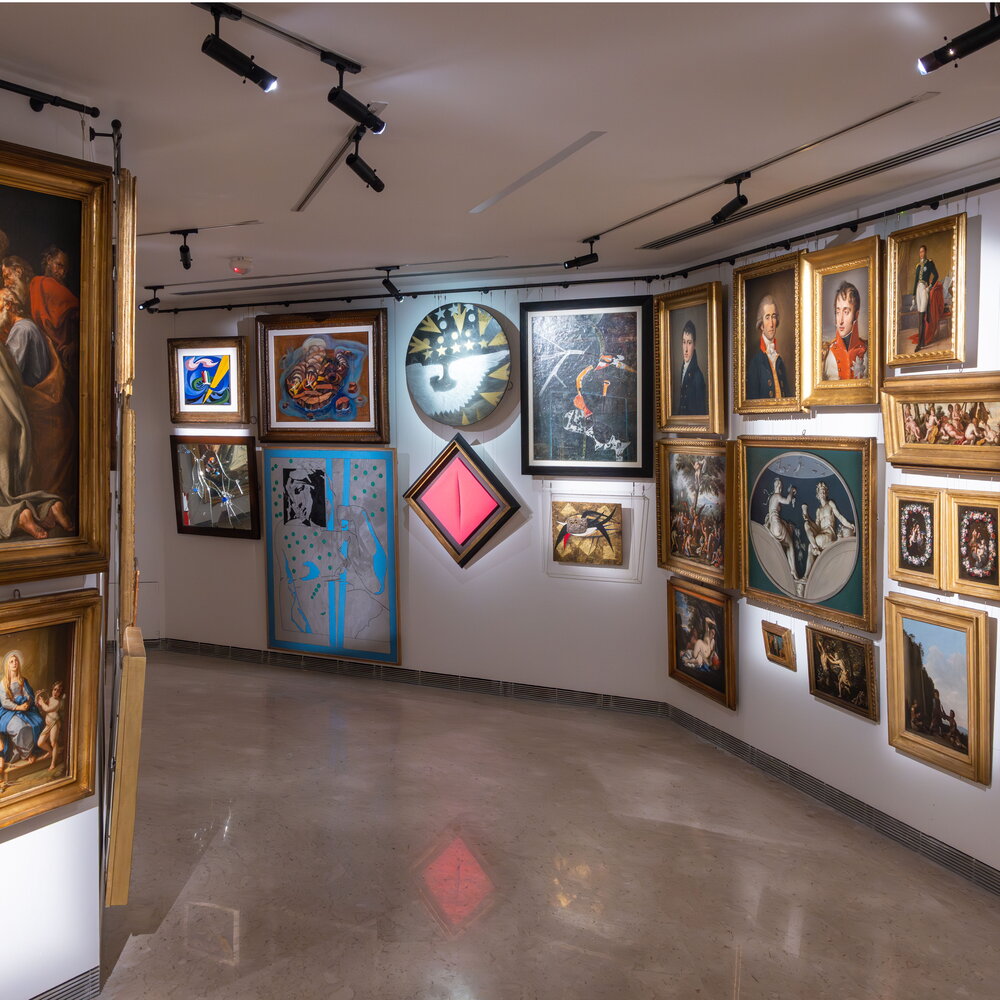
One year after the opening of Museo del Corso – Museum complex, which unites the prestigious Palazzo Cipolla and Palazzo Sciarra Colonna along via del Corso, the Rome Foundation presents the 2025-2026 season with a program of exhibitions, events and exhibition itineraries that consolidate the mission of offering the city a great cultural hub, where tradition, innovation and inclusiveness interact continuously. The Corso Museum – Museum complex, created to return a unique heritage of art and history to the community, continues in this way its growth path, presenting important to the public innovations that enhance the vast heritage preserved by the Rome Foundation, also thanks to prestigious international loans.
“With the opening of the 2025-2026 season of the Museo del Corso – Museum Complex, the Fondazione Roma renews its commitment to the city and its cultural heritage. The program we present today represents a further step in the path we have undertaken: enhancing art, preserve the memory and return places to the community and collections of extraordinary historical richness”, he declares Franco Parasassi, president of Fondazione Roma.
“The exhibitions dedicated to Carlo Maratti and in the long run artistic tradition linked to the Monte di Pietà they testify to our desire to bring different eras and languages into dialogue – he continues – creating a bridge between the past and the contemporary. Likewise, the renewed permanent collection and the vault of Palazzo Cipollatransformed into a unique space for cultural enjoyment, strengthen the mission of the museum center as a hub of knowledge and innovation. Our goal is clear: make the Corso Museum an open placeaccessible and inclusive, capable of telling the story of Rome and, at the same time, projecting itself towards Europe and the world”, adds Parasassi.
The exhibition ‘Homage to Carlo Maratti’
The season presents, first of all, the exhibition ‘Homage to Carlo Maratti’ (21 November 2025 – 12 April 2026), set up at Palazzo Sciarra Colonna, which celebrates the fourth centenary of the birth of the great painter from the Marche (1625–1713), undisputed protagonist of the Roman scene after the disappearance of Pietro da Cortona and Gian Lorenzo Bernini. Pupil of Andrea Sacchi and ideal continuer of the Raphaelesque tradition, Maratti was able to combine classicism and baroque in a new and original synthesis.
Exhibition divided into three sections
The exhibition, divided into three sections – Arcadian themes, sacred painting and portraits – recounts the main aspects of his production, highlighting the critical success and the vast following that his art had among students and painters of the eighteenth century. Among the most important moments is: the acquisition of Carlo Maratti’s painting ‘Portrait of Gaspare Marcaccioni’a work of extraordinary quality whose return to Italy represents an important act of recovery for the national artistic heritage and a contribution of the highest value to the Collection of the Rome Foundation.
‘De arte pingendi. Painting in the papers of the Monte di Pietà of Rome
The exhibition ‘De arte pingendi’ is also held in the same period. Painting in the papers of the Monte di Pietà of Rome‘, hosted in the Historical Archives of the Rome Foundation. The exhibition is inspired by the work 50 magical secrets for painting by Salvador Dalí, in which the artist celebrates the great masters of the Renaissance – from Raphael to Leonardo, from Bramante to Palladio – comparing them to the genius of his time, Pablo Picasso. Starting from this suggestion, the exhibition investigates the relationship, still little explored, between the Monte di Pietà and art: a link that sees the institution not only as client and custodian of an important artistic heritage, but also as a promoter of a specific iconography, determined by religious and moral themes who have guided its mission over the centuries.
The letter of Raphael and Baldassarre Castiglione to Pope Leo
The exhibition itinerary is enriched by two exceptional loans: the Treatise on painting by Leonardo da Vinci (1540), coming from the Vatican Apostolic Library, and the famous letter that Raffaello Sanzio, together with Baldassarre Castiglioneaddressed to Pope Leo X in 1519, granted by the State Archives of Mantua.
These documents dialogue with a selection of materials coming from the two archival funds kept by the Rome Foundation – that of the Monte di Pietà and that of the Cassa di Risparmio di Roma – offering the public an unprecedented itinerary through the history of paintingclients and institutions.
The permanent collection at Palazzo Sciarra Colonna
Alongside the large temporary exhibitions, the Fondazione Roma presents the renewed Collection permanent exhibition set up in the historic rooms of Palazzo Sciarra Colonna, once home to one of the most important Roman art collections. The new exhibition itinerary, which develops along the rooms of the main floor, spans four centuries of artfrom the fifteenth to the eighteenth century, and includes paintings, sculptures, furnishings, tapestries, leather and the precious collection of numismatics.
Exhibitions accessible free of charge upon reservation
The temporary exhibitions, the historical archive and the permanent collection are accessible free of charge, from Wednesday to Sunday, upon reservation via the Museum website. Also at Palazzo Sciarra Colonna, they resume every first Sunday of the month guided tours of the Cardinal’s Apartmentswith the rooms of the Library and the adjacent Cabinet of Mirrors, which still retain the original eighteenth-century layout designed by Luigi Vanvitelli intact.
Opening of the Palazzo Cipolla vault
The dialogue between ancient and modern closes with the opening of vault of Palazzo Cipolla, now redesigned as a visitable deposit. Maintaining its original function as a ‘safe’ of the ancient Cassa di Risparmio di Roma, the space has been transformed into a museum environmentconceived as an archive of painted treasures and at the same time as a real educational journey. Octagonal in shape, the vault has eight vertical walls in the center which tell the stories of the Bible, inviting the visitor on a journey through genres and iconographies: from sacred narratives to landscapes, up to portraits.
Organized according to thematic criteria that favor dialogue visual and symbolic between different eras, the works preserved thus become authentic “gold reserves” of the Foundation’s permanent collection. On the large steel armored door – a symbol of protection, memory and continuity – it condenses the very vocation of the vault: a place that preservesbut at the same time reveals, transforming the legacy of the past into an experience of contemporary discovery. Finally, in parallel, the exhibition path continues ideally in the rooms on the ground floor of Palazzo Cipolla with the exhibition “Dalí. Revolution and Tradition” (opened to the public last October 17, open to visitors until February 1, 2026), which brings over sixty works including paintings, drawings, documents and audiovisual materials to Rome.