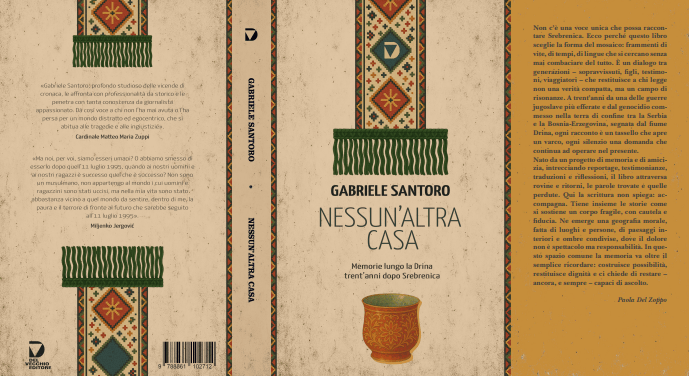
Thirty years after the Srebrenica genocide and the Dayton Agreementthe memory of that war returns to make itself heard in the book ‘No other house’ by Gabriele Santoropublished by Del Vecchio Editore (320 pages cover price 22 euros). A work that intertwines reportage, civil literature and testimony, with the preface by Cardinal Matteo Maria Zuppi and an unpublished contribution by Miljenko Jergovićamong the most important contemporary Balkan authors.
Ten stories
The volume collects ten stories that span three generations: the young soldier who survived the nights on the run in the woods, the women who searched for their loved ones in mass graves, and Bekir, born under the bombs and returning years later to bury his father, choosing life instead of revenge. They are voices that resist the shattering of humanity caused by war and entrust the recomposition of the conflict to the power of the imagination.
Santoro, who has conducted field research in Bosnia for years, builds a narrative mosaic in which individual memories are intertwined with landscapes: libraries, bridges, factories, places that become geographies of pain and care. The book does not seek a total story, but offers a series of fragments, all useful to keep the memory and listening alive. “Memory and oblivion are not neutral terrain – writes Santoro – but battlefields in which collective identity is shaped”. No other house is not just a journey into the past: it is a question about the present and everywhere. Because war doesn’t end with the last bomb: trauma is passed down, and facing it means dealing with today, in a world still crossed by conflicts and divisions. “If Europe died in 1995 in Srebrenica – recalls the author – we did little to demonstrate that that tragedy really concerned us”.
The project
The book was born from an oral history project created with the Alexander Langer Foundation and the Adopt Srebrenica association, to preserve memories and open spaces for dialogue between communities. It is a work that transforms memory into responsibility and offers a difficult, laborious and necessary prospect of peace. It was born in the summer of 2018, when the author crossed the Drina and listened to the voices from the silence of Srebrenica. “Thirty years later, recounting Srebrenica – warns Santoro – means reflecting on the unresolved issues of that history and the role of Europe, which then turned its back. Literature does not save, but it can alert, recalibrate, bring the soul back to a minimal grammar: subject, relationship, responsibility”.
The author
Gabriele Santoro was born in Rome where he lives. Professional journalist since 2010. He is the author of the investigative essay “The discovery of Cosa Nostra. Valachi’s turning point, the Kennedys and the first anti-mafia pool” (Chiarelettere, 2020) and the international political essay “Tutti i colori del rosso” (Feltrinelli, 2024). Since 2009 he has collaborated with “Il Messaggero” for the cultural pages. He writes for the Friday newspaper of “Repubblica”, Treccani, the Giangiacomo Feltrinelli Foundation and the Balcani – Caucaso Observatory. He is a television writer for Tv2000. He worked for “Adnkronos” and RaiNews24 foreign affairs.