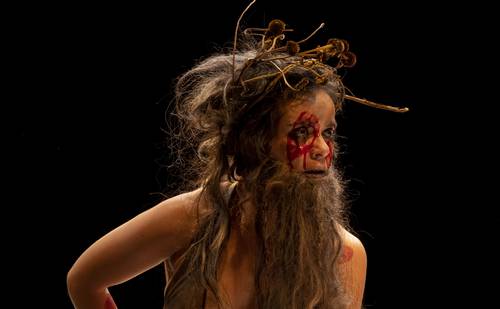
With an eight-year tour of national stages – an unusual situation in the Mexican theater environment –, Oedipus: No one is an atheist, He traveled to Spain to participate in the 43rd edition of the Autumn Festival of the Community of Madrid, considered the most important performing arts meeting in the Iberian country and one of the most relevant in the world.
Premiered in 2018, this work by David Gaitán – which tells a classic story from a contemporary vision – will offer performances today and tomorrow in the Green Room of the Teatros del Canal, a modern performing arts center located in the central Madrid district of Chamber.
It is part of a program made up of 23 theater, dance, music, dance and poetry shows from 17 countries, which began on the 6th and will conclude on the 30th of this month, and which also includes Mexican productions. Young lion, by Conchi León, and Until I find you, de Vicky Araico.
That the inclusion of these national proposals occurs in a context of diplomatic tensions between Mexico and Spain – which date back to 2019, when former president Andrés López Obrador asked the Spanish crown to apologize for the violence committed during the Conquest against the native peoples, a demand that President Claudia Sheinbaum has endorsed – does not affect the artistic aspect, considers actress Diana Sedano, who plays Tiresias, the blind oracle, in this version of Oedipus.
“As a creator you have to be aware of the reality that one goes through. That said, I hope I am not naive: I do believe that theater or art is not separated from the political, but it is not the primary theme of this work.
“If it touches on those themes or wounds, it is tangential. It is not its end. The work was made in 2018. The interesting thing is how it dialogues with reality. Reality, life and the quarrels that one may have are unstoppable,” he reflects.
In a telephone interview from the Spanish capital, the producer and director also cites, for example, that the first time they did this production, Covid did not yet exist, and one of the characters, the messenger, came in with a mask because he was talking about the plague.
“When we resumed the work, in 2022, after the pandemic, it was very strong; that same image had a completely different weight, which we had never anticipated.
“Reality moves forward. One makes a work and never imagines how it will dialogue with the circumstances and situations of the specific moment,” he points out.
“We never imagined making a political speech with face masks. It just happened. So, the crossing of a work of the caliber of Oedipus: No one is an atheist, which of course is a political piece, with reality it is the viewer’s job.
“The work was made without knowing about the covid or this political situation (between Mexico and Spain); but, if it is alive, it will dialogue with the reality that we have and where it is. This intersection is also done by the public when interpreting the signs and the conclusions it reaches.”
For Diana Sedano, a work at its best establishes questions, it does not give closed messages. “If someone finds these lines of intersection (the current relationship between Mexico and Spain) with the work, then the discussion is welcome. But we will not know until we present it,” he adds.
“The play is already a political gesture in itself; of course, staging it in Spain is a political gesture; now we have to see how that dialogues with the reality in front of us. It’s something we don’t know, we’ll have to wait for it to happen.”
Asked if she considered it a gesture of good will that the festival had invited the aforementioned Mexican productions this year, the stage creator assumed that such a response should be given to the organizers, but she stressed that, “beyond the gestures, the Mexican scene has a lot to say and a lot of talent.”
This piece by David Gaitán has managed to make old bones, with three seasons in Mexico City and one more in Guadalajara since its premiere, which is described by Diana Sedano as unusual: “What is common now are short seasons; the most Efiteatro gives is 24 performances.”
He asserts that it is a very current proposal in terms of theme: “One would think that the myth of Oedipus, which is foundational and ancestral, could be a little exhausted. But in this montage there are several edges. One is that Oedipus establishes ‘days for the truth’, a contribution from Gaitán to the narrative, to try to find the culprit of the plague.”
He quotes the German philologist Walter Otto to talk about the importance of myths in modern life: “Myths are here; that is, they are a latency of the soul, of the spirit, not an old story that was told a long time ago. They exist so much that the myth of Oedipus was taken up by Freudian psychoanalysis and still governs us in the West in many aspects.”
The cast of the play is made up of David Gaitán, Carolina Politi, Adrián Ladrón, Ramón Morales and Diana Sedano.