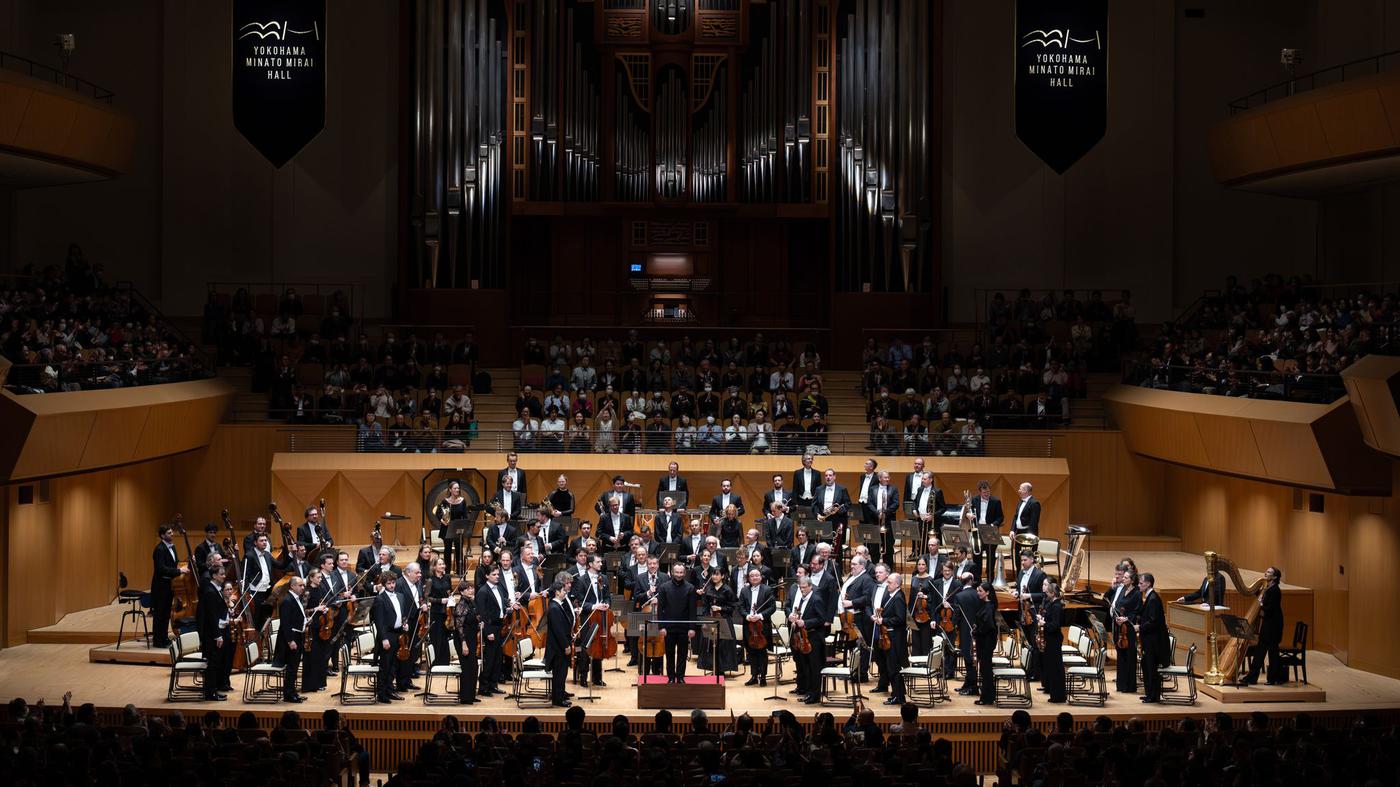
The Japanese don’t want to stop applauding. Kirill Petrenko, chief conductor and artistic director of the Berlin Philharmonic, has actually already changed when he appears on the stage of the Minatomirai Hall in Yokohama for the audience again – now in jeans and a sweater.
“The Japanese audience is incredibly enthusiastic,” says artistic director Andrea Zietzschmann to the dpa at the end of this year’s Asian tour of the Berlin Philharmonic in Tokyo – after appearances in the young growth markets of South Korea, China and Taiwan.
Japan is always a very special experience for German orchestras like the Berlin Philharmonic. “Every German orchestra longs to play regularly in Japan,” says Zietzschmann. “The Japanese have an incredibly high appreciation for culture and music.”
The enthusiasm is mutual. Not only are several Japanese members of the Berlin Philharmonic, the first concertmaster is the violinist Daishin Kashimoto. They have also premiered several pieces by Toshio Hosokawa, one of Japan’s most important contemporary composers.
Concentrated and as quiet as a mouse
The Japanese are extremely well versed in European classical music, engage with the pieces of music intensively and always listen to the concerts with great concentration – and always in complete silence. At the end there is always a quick round of applause with hands stretched up – always in the right places – almost like a kind of fury after deep concentration.
Connoisseurs like Walter Küssner, viola player with the Berlin Philharmonic Orchestra and married to a Japanese woman, explain the Japanese people’s love for German and Austrian classical music by saying that they can “feel an emotionality in the music that everyday life in their country’s society, where people interact with each other in a very formal and regulated manner, hardly allows.”
Tens of thousands belt out the ninth
The spread of German and Austrian classical music began in the Meiji period, when Japan opened up to the West after 1868 and brought foreign experts to the country.
At the beginning of the 20th century, the works of Beethoven, Bach, Brahms, Mozart and Schubert spread quickly throughout the island kingdom. German and Austrian composers became the core of the repertoire of Japanese orchestras. A special milestone was the performance of Beethoven’s Ninth Symphony in 1918 by German prisoners of war in the Bando camp – the first performance of this work in Japan. The “Ninth” is now considered Japan’s second national anthem.
“Classical European music is part of the Japanese educational canon,” explains Professor Hermann Gottschewski, musicologist at the renowned University of Tokyo, to the dpa. But Japan’s society is aging – and shrinking. And with that the number of people who are still interested in classical music is decreasing. After the Second World War, there was still a piano in practically every normal Japanese household, but this is no longer the case today. The number of music students has also fallen.
Young Korean and Chinese audience
“The teaching institutes are sometimes very burdened by this,” says Gottschewski. Some struggled for sheer survival with offerings such as adult education. The once high number of Japanese people going to Germany to study music has also fallen sharply, while the number of Koreans has increased – just as interest in the German language is declining in Japan.
According to the expert, it will soon be mainly Chinese people who want to study music in Germany. The German orchestras are also feeling the effects of the rapid aging in Japan.
“The Korean or Chinese audience is very young compared to the Japanese audience,” says Zietzschmann. It is fantastic to see how many young people are now enthusiastic about classical music in Japan’s neighboring countries South Korea, Taiwan and China.
For this year’s tour, the Berlin Philharmonic had a special public viewing in Taiwan’s capital Taipei, which was attended by several thousand fans despite rain and squalls caused by a typhoon. “The whole orchestra went out after the concert and greeted everyone.” It was very moving.
Conservative tastes prevail in Japan
The Philharmonic also owes the fact that fan groups who know the musicians gather at the artists’ exits not only in Japan but also in these countries to their Digital Concert Hall, a multimedia streaming platform that you can subscribe to and which has one of the largest fan bases in the world in the high-tech country of Japan. Nevertheless, conservative tastes predominate in program discussions with concert organizers in Japan, says director Zietzschmann.
“You would prefer to hear a German orchestra only with German repertoire,” she adds. Nevertheless, this year’s tour in Japan included, in addition to a program with works by Wagner, Brahms and Schumann, also one with works by Béla Bartók, Igor Stravinsky and Leoš Janáček. After all, these 20th century works were part of the core repertoire of the Berlin Philharmonic. Lesser-known orchestras, on the other hand, would have a difficult time with such an ambitious program in the rather conservative Japan.