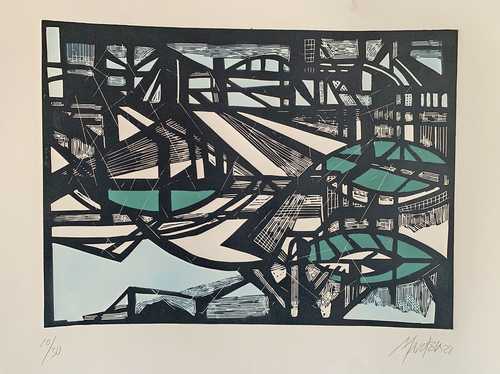
Although the sculptural and pictorial work of Gabriel Macotela (Guadalajara, 1954) is well known, “we have stopped to look less at its graphic side,” says his colleague Demián Flores, who prepared two exhibitions focused on the work of the Jalisco artist as an engraver.
The first, The measure of things, It is exhibited in the Cache gallery, in Mérida, Yucatán. This space debuts in Mexico, since its main headquarters is located in Montreal, Canada. The exhibition consists of 15 works and one intervention on site on a wall The second, The reinvention of the world, of 30 engravings, will be inaugurated on December 13 at the House of Culture of Juchitán, Oaxaca.
The Cache gallery, whose director is Mexican-Canadian Eric Bertrand, has served as a bridge with Mexican artists and the Montreal cultural scene, notes Flores, who was invited to propose an artist to start the project. “I was already working on the Juchitán exhibition; then, I thought of Gabriel. Furthermore, I had never had an individual exhibition in Mérida,” he details.
For Flores, graphics have been “fundamental” in Macotela’s career. “He is an extraordinary engraver who handles all graphic techniques and languages. We must remember that at the end of the 70s, Gabriel was a pillar within the strategies of the artist’s book. He had his publishing house, La Cocina Ediciones, together with Yani Pecanins. Later, El Archivero was a space for the dissemination and promotion of the artist’s book.”
The exhibition is also a review of the workshops in which Macotela has worked.
Beyond technique and language, Gabriel Macotela “is one of those great artists who also has that link with the social. There are very few who take that breath like Francisco Toledo did. For me, Gabriel is another artist with a humanist sense who not only has his own, individual work in the plastic arts, but also has a directly social link.
“He is present when he goes to paint walls, fences, demonstrating. That speaks of a person who, in addition to an impressive artistic development, has had a totally ethical life, linked to what he thinks and believes. It is difficult to find creators of such a strong magnitude, with a social sense and committed to the things that happen to us daily, which sometimes we are not able to talk about, but he is. Gabriel has always been a critical, thinking voice.”
A neglected generation
In August 2024, Macotela was the subject of a tribute from the National Institute of Fine Arts and Literature for his 50 years of “passionate artistic life dedicated to experimentation and critical reflection of his environments, and for his commitment and social activism through the arts.” However, it belongs to a generation that has yet to be fully appreciated.
According to Flores, “Gabriel’s generation has been a very forgotten and little attended generation.” Emphasizes the need to review the work of its representatives. He finds it “incredible,” for example, that Macotela does not have a book of his production. “It has a very strong art market, although it is not from galleries, but from collectors who look for it,” he indicates.
In the 70s of the last century Macotela was part of the so-called Generation of Groups as he belonged to Suma. “Much of conceptual art, that is, of the new contemporary languages, is due to these generations that were the ones who started it. Everything that Grupo Suma did, using the streets as a creative laboratory, the use of stencils, stencils and this idea of repetition, is the beginning of what we do now.”
For the artist and curator, Macotela is “fundamental for the subsequent development of new generations. It would be fair to review these artists who are key pieces to understanding the visual medium in Mexico.”