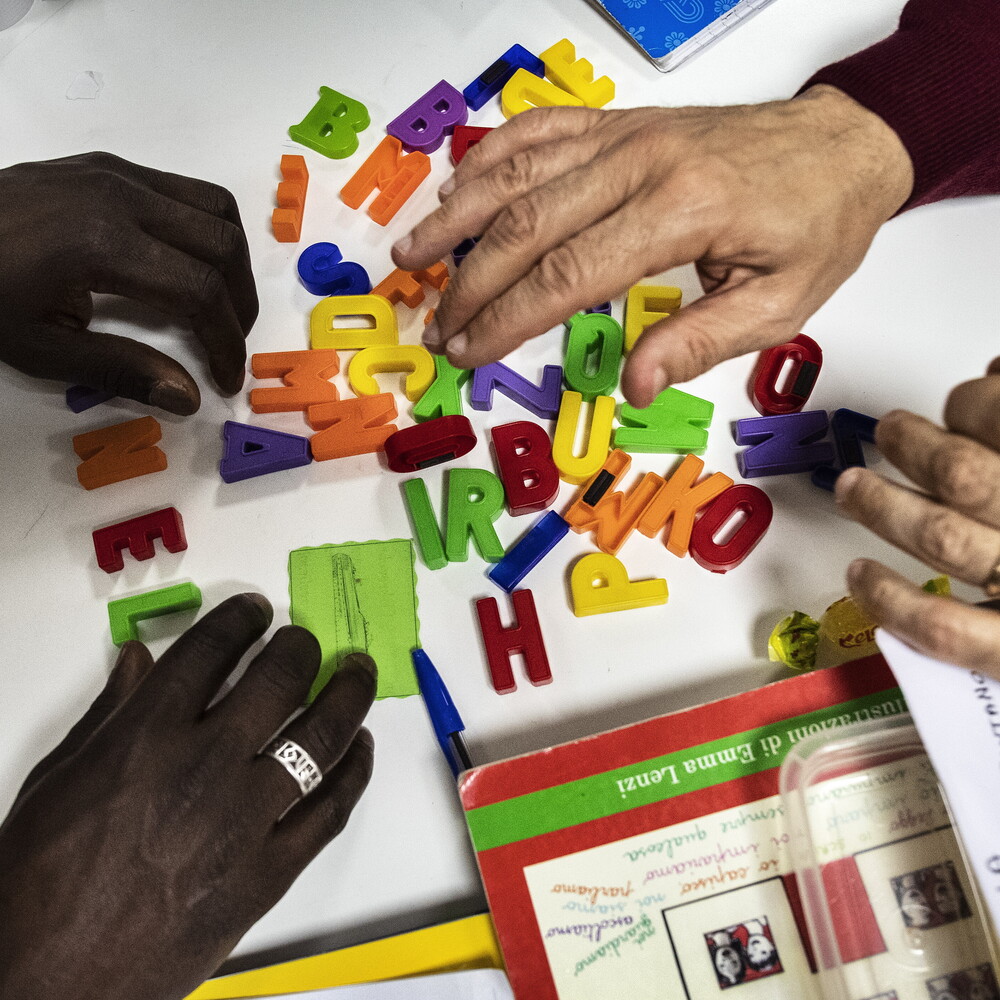
Italian resists, but it is under siege, threatened by an army of chats, vowels, abbreviations, emojis, anglicisms thrown everywhere. A “new technological vernacular”, as Saro Trovato, sociologist and mass communication expert, defines it, which every day puts pressure on basic rules of our language.
From this concern was born “501 quizzes on the Italian language”, just released by Newton Compton. A game book designed not only for those who love Italian, but for those who feel that something is missing in the race between notifications, memes and instant messages.
A game to play with the family (and a little linguistic resistance)
The volume contains 501 multiple choice questions on grammar, spelling, history of the language, daily use, literature and poetry. It is not a “serious” manual, but a book-game to use at homein class, in evenings with friends: we challenge each other, we make mistakes, we laugh, and in the meantime we naturally review accents, subjunctives, concordances, author quotations.
Trovato, founder of the digital community Libreriamo, defines it as a “society book”: an object to be placed at the center of the table to create conversation, comparison, even between generations. Because if younger people live immersed in the language of social media, it is often their parents and grandparents who wonder how to reconnect with correct Italian without seeming like bigoted professors.
The “technological vernacular” and the risk of a half-language
Hearts instead of words, sentences reduced to the bare bones, punctuation eliminated, anglicisms used as shortcuts: this is the “technological vernacular” that the author focuses on. Not to demonize smartphones and social mediabut to remember that a poor language also limits thinking and the possibility of truly understanding each other.
Defending Italian, in this perspective, It’s not nostalgia for purists: it means preserving a common tool, which allows people of different ages, backgrounds and skills to meet on the same ground. If the rules fail completely, communication becomes faster but also more fragile, more exposed to misunderstandings and extreme simplifications.
From Crusca to the web: when the quiz becomes serious
To underline the seriousness of the project there is the preface by Paolo D’Achille, president ofCrusca Academy. A strong signal: the world that studies and protects the Italian language supports a popular, light format, built specifically for social media.
It’s no coincidence: for years Libreriamo has been experimenting with quizzes and viral content on the languagecapable of reaching millions of people online. The book brings that same formula to paper (and in e-book), transforming it into a small mental gym: each question asks you to remember, choose, reason. A simple way to train memory and attention, in an era in which we scroll through text and images almost without stopping.
An invitation to slow down
Ultimately, “501 quizzes on the Italian language” is also an invitation to slow down: close the apps for a moment, go back to the words in fulldeal with doubts that we thought we had solved in elementary school (“do you write which one is with the apostrophe?”) and perhaps discover something new.
Because Italian does not defend itself with proclamations or bans, but by using it better, more consciously. Maybe, why not, even playing.