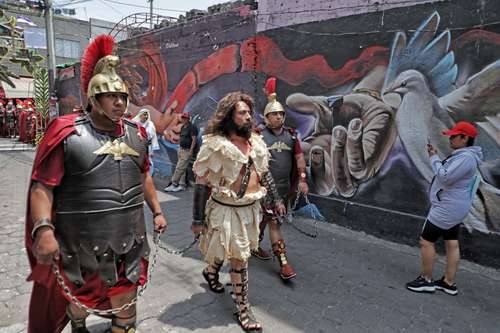
The representation of the Passion, Death and Resurrection of Christ in Iztapalapa, a tradition that unites the faith and community participation of the eight original neighborhoods of that town, is one of the 68 candidates to be part of the list of intangible heritage of the United Nations Educational, Scientific and Cultural Organization (Unesco, for its acronym in English).
In a statement, it was reported that the Intergovernmental Committee for the Safeguarding of the Intangible Cultural Heritage of UNESCO will hold its twentieth ordinary meeting from December 8 to 12 in New Delhi. There, the 68 candidacies presented by 78 States will be examined for inclusion in the Convention Lists.
Intangible cultural heritage includes oral traditions, performing arts, social practices, rituals, festivities, knowledge and skills that communities, groups and individuals recognize as part of their cultural identity. Unlike objects and monuments, intangible heritage is a form of living heritage transmitted from generation to generation, whose evolution is linked to that of communities.
It will encourage measures for its continuity
This heritage reinforces the sense of belonging, stimulates creativity and promotes dialogue between cultures. Through their recognition in the UNESCO lists, the diversity of traditions is highlighted and countries and communities are encouraged to take measures for their safeguarding and continuity.
The members of the Holy Week Organizing Committee in Iztapala AC, a collegiate, autonomous, horizontal, inclusive and representative body of the eight original neighborhoods that exist in the town of Iztapala, expressed their consent for the Mexican government, through the National Commission of Intangible Cultural Heritage, to present the candidacy of their cultural expression.
According to the committee’s consent document, the community participation process included registration in the inventory of the Intangible Cultural Heritage of Mexico, and the instruments for the application were prepared from September 2022 to December 15, 2023.
The announcement of the candidacy for the representation of Mexican Holy Week is very important, since it is a tradition that involves thousands of inhabitants of the eight neighborhoods of Iztapalapa, who each year renew a community commitment that combines popular theater, rituality, historical memory and neighborhood organization. This social fabric, transmitted generation after generation, is what UNESCO seeks to preserve.
This year, Mexico competes with Afghanistan, Argentina, Bangladesh, Belgium, Belize, Bolivia, Bulgaria, Chile, China, Croatia, Cuba, Egypt, El Salvador, Ethiopia, Georgia, Haiti, Iceland, India, Indonesia, Italy, Japan, Kenya, Paraguay, Peru, Portugal, Romania, Venezuela and Vietnam, among other countries.
The list of intangible cultural heritage requiring urgent safeguarding measures identifies elements of living heritage whose continuity is threatened and allows states parties to the Convention to mobilize the international cooperation and assistance necessary for the development of safeguarding measures.