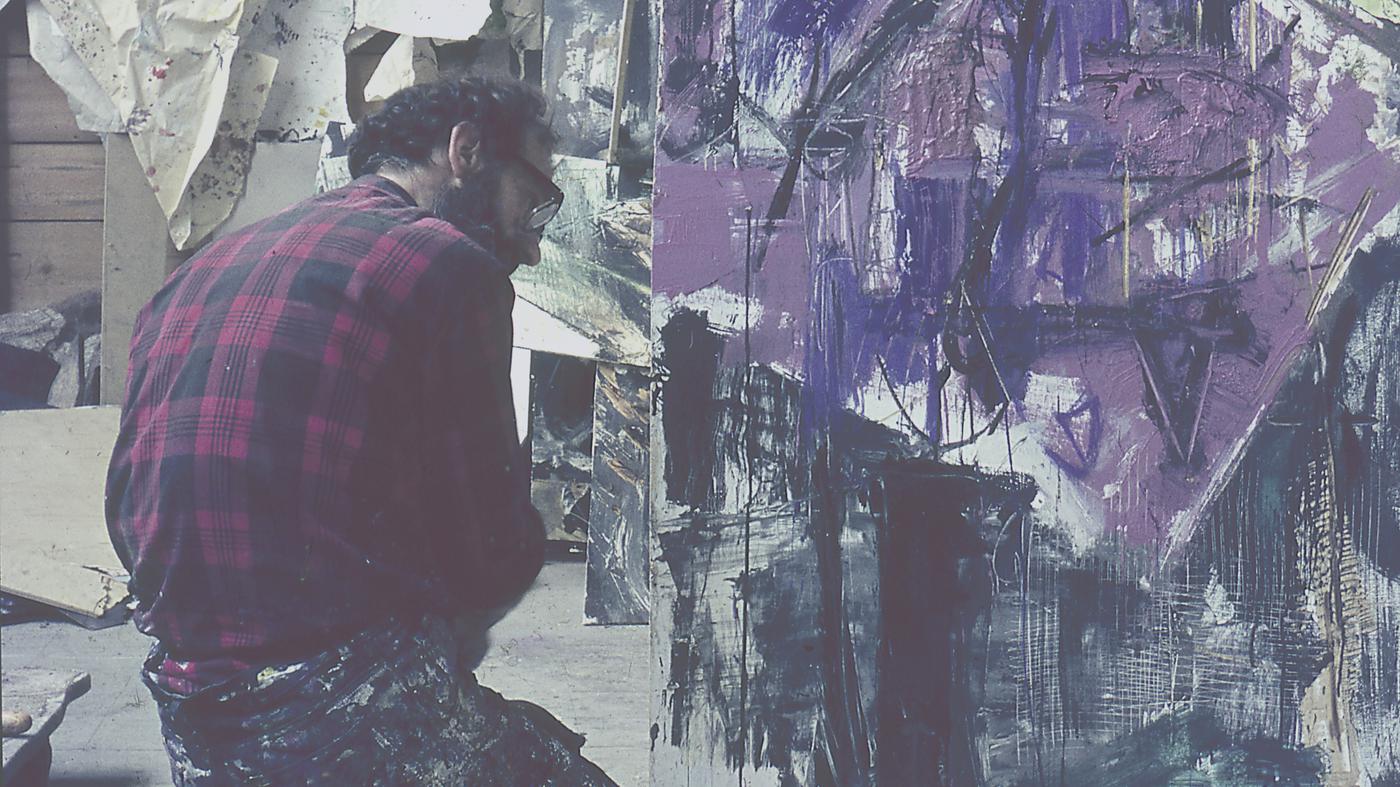
For its tenth birthday, the Kunsthaus Dahlem is giving itself a special present. Emilio Vedova’s expansive and captivatingly dynamic works return to the place where they were created. Because it was precisely here in the former studio of the Nazi sculptor Arno Breker that the Venetian created these huge, hinged, movable and picturesquely exuberant formats, which he called “Plurimi”.
The artist is often considered a leading representative of Informel, but he himself found this inappropriate. He did not perceive his works as “formless”, but on the contrary as strongly structured. In fact: the small bozzetti on display, i.e. design models made of cardboard, reveal how systematically Vedova proceeded. Extremely knowledgeable about art history, he located himself in other traditions.
The exhibition impressively shows how closely Vedova, born in 1919, linked himself to the politically and artistically rebellious Dada movement in Berlin and also took up its collage technique. His art is expressive in any case. And it invites viewers to interact, to walk around and come closer, so invitingly that this time the museum management couldn’t do without barrier tape to protect the exhibits. Because the brutal-looking large formats made of found doors and angular plywood panels, balanced into the room with rusty hinges and coarse ropes, do not hold on to the walls.
© Photo: Vittorio Pavan, Venedig
They make painting a three-dimensional affair. However, the artist did not see himself as a sculptor. His great guiding star was the old Venetian master Tintoretto. A nervous restlessness also pulsates in his works. But when it comes to painting dynamics and coloristic furor, Vedova is of course in a different league. His application of paint appears harsh and wild, completely untamed. People scratch, daub, glue and even work with their bare hands.
Photos and film footage show the paint-spattered artist in full action. The lanky two-meter-long man with his impressive full beard was obviously constantly on the move, a motorcyclist who translated his urge for activity into rapid painting gestures and an unbridled joy in experimenting. It was no coincidence that he ended up in the 9 meter high state studio of Hitler’s court artist Breker.
© Emilio and Annabianca Vedova Foundation, Venedig © Photo: Vittorio Pavan, Venedig
Emilio Vedova came to the walled city in the fall of 1963 with a scholarship from the US Ford Foundation. He found an academy studio offered to him too small and, above all, too dark. The Venetian, who was used to light and grew up as the son of a craftsman among the radiant church buildings of the Serenissima, set out to look for a more suitable work space. One in which he could develop.
Vedova worked against the spirit of Arno Breker
“Berlin / Käuzchensteig, 1” is what Vedova called an impulsive ink drawing, his debut work: abstract. At the very end of the quiet residential street, already half-enclosed by the pine trees of the neighboring Grunewald, stands the studio house designed by Albert Speer, planned as part of a Nazi elite settlement. He was very aware of the legacy Vedova was taking on here. He opposed this with his fear of freedom.
But first it had to be cleared out. The Berlin metal sculptor Bernhard Heiligener worked in the side wing. Vedova apparently didn’t get along with him at all, said museum director Dorothea Schöne. The characters and political attitudes were too different. As an anti-fascist and former partisan, the politically wide-awake Vedova was decidedly left-wing, also took part in demonstrations and, in the conflict-heated year of 1968, created a collage series of newspaper photos in which striking keywords such as “Dutschke”, “Vietnam” and “España Libre” leave no doubt about the intended effect.
Vedova’s admiration was for Dadaists like George Grosz and their socially critical edge. The elderly Hannah Höch visited him in the Dahlem studio, and he also exchanged ideas with John Heartfield and his brother Wieland Herzfelde. He was also networked in the younger scene and met Hans Scharoun and the architect Werner Düttmann, who a little later built the Brücke Museum on the neighboring property.
Documenta impresario Arnold Bode balanced high up on a ladder in the chaos of the Vedova studio to examine the works to be exhibited. The artist donated his best-known major work from 18 months in the divided city, the “Absurd Berlin Diary ’64”, to the Berlinische Galerie. The giant, multi-part structure will be exhibited there again next year; it is currently stored in the depot.
Four other large “Plurimi” have returned to Dahlem for the current show. One, privately owned, spreads its wings screwed high up on a wall. The three floor works come from the Fondazione Vedova. It is based in the artist’s Venetian studio house, a medieval salt warehouse in the Dorsoduro district. Today it is a chic cultural district, not far from the financially strong Pinault Collection and the church of Santa Maria della Salute.
At that time, in the 1970s, the area was slated for demolition to create public swimming pools. Emilio Vedova’s massive protest helped to save the historic building and thus a piece of cultural heritage. There was primarily a practical reason why he moved into these historic walls: he needed the largest possible studio space, says Vedova expert Elena Bianchini from the Fondazione. And that was in short supply in Venice, just like in Berlin.
A little later, the DAAD took over his Grunewald studio on Käuzchensteig for its artist exchange program. The huge main room was now divided into eight small nesting rooms using a false floor for several scholarship holders. It has only been possible to experience it in its original dimensions again since the Kunsthaus Dahlem moved in.