In the last part of the interview with Lieutenant Colonel Lanfranco DisibioHead of the Operations and Logistics Section of the Command Carabinieri for the Protection of Cultural Heritage and “Blue Helmet of Culture” on the investigative activity of our art detectives let’s retrace some of the most famous investigations which allowed the return to Italy of assets considered lost, but also disputes still open. In Rome from 2022, there is a special museum which collects in rotation the exhibition of works of art stolen from natural or anthropic disasters such as wars, looting or thefts: this is the “Saved Art” museum in the Octagonal Hall of the Baths of Diocletian.
Returning to investigations: we often read about disputes between the Italian state and foreign museum institutions. How is it possible that some large museums have exhibited works of art that were illegally stolen from Italy?
It is a problem that has been dragging on for many years and there is generally a reversal of the trend and is linked above all to a different conception of the concept of ownership of cultural goods, between countries that we define as producers of cultural goods and consumer countries. Let’s start with this idea. Normally, consuming countries are those that have the regulatory regimes Common Law and producing countries have a civil law system. That speech I made before I dig on my property, if I find something it belongs to the State, this reasoning in England and America is very difficult to get through. Let’s say that over the years there have been many museums where there was market demand, which received on the “grey” market because we have to define it as such, then everything goes to demonstrate that in this market there was awareness of an illicit provenance of these goods on the part of the museums.
Can we give some examples?
To give an example, the Euphronius Craterdepicting the death of Sarpedon. This vase, which was excavated in the 1970s in Cerveteri and which was then sold after a passage in Switzerland to the Metropolitan Museum of Art in New York, was recovered in 2008 after a series of investigative activities which made it possible to demonstrate to the Met that the item came from Italy, from where it had been illicitly exported. When it arrived at the museum at the Met in New York, they said about its origin that it was a good that came from the Middle East. There are important museums such as the Paul Getty Museum in Los Angeles, from which we still carry out recoveries today.
Once the good has been identified, how does the return request take place?
Every time you have to try to demonstrate to the museum that the work is Italian, that it is inalienable, that it was exported unduly, that it entered the foreign country irregularly. Over time there has been an increase in the sensitivity of museums, which have enriched themselves with works from different countries, with goods that have been looted by traffickers and who have disguised these sales through false documentation on the origin. Then the fact that museum experts can have the cultural and scientific tools to verify in a more in-depth manner whether these documents are original or not, is another matter that brings into play the problem concerning the good faith of these institutions.
Are there open disputes with the USA?
Today we once again opened the case of the Athlete from Fano on which there are also favorable sentences in Italy.
Is there hope that you will return to Italy, sooner or later?
I hope so! The dispute is open. The Athlete of Fano represents the centerpiece for the museum. It would be like taking away the Riace Bronzes from Reggio Calabria.
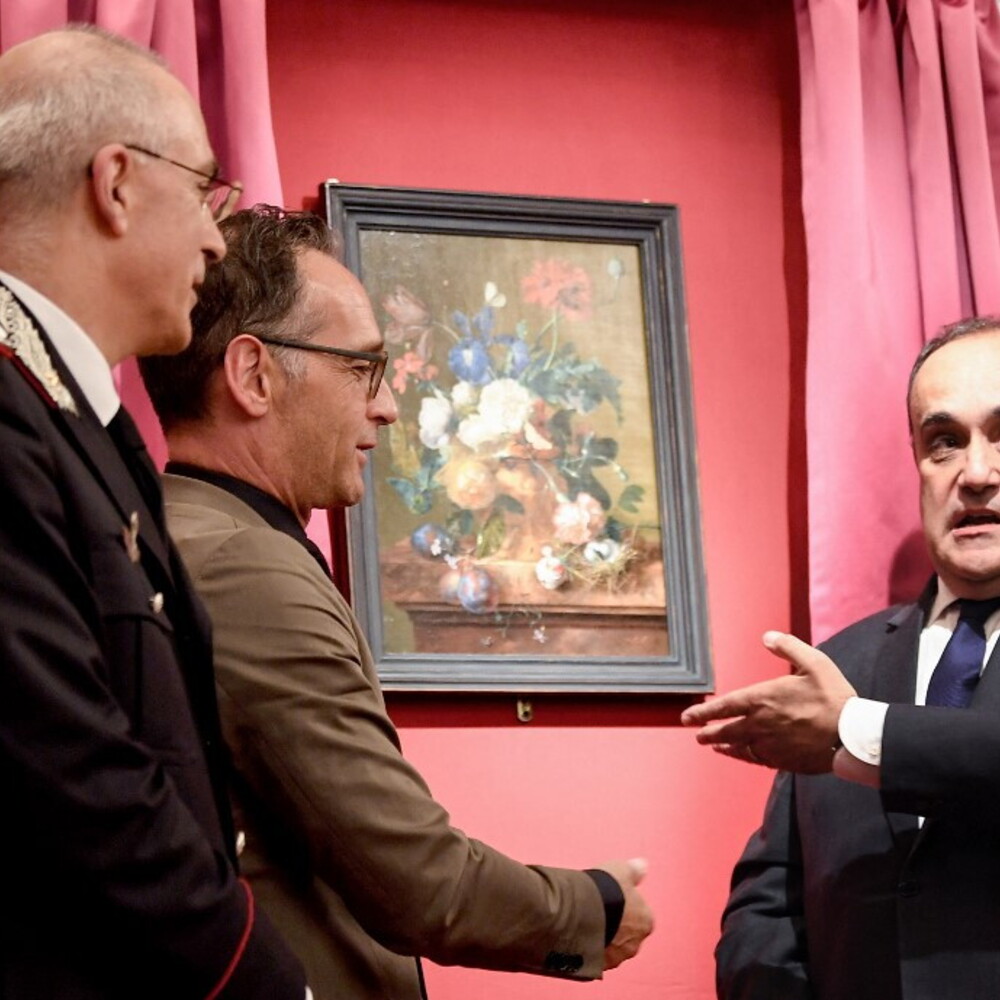
You participated in the recovery of the painting “The Vase of Flowers” by Jan van Huysum which returned to Palazzo Pitti 75 years after the theft. What kind of investigation was that?
A complicated investigation. Some German professionals tried to return the property for consideration, therefore as if Italy had to buy it back, claiming that the family that owned it had acquired it in good faith. It was therefore necessary to carry out historical and documentary research that started in the 90s and ended in 2019. This work, after fall of the Berlin Wall from Germany to the East it reappears and is taken to Munich to be restored. It was taken away from the Palatine galleries of Florence during the Second World War, in 1940 to be exact, from the depots where they had been set aside for security reasons, but the Germans managed to locate these depots. During transport to Germany, this painting along with others disappeared. As part of the research we demonstrated that the German soldier who received this work sent it by military mail to his wife as a wedding gift. Reconstructing the story was possible because one of the lawyers who attempted to ask for money for the return of the canvas forgot a folder full of documents. But the numerous attempts to negotiate the return of the work for consideration have made it possible for the Florence prosecutor’s office to configure an extortion attempt. Their request was for millions of euros. One of the lawyers who arrived in Florence to negotiate with the director of the Palatine Gallery, carrying photos of the work as if it were a hostage, however forgot a folder full of documents which was then sent back to him. An official made photocopies of the contents and many years later, in 2016, she handed it over to the Carabinieri. From the analysis of this documentation we were able to discover that the work had never left the family axis of the person trying to sell the work and therefore possession in good faith was totally excluded. That German soldier who sent the work to his wife was the grandfather of the person who, decades later, tried to sell the canvas to Italy. We succeeded in the operation also thanks to the press, especially broadcasting “Who saw it?”. On the one hand, the exhibition of a copy of the painting with the wording “Stolen” by the director Eike Schmidt and the collaboration with the editorial team of the Rai broadcast made it possible to bring the work back to Italy. Once it became known in the media, it also proved impossible for the heirs to sell it.
Click here and subscribe to our Whatsapp channel! News, in real time, from Agenzia Italia now also on your smartphone