This was announced this Wednesday by the BNE, which organizes the exhibition with Acción Cultural Española (AC/E) and the Provincial Council of Álava, with the collaboration of the ACS Foundation and the Friends of the National Library of Spain Foundation (FABNE).
In the documentation process, the professor of Hispanic Literature at Brooklyn College (City University of New York) Álex Alonso Nogueira has located two unpublished texts that the writer had sent for evaluation in 1952 and 1953 and that were never published in their entirety.
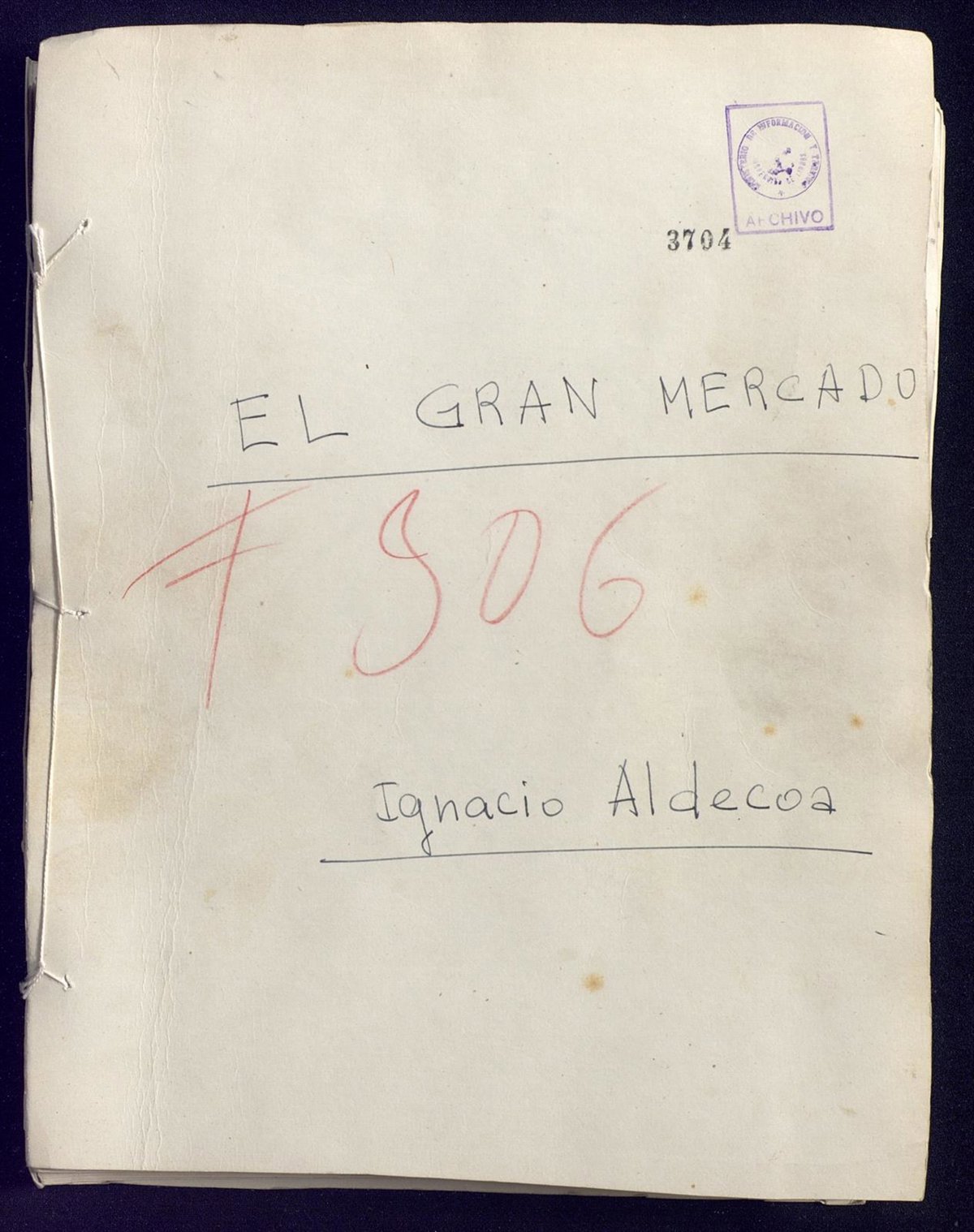
It is about the typescript of the short novel ‘City of Afternoon’with which Aldecoa had been a finalist for the Café Gijón novel prize in 1952, and for the typescript of an extensive novel of more than three hundred pages, titled ‘The Great Market’ and that, according to the documentation preserved in the same file, it was going to be published by the Planeta publishing house.
The censorship authorized the publication of both texts, of which no other copy is known.. They were never collected from the archive, neither by the author nor by the editors, and they have remained there until now. According to the BNE, although they were partially reused and served as material for some of his stories (such as ‘Vespers of Silence’ or ‘The Market’), “novels as such can and should be considered unpublished texts“.
Regarding the typescript of ‘El Gran Mercado’, he explained that it is preserved in “very good” conditions and can be seen, along with the documentation that accompanies it in the censorship file, in the exhibition ‘Ignacio Aldecoa. The craft of writing’, which will be open until June 14, 2026 in the Jorge Juan Room of the BNE.
MATURITY OF STYLE AND COMPOSITION
For Álex Alonso Nogueira, it is about “two relevant texts in the author’s career, in which Aldecoa demonstrates a maturity of style and composition that deserves to be highlighted“. The BNE has indicated that ‘The Great Market’ is an “ambitious and choral” novel in which, In the style of ‘The Beehive’, various stories are intertwined and a detailed tour is offered through multiple scenarios of a post-war Madrid in which misery coexists with the well-being of a well-off middle classes with advantage to the new circumstances.
According to the professor, it is also “significant for understanding the evolution of the Spanish novel of the time, since it is a text that opens the way to the new objectivist and social realism, a sign of identity of the young generations of writers in the 1950s.“.
Professor José Ramón González, curator of the exhibition and professor of Spanish Literature at the University of Valladolid, emphasizes that “it is a discovery important and not merely anecdotalbecause it allows us to delve deeper into the author’s career and better understand what his narrative project was from the beginning, since they would be his first two novels“.
In his opinion, in the second of them, ‘The Great Market’, the entire narrative program that the author would deploy in his short fiction and in his novels is contained in germ until the moment of his death. “The humble and dispossessed characters who star in many of his stories circulate through it.but also those inane and selfish middle classes that emerge from time to time in his stories, especially in those of recent times, and that the author portrays with an irony and a distance in which a slight, somewhat burlesque tenderness is never absent,” he points out.
The National Library of Spain has pointed out that this discovery “enriches the centenary exhibition and is an excellent example of the documentary wealth of the national libraries and archives. in which it is still possible to delve deeper for a better knowledge of our past and our present“.