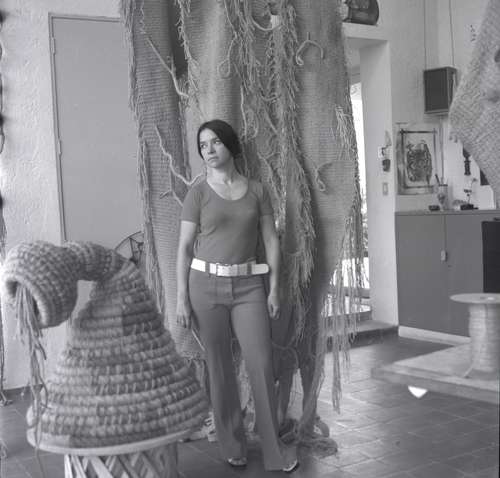
The notebooks and personal diaries of the Catalan-Mexican artist Marta Palau (1934-2022), which her family keeps, served as the basis for creating My paths are terrestrialan anthology of a hundred pieces, including installation, tapestry, drawing, painting and archival material, which are exhibited at the University Museum of Contemporary Art (MUAC). Palau arrived in Mexico in 1940, accompanied by her family, as part of the Spanish republican exile, and settled in Tijuana.
Access to said archival material allowed us to propose a “new curatorial thesis,” according to Imma Prieto, curator of the exhibition and director of the Tapies Museum in Barcelona, where it was shown at the beginning of the year, since it is a collaboration between the Catalan venue and the MUAC.
“Marta was very good at writing. We have not been able to see all of her notebooks; however, those that we have have allowed us to enter into her deepest thoughts and propose a new way of seeing her work,” says Prieto, to whom “chronological retrospectives” seem “boring and easy.” “The works are always autonomous and when they are strong it is generally because there is a conceptual framework on which they are based. There are concepts that can appear in the work regardless of the period,” says the curator.
With this new curatorial thesis, making the exhibition “retrospective” would be equivalent to “not having understood anything, because the new script we propose is based on the relationship between history and magic, especially historical time which, for Marta, is not linear, but cyclical. She writes that in her notebooks. That is why making a linear exhibition would be against her own thinking.”
For the curator, Palau had “a lot of intuition that she was able to channel.” Then, “he thought about all this, he transformed it. I imagine that certain readings when working influenced his work, even if it was not consciously.” It stands out that it has “Madame Blavatsky, a Russian theosophist of the 19th century, so present, and speaks of an analysis of society that affects history and the way of understanding that magic, that spiritual part of the works.”
Diary of a failure
The title of the exhibition is taken from one carried out in 1985. Thanks to access to personal diaries, “one was found from that same year entitled Diary of a failurein which he explains how the spiritual has surely always been in his work; However, she was not aware of it. That same year he titled an exhibition My paths are terrestrial. That is, a spirituality that is earthly. It is not a beyond, it is a more here, a spiritual part that necessarily arises from a dialogue with the environment, with nature.”
Prieto learned about Palau’s work “by chance”: “it was the time of the pandemic. In a book of mine about Mexican artists I found a photograph of a work by Marta. Her last name caught my attention because I am also Catalan. When searching on the Internet I found the contact of her daughter, Marta Gassol. I called her on the phone, I said that I was interested in her mother’s work and that I would go to Tijuana to see it. While there I wrote to Cuauhtémoc Medina, then curator at head of the MUAC, who told me that Amanda de la Garza, the previous director, was also interested.
“On my way back from Tijuana, I stopped in Mexico City, met with Amanda and we decided to do the exhibition together. At that time I was director of the Museum of Contemporary Art of Mallorca, while Amanda became deputy director of the Reina Sofía Museum. The closer I got to Marta’s work, the more my passion increased. Hers seems to me to be a pioneering work in many ways.”
For the curator, Palau is a “multifaceted” artist, owner of a work with “many layers of meaning.” Furthermore, “he knows how to create a striking dialogue between the personal and the collective. He appeals to a self that transcends that individuality.”
Palau’s production had its different eras. It represents the “liberalization” of the artist with respect to technique. That is to say, he is no longer just a painter or sculptor, but “depending on the project at hand he chooses one language or another.”
Known above all for her work around textiles, Prieto remembers her experience in Josep Grau-Garriga’s workshop. “There, Marta approached another way of understanding textiles that goes beyond a two-dimensional plane. Grau-Garriga worked primarily on volume and space, that is, materiality. Marta incorporates all this in her work, but rooted in that Mexican reality, such as introducing corn or other native elements, especially from Baja California.”
In parallel to the exhibition, the Chopo University Museum restores Quetzalcoatlusa work made by Palau in 2003 to be exhibited in that space as part of the exhibition fantastic zoologybelonging to its collection. Made with paper, leaves, branches and bark, the piece will be assembled in the place it originally occupied starting today.
Marta Palau. My paths are terrestrial It will be exhibited until May 3, 2026 at the University Museum of Contemporary Art (Centro Cultural Universitario, Insurgentes Sur 3000, Coyacán).