Álvar Carrillo Gil met the Mexican artist Gunther Gerzso (1915-2000) when he had his first exhibition at the Mexican Art Gallery in the 1950s. Over time, the Yucatecan pediatrician bought pieces from him that were considered “fundamental” in his production, such as those in the series Greece landscapewhich, being the first of early architecture, are “historical pieces of what he would do throughout his life, which ended in abstractions.”
At that time, when he made his first exhibition, Gerzso was “quite depressed because he thought it was no good,” says Carlos Palacios, curator of Gunther Gerzso: Something in common with the pastan exhibition mounted at the Carrillo Gil Art Museum (MACG), whose base is 46 paintings and a sculpture by the artist, both from the permanent collection of the venue and other collections, made between the 50s and 90s. Works by 24 modern and contemporary artists, such as Georgia O’Keefe, Lucio Fontana and Graciela Iturbide, “dialogue” with them.
A successful designer of theatrical and film sets, Gerzso was indeed depressed because he never intended to be a full-time painter. “He painted as an exercise in composition and color – he was a great colorist -, in parallel to his work as a set designer. He knew that architects, like Le Corbusier, did the same. He was not a ‘Sunday painter’ nor did he do it as a hobby, but rather when there was no film project on the horizon,” according to the site www.gunthergerzso.com
Starting from the core Greece landscape “Many stories and associations could be interwoven from the themes that Gerzso handled, such as color, which I grouped from the works in the collection,” says Palacios, for whom the artist of Hungarian-German descent is “a fine, elegant and original painter, in addition to being one of the few artists of the 20th century who associates abstraction with figuration and vice versa to create a new pictorial language in which the work based on reality, in the past, is presented in a completely balanced way. and advanced towards the future.” His is “a unique work of Mexican art in the 20th century.”
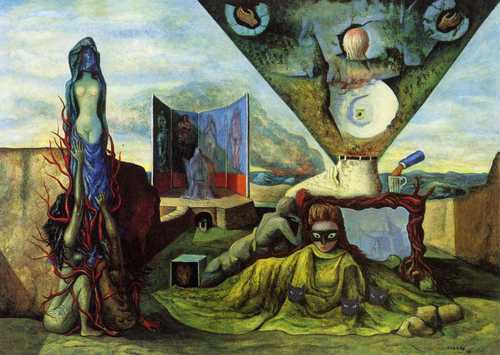
The exhibition focuses on Gerzso’s abstract work, therefore it does not consider his surrealist period.
Returning from a stay in the United States – where he received a scholarship to study at the Cleveland Playhouse – the set designer, also educated in Europe, interacted with the group of surrealist artists who lived as refugees in Mexico at the time of the Second World War, among them, Leonora Carrington, Remedios Varo, Benjamín Péret, Alice Rahon and Wolfgang Paalen.
The oil The days of Gabino Barreda Street (1944), by Gerzso, is the living memory of the first house rented by the Varo-Péret couple in the San Rafael neighborhood, converted into the headquarters of this European artistic movement. For Palacios, chief curator of the MACG in 2012 and 2019, when Gerzso decided to be a painter it was after the surrealist period and the series Greece landscape.
From Gerzso’s time as set designer, Palacios only included a fragment of the film Raquel’s bolero (1957), starring Mario Moreno Cantinflasto the extent that its design reflects an “idea of modernity” by using “elements of the iconography of Le Corbusier, one of his great artistic references.”
“Spatialist”
–Is Gerzso a forgotten artist? –Palacios was consulted.
-Don’t know. He is an eccentric artist in the sense that he is outside the center, of the stories of modern art of the 20th century in Mexico. Isolated in some way from a genealogy, for me he founds his own based on this absolute invention that consists of taking textures and spaces. He is a ‘spatialist’, which makes him interesting as a painter. He works with the idea of space, which is why he does not paint landscapes or monuments from the pre-Hispanic past. It takes elements from that and generates a new language.
Regarding the influence of archaeology and architecture on his work, Palacios remembers that Gerzso commented to the art critic Luis Cardoza y Aragón that without pre-Hispanic art “my painting would not exist.” The exhibition includes a photograph by Graciela Iturbide in which Gerzso’s hands are seen “framing a Teotihuacan pyramid. That is definitely a declaration of what he means, that is, the orthonogality of the purity of the abstract with the richness of the pre-Hispanic past, as a texture, as an idea.
“Another very beautiful thing about Gerzso is this idea that they are surfaces that deepen inward. With his gaze he looks for what will be behind all these slabs that make up the paintings. Without a doubt, that depth has to do with Lucio Fontana, active in the 50s and 60s and whose work he knew.”
For the purposes of the exhibition, Perla Krauze created the installation Structures #18made of volcanic stone, tezontle, lead sheet, bronze, gold leaf, among other materials, while Jorge Méndez Blake is included the castle (2007), a long brick wall from the Jumex Collection. Everything, with the idea of showing the validity and contemporaneity of the exhibitor.
Gunther Gerzso: Something in common with the past It will remain until April 12, 2026 at the Carrillo Gil Art Museum (1608 Revolución Avenue, San Ángel neighborhood, Álvaro Obregón mayor’s office).