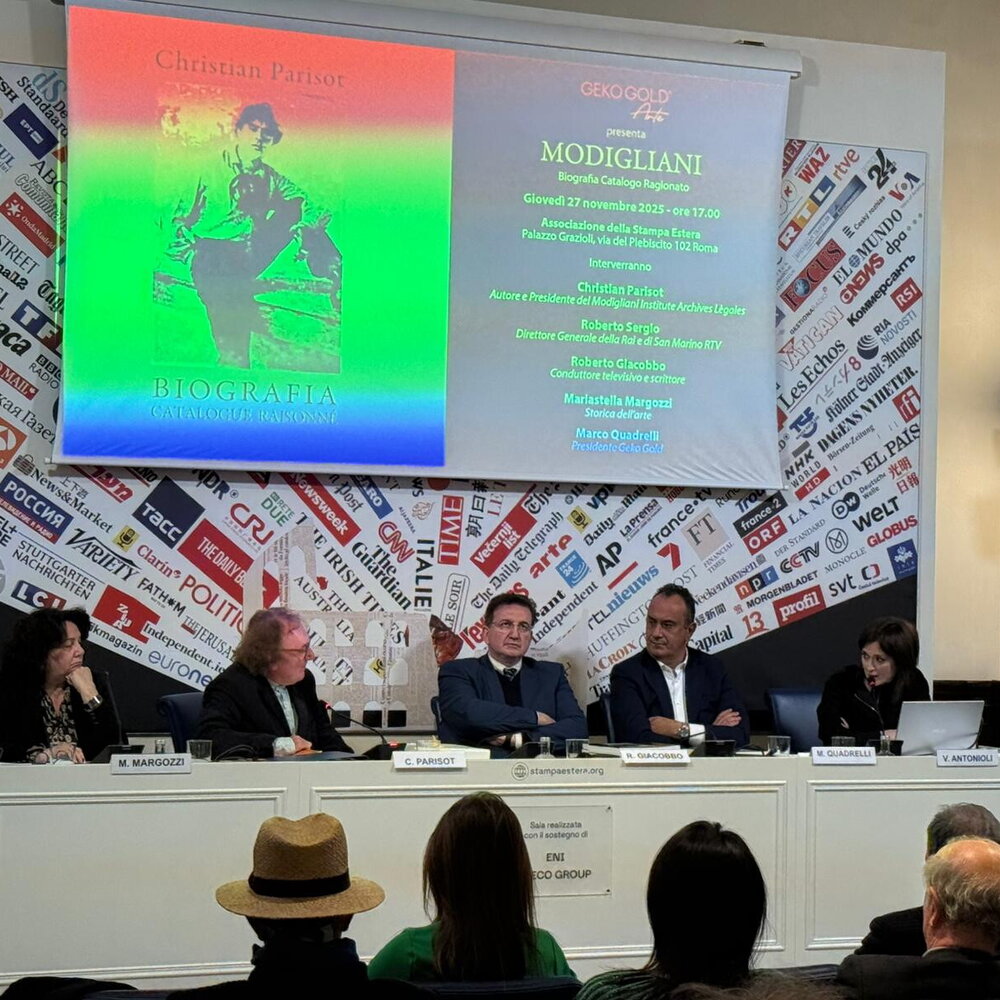
An in-depth and passionate journey into the work of Amedeo Modigliani is what Prof. Christian Parisot offers to the public in the volume “Modigliani – Biography Catalog Raisonné”. A work lasting years, since the artist’s daughter Jeanne involved him in the organization of some exhibitions in 1975. Today Parisot is the custodian of Modigliani’s archives (Christian Parisot, Archivist of the Modigliani Institute Archives Légales) and this book, which was presented at the headquarters of the Foreign Press in Rome, adds elements to the artist’s history, dispelling some myths around his figure, such as the one that wants him to be in contrast with Picasso, but which Parisot, also thanks to the testimony of Maria Picasso, was able to demonstrate as a friendship. It was Modi’s only daughter Jeanne who wanted to free her father from the black legend of the Modi maudi.
This text therefore stands out from all studies on Modigliani for its solidity of sources, for a detailed description of the Parisian context of the avant-garde of the late 19th century, among models, painters, writers who made Paris of those years a unique cultural place, among cultural drives and vices. Among the elements of greatest interest emerge new materials coming from figures linked to the artist’s life. The contribution of Hanka Zborowska, wife of the famous art dealer Léopold Zborowski, stands out, offering new perspectives on the relationship between Modigliani and the family that more than any other supported his work during the difficult years.Of particular value is also the integration of sources and testimonies that have so far remained outside the main critical reconstructions, capable of shedding light on still obscure episodes of his biography.
The role of Christian Parisot is central in this great reconstruction: in 1983 Jeanne Modigliani, the artist’s only daughter, designated him as continuer of the work of protecting his father’s documents, entrusting him with a mission that over the years has taken on an international scope. “What weighs most on Modigliani’s life is this legendary interpretation which distorted history and we were all more or less involved in it – explains Parisot -. In reality he was not unbalanced at all, in fact he was a person who knew four languages, who read a lot. The few books he left us are annotated, drawn, therefore objects of affection. Modigliani studied a lot, but he also had a lot of fun, leaving home and meeting a large number of artists, poets, writers, musicians with whom he exchanged his currency: his drawings and his portraits”.
“Modigliani has experienced mixed fortunes in Italy. This Italian identity was sought in Modigliani’s work, despite the fact that he was also trained in Italy from a literary and poetic point of view”affirmed Mariastella Margozzi, storic of art he added “The myth of Modigliani grew in the 1950s with exhibitions in major American cities. The entrepreneur Riccardo Guarino was the first Italian collector of Modigliani, but between 1950 and 1960 his fame and the market consolidated”.
How to spread culture today
Retracing Modigliani’s artistic career was also the starting point for thinking about how to spread cultural content in an increasingly connected and fast-paced world. “I believe that young people are not far from culture at all but maybe they are far from languages that they cannot recognise. So we have to go towards them and not wait for them to come towards us. The most effective tools are those that speak their language and therefore we must use a short series that combines entertainment and content. We need to move towards multiplatform distribution. You can no longer be tied to a linear schedule, you have to get there smartphones, on social media, in the spaces where young people build their imagination. We must work without lowering the quality of the product and we must ensure that the kids recognize the authenticity of the work being done. The challenge is to maintain editorial rigor with the new formats” said the General director of Rai and San Marino RTV, Roberto Sergio, connected with the foreign press.
Face of scientific and cultural dissemination Roberto Giacobbo recalled the historical context in which Modigliani operated characterized by the diffusion of energy electric and light in cities. The presenter who in his career moved from La7, then to Rai and finally to Mediaset, recalled with a touch of pride that the first segment of the public who follows his programs are precisely young people between 18 and 27 years old. “Today we become attached to the contents, and not to the channels, and everyone creates their own schedule”. He then talked about the format in which he is the protagonist “The Titan – the secret of freedom”, a format in 5 30-minute episodes where the history of the Republic founded in 301 AD will be told.
“I make you free from both men” Marino would have said to the inhabitants of the mountain, referring to the Pope and the Emperor. Giacobbo wanted to underline that today around 30 thousand inhabitants live in San Marino, but during the war, taking advantage of the neutrality of the small republic, many took refuge there, reaching over 100 thousand presences, who were welcomed and not expelled, precisely in the name of that freedom which constitutes its foundations. The secret of culture “is to do it while having fun” said the host.
At the end of the evening, Prof. Parisot, the Rai General Manager, Roberto Sergio, the host Roberto Giacobbo, and the historian Mariastella Margozzi received the award Geko Gold Art, awards dedicated to art and culture. The Award enhances quality, innovation and cultural impact, rewarding works and paths that range between painting, literature, music, cinema, television and digital media. Inspired by the best European practices, it promotes contamination between languages, circulation of works and exchange between creative communities, positioning itself as a hub where tradition and experimentation meet and where Italy affirms its role in the contemporary cultural panorama.
In the reasons for the award to Parisot “for the care with which he preserved and promoted Modigliani’s work” and to the Rai General Manager “for his undisputed managerial ability and for promoting culture”.