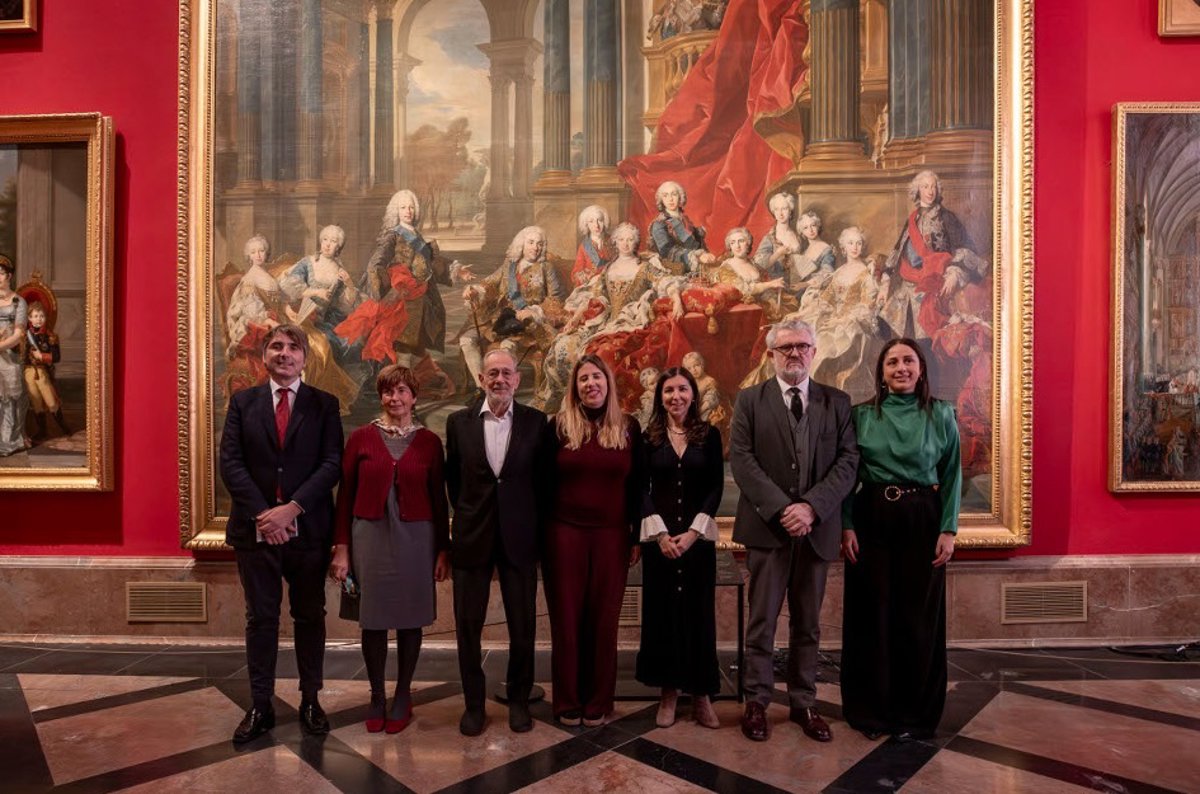
The queen Elizabeth of Farnese (1692-1766) has been the figure chosen to star in the III edition of ‘The Prado in feminine’, the initiative launched by the Prado Museum to make visible the role of women in art. The exhibition, carried out with the collaboration of the Women’s Institute, can be visited from this Friday until May 26, 2026.
As they explained this Friday at a press conference, Isabel de Farnesio was the artistic promoter who “has most contributed to the enlargement of the former Royal Collection and, consequently, of the Prado Museum“.
Specifically, the queen gathered nearly a thousand paintings, more than a third of which are kept in the Prado Museum, among which are pieces by Velázquez, Ribera, Murillo, Teniers, Correggio, Rubens, Luca Giordano, Reni, Guercino, Veronese, Tintoretto, Brueghel the Elder, Van Dyck, Brueghel the Younger, Clara Peeters, Parmigianino and Watteau, among others. others.
The legacy of Isabel de Farnesio – from which come nearly 500 paintings, drawings and sculptures preserved in the Prado, of which more than a hundred are in the Permanent Collection, exhibited in half of its rooms – made possible the arrival of creations such as Rubens’ ‘Apostolate’, Velázquez’s ‘Sibyl’ or José de Ribera’s ‘Jacob’s Dream’.
In addition, it led to the formation of the classical sculpture group that is guarded by the Prado Museum, with ‘The San Ildefonso Group’ o ‘The Goat Faun’ and opened the doors to the entry of Murillo’s works into the Royal Collection, whose sketch of ‘Saint Anne giving a lesson to the Virgin’ is exhibited for the first time in the Prado after its recent identification in the Museum of Pau (France).
The exhibition – under the curation of the professor and scientific director of ‘El Prado en Femenino’, Noelia García Pérez – is thus made up of 45 works distributed in three sections (five of these works remained in a warehouse, two were at the University of Zaragoza and the London embassy and one by Murillo, found in France).
The The first section analyzes the creation and evolution of the image of Isabel de Farnesio, which explores the different iconographic strategies used by the queen during her reign. While, The second and third sections are focused on his collection of paintings and sculptures, respectively.and delve into the decisive role that his artistic patronage played in the formation of the Prado collections.
“We are faced with a collector of exceptional magnitude, “whose work as an artistic promoter was decisive for the configuration of the Prado Museum’s collections”the commissioner stated at a press conference.
Since the arrival of Isabel de Farnesio in Spain in 1714, on the occasion of her marriage to Philip V, she exercised active and sustained patronage for more than half a century, using her own resources through the ‘queen’s pocket’, which allowed her great autonomy in her artistic choices.
“We cannot forget that Isabel de Farnesio belonged to the ‘House of Farnesio’, famous for the collecting she developed and especially for have one of the most valued and coveted collections of classical culture, with iconic works such as Hercules Farnese or the Farnese Bull”, García Pérez highlighted.
Through his network of craftsmen, nobles and diplomats who acted as agents and mediators, he collected paintings that reflect his marked predilection for the Flemish and Italian schools, as well as the production of Murillo, his favorite artist along with Teniers and Brueghel the Elder. His artistic promotion also extended to the field of sculpture, with the acquisition of a large part of the collection of Queen Christina of Sweden.
So, In his works you can recognize the ‘fleur de lis’, a mark that distinguished his possessions from those that belonged to Philip V.. Specifically, there are 358 paintings that are kept in the Prado. For this reason, García Pérez has reflected on what the Prado Museum would be like without the works of Isabel de Farnesio and has assured that “imagining it is truly revealing.”
“Without Isabel de Farnese we would not have the ‘Apostleship’ series by Rubens, ‘The Triumph of Death’ by Bruegel and so many other works that form an essential part of the museum’s identity.“, he pointed out, in addition to highlighting that the “fundamental” pillars of Isabel de Farnesio’s contribution to the Prado collections are the “collection of reference classical sculpture that constitutes the most relevant core of ancient sculpture in the museum.”
“Secondly, we would not have Murillo. They are works that are part of our shared imagination, of that everyday Prado that accompanies us, although on many occasions we do not notice it. Without Murillo, the Prado would lose one of its warmest and most human voices, but also an essential pillar of its historical and artistic identity,” has stated.
COMPLEMENTARY ACTIVITIES
This exhibition is complemented by an itinerary accompanied by a book focused on its protagonists, as well as an audiovisual piece in co-production with ‘CaixaForum+’ and an extensive program of complementary activities.
Thus, among these activities are various cycles of conferences, and ‘storytelling’, guided tours with the curator of the exhibitionthe creation of digital resources such as infographics and guides, a course for teachers, various concerts and a new ‘editatona’ in collaboration with Wikimedia Spain.